




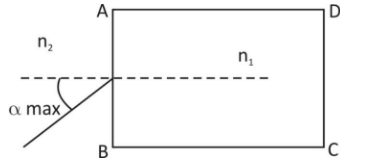
A rectangular glass slab ABCD of refractive index ${n_1},$ is immersed in water of refractive index ${n_2}\left( {{n_1} > {n_2}} \right).$ A ray of light is incident at the surface AB of the slab as shown in the figure. The maximum value of angle of incidence ${\alpha _{\max }}$such that the ray comes out only from the other surface CD, is given by
A. ${\sin ^{ - 1}}\left[ {\dfrac{{{n_1}}}{{{n_2}}}\cos \left( {{{\sin }^{ - 1}}\dfrac{{{n_2}}}{{{n_1}}}} \right)} \right]$
B. ${\sin ^{ - 1}}\left[ {{n_1}\cos \left( {{{\sin }^{ - 1}}\dfrac{1}{{{n_2}}}} \right)} \right]$
C. ${\sin ^{ - 1}}\left( {\dfrac{{{n_1}}}{{{n_2}}}} \right)$
D. ${\sin ^{ - 1}}\left( {\dfrac{{{n_2}}}{{{n_1}}}} \right)$
Answer
 Verified
597.6k+ views
Hint:Concept of Total internal reflection is to be used. Then by shell’s law, the maximum value of $\alpha $ can be found.
Formula used:
1. Snell’s law
\[{\mu _1}\,\,\sin \,\,i\,\, = {\mu _2}\,\,\sin \,\,r\]
2. $\sin \,\,{i_C} = \dfrac{{{\mu _2}}}{{{\mu _1}}}$
Where i is the angle of incidence
R is the angle of refraction
${i_C}$ is the critical angle
The ray travel from medium having refractive index ${\mu _1}$ to medium having refractive index ${\mu _2}.$
Complete step by step answer:
For the ray to emerge from the face CD, it has to undergo total interval reflection at face AD firstly as shown in the figure.
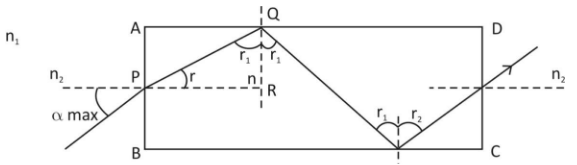
For total interval reflection to take place, angle of incidence, ${r_1} > $ critical angle ${i_C}.$
i.e. ${r_1} > {i_C}$
Now, $\sin \,\,{r_1} = \dfrac{{{n_2}}}{{{n_1}}} \Rightarrow {r_1} = {\sin ^{ - 1}}\left( {\dfrac{{{n_2}}}{{{n_1}}}} \right).......\left( 1 \right)$
Now, let corresponding ${\alpha _{\max }},$ r is the angle of redfraction
We know that,
$r + r = 90$
$ \Rightarrow r = 90 - r,$
So, $sin\,\,r = \sin \left( {90 - {r_1}} \right)$
$\sin \,\,r = \cos {r_1}\,\,\,\left( {as\,\,\cos \left( {90 - \theta } \right) = \sin \theta } \right).......\left( 2 \right)$
Now, we know that by Snell’s law the ratio of $\sin r$ (angle of incidence) to $\sin \,\,i$ (angle of refraction) is constant and gives the refractive index in case of refraction.
So, for the face AB, by applying Snell’s law, we have
${n_2}\,\,\sin \,\,{\alpha _{\max }} = {n_1}\,\,\sin \,\,r$
(as here angle of incidence $ = {\alpha _{\max }}$ and angle of refraction $ = r$) and the ray is travelling from ${n_2}$ to ${n_1}.$
Putting equation (2) in it, we get ${n_2}\,\,\sin \,\,{\alpha _{\max }} = {n_1}\,\,\cos \,\,{r_1}$
Putting ${r_1}$ from equation (1) in it,
We have
${n_2}\,\,\sin \,\,{\alpha _{\max }} = {n_1}\,\,\cos \,\left[ {{{\sin }^{ - 1}}\left( {\dfrac{{{n_2}}}{{{n_1}}}} \right)} \right]$
$ \Rightarrow \sin \,\,{\alpha _{\max }} = \dfrac{{{n_1}}}{{{n_2}}}\,\,\cos \,\left[ {{{\sin }^{ - 1}}\left( {\dfrac{{{n_2}}}{{{n_1}}}} \right)} \right]$
$ \Rightarrow {\alpha _{\max }} = {\sin ^{ - 1}}\,\left[ {\dfrac{{{n_1}}}{{{n_2}}}\cos \left( {{{\sin }^{ - 1}}} \right)\left( {\dfrac{{{n_2}}}{{{n_1}}}} \right)} \right]$
Hence, option (A) is the correct option.
Note: \[r + {r_1} = {90^0}\]
This is because $\Delta PQR,$ is a right angled triangle so,
\[r + {r_1} + {90^0} = {190^0}\] (by angle sum property)
\[r + {r_1} = {190^0} - {90^0}\]
\[ \Rightarrow r + {r_1} = {90^0}\].
Formula used:
1. Snell’s law
\[{\mu _1}\,\,\sin \,\,i\,\, = {\mu _2}\,\,\sin \,\,r\]
2. $\sin \,\,{i_C} = \dfrac{{{\mu _2}}}{{{\mu _1}}}$
Where i is the angle of incidence
R is the angle of refraction
${i_C}$ is the critical angle
The ray travel from medium having refractive index ${\mu _1}$ to medium having refractive index ${\mu _2}.$
Complete step by step answer:
For the ray to emerge from the face CD, it has to undergo total interval reflection at face AD firstly as shown in the figure.
For total interval reflection to take place, angle of incidence, ${r_1} > $ critical angle ${i_C}.$
i.e. ${r_1} > {i_C}$
Now, $\sin \,\,{r_1} = \dfrac{{{n_2}}}{{{n_1}}} \Rightarrow {r_1} = {\sin ^{ - 1}}\left( {\dfrac{{{n_2}}}{{{n_1}}}} \right).......\left( 1 \right)$
Now, let corresponding ${\alpha _{\max }},$ r is the angle of redfraction
We know that,
$r + r = 90$
$ \Rightarrow r = 90 - r,$
So, $sin\,\,r = \sin \left( {90 - {r_1}} \right)$
$\sin \,\,r = \cos {r_1}\,\,\,\left( {as\,\,\cos \left( {90 - \theta } \right) = \sin \theta } \right).......\left( 2 \right)$
Now, we know that by Snell’s law the ratio of $\sin r$ (angle of incidence) to $\sin \,\,i$ (angle of refraction) is constant and gives the refractive index in case of refraction.
So, for the face AB, by applying Snell’s law, we have
${n_2}\,\,\sin \,\,{\alpha _{\max }} = {n_1}\,\,\sin \,\,r$
(as here angle of incidence $ = {\alpha _{\max }}$ and angle of refraction $ = r$) and the ray is travelling from ${n_2}$ to ${n_1}.$
Putting equation (2) in it, we get ${n_2}\,\,\sin \,\,{\alpha _{\max }} = {n_1}\,\,\cos \,\,{r_1}$
Putting ${r_1}$ from equation (1) in it,
We have
${n_2}\,\,\sin \,\,{\alpha _{\max }} = {n_1}\,\,\cos \,\left[ {{{\sin }^{ - 1}}\left( {\dfrac{{{n_2}}}{{{n_1}}}} \right)} \right]$
$ \Rightarrow \sin \,\,{\alpha _{\max }} = \dfrac{{{n_1}}}{{{n_2}}}\,\,\cos \,\left[ {{{\sin }^{ - 1}}\left( {\dfrac{{{n_2}}}{{{n_1}}}} \right)} \right]$
$ \Rightarrow {\alpha _{\max }} = {\sin ^{ - 1}}\,\left[ {\dfrac{{{n_1}}}{{{n_2}}}\cos \left( {{{\sin }^{ - 1}}} \right)\left( {\dfrac{{{n_2}}}{{{n_1}}}} \right)} \right]$
Hence, option (A) is the correct option.
Note: \[r + {r_1} = {90^0}\]
This is because $\Delta PQR,$ is a right angled triangle so,
\[r + {r_1} + {90^0} = {190^0}\] (by angle sum property)
\[r + {r_1} = {190^0} - {90^0}\]
\[ \Rightarrow r + {r_1} = {90^0}\].
Recently Updated Pages
Basicity of sulphurous acid and sulphuric acid are

Master Class 12 English: Engaging Questions & Answers for Success
Master Class 12 Social Science: Engaging Questions & Answers for Success
Master Class 12 Maths: Engaging Questions & Answers for Success
Master Class 12 Economics: Engaging Questions & Answers for Success
Master Class 12 Physics: Engaging Questions & Answers for Success
Trending doubts
Which are the Top 10 Largest Countries of the World?
Draw a labelled sketch of the human eye class 12 physics CBSE
Which state in the country is at the forefront in controlling class 12 social science CBSE
Mention the role of cyanobacteria as a biofertiliz class 12 biology ICSE
Where is the largest hydroelectric power station located class 12 biology CBSE
Which country did Danny Casey play for class 12 english CBSE