




A rectangular coil of sides $'l'$ and $'b'$ carrying current $'I'$ is subjected to a uniform magnetic field $\overrightarrow{B}$ acting perpendicular to its plane. Obtain the expression for the torque acting on it.
Answer
 Verified
659.4k+ views
Hint: First find the area of cross-section of the coil. Then find a magnetic moment associated with the coil. From the value of the magnetic moment, calculate the torque (rotating force) acting one the dipole.
Formula used: Torque, $\tau =\text{ Force}\times \text{ perpendicular distance between the dipole}\text{.}$
Magnetic moment of the current loop, $m=NIA$, $m=\text{ magnetic moment}$ $I=\text{ Current inside the loop}$, $N=\text{ number turns of the loop}$.
Force on a current carrying conductor of length $x$ on a magnetic field $\overrightarrow{B}$ is $\overrightarrow{F}=I\left( \overrightarrow{x}\times \overrightarrow{B} \right)=Ix\left| B \right|\sin \theta $
Where $I\text{= Current inside conductor}$, $x=\text{ length of the conductor}$.
Torque, $\tau =\overrightarrow{m}\times \overrightarrow{B}=NIBA\sin \theta $
Complete step by step answer:
Area of the coil,$A=lb$
Magnetic moment associated with the coil is, $m=NIA$
Here $N=1$ so magnetic moment becomes $m=IA=Ilb$
The torque acting on the coil is given by
\[\tau =\overrightarrow{m}\times \overrightarrow{B}=mB\sin \theta \widehat{n}\] ,Where $\widehat{n}$ is the direction of torque determined by Fleming’s left hand rule. $\theta =\text{ angle between the Magnetic field and normal to the plane of coil}$.
For the given case \[\tau =\overrightarrow{m}\times \overrightarrow{B}=mB\sin \theta \widehat{n}=IlbB\sin \theta \widehat{n}\]
Here the angle between the normal and the magnetic field is $0$.
So, Torque,$\tau \text{=0}$
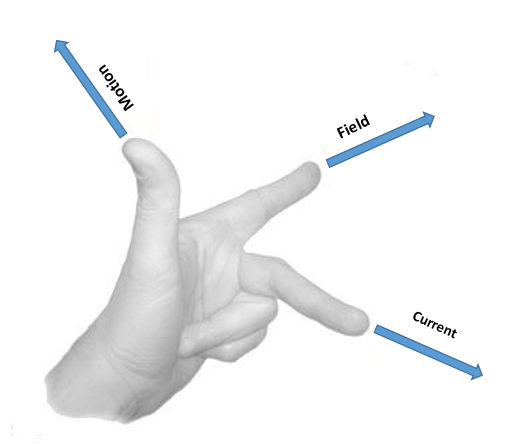
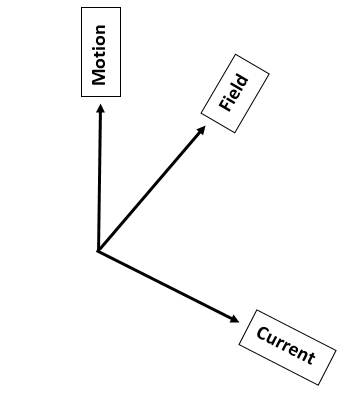
Additional Information: Fleming’s left hand rule states that when a current carrying conductor is placed in an external magnetic field it experiences a force which is perpendicular to the plane containing both magnetic field and flow of current. i.e. if you place your thumb, index finger and middle finger perpendicular to each other. And if the index finger represents the direction of the applied field, the middle finger represents the direction of flow of current, then the thumb will represent the force on the conductor. So the conductor will experience a force in upward direction and will try to move in that direction.
Note: The expression $\tau =NIBA\sin \theta $ holds good for planar loops of any shape. Because the torque on a current carrying loop only depends upon strength of magnetic field , number of turns of coil area of coil and current inside the coil. But is independent upon the shape of the coil.
A planar current loop of a given perimeter suspended in a magnetic field will experience maximum torque when the shape of the loop is circular, because a given perimeter circle has maximum area.
Formula used: Torque, $\tau =\text{ Force}\times \text{ perpendicular distance between the dipole}\text{.}$
Magnetic moment of the current loop, $m=NIA$, $m=\text{ magnetic moment}$ $I=\text{ Current inside the loop}$, $N=\text{ number turns of the loop}$.
Force on a current carrying conductor of length $x$ on a magnetic field $\overrightarrow{B}$ is $\overrightarrow{F}=I\left( \overrightarrow{x}\times \overrightarrow{B} \right)=Ix\left| B \right|\sin \theta $
Where $I\text{= Current inside conductor}$, $x=\text{ length of the conductor}$.
Torque, $\tau =\overrightarrow{m}\times \overrightarrow{B}=NIBA\sin \theta $
Complete step by step answer:
Area of the coil,$A=lb$
Magnetic moment associated with the coil is, $m=NIA$
Here $N=1$ so magnetic moment becomes $m=IA=Ilb$
The torque acting on the coil is given by
\[\tau =\overrightarrow{m}\times \overrightarrow{B}=mB\sin \theta \widehat{n}\] ,Where $\widehat{n}$ is the direction of torque determined by Fleming’s left hand rule. $\theta =\text{ angle between the Magnetic field and normal to the plane of coil}$.
For the given case \[\tau =\overrightarrow{m}\times \overrightarrow{B}=mB\sin \theta \widehat{n}=IlbB\sin \theta \widehat{n}\]
Here the angle between the normal and the magnetic field is $0$.
So, Torque,$\tau \text{=0}$
Additional Information: Fleming’s left hand rule states that when a current carrying conductor is placed in an external magnetic field it experiences a force which is perpendicular to the plane containing both magnetic field and flow of current. i.e. if you place your thumb, index finger and middle finger perpendicular to each other. And if the index finger represents the direction of the applied field, the middle finger represents the direction of flow of current, then the thumb will represent the force on the conductor. So the conductor will experience a force in upward direction and will try to move in that direction.
Note: The expression $\tau =NIBA\sin \theta $ holds good for planar loops of any shape. Because the torque on a current carrying loop only depends upon strength of magnetic field , number of turns of coil area of coil and current inside the coil. But is independent upon the shape of the coil.
A planar current loop of a given perimeter suspended in a magnetic field will experience maximum torque when the shape of the loop is circular, because a given perimeter circle has maximum area.
Recently Updated Pages
Which of the following graphs shows the variation of class 12 physics CBSE

Draw a labelled diagram of the human male reproductive class 12 biology CBSE
Describe the experiment to compare the emf of two cells class 12 physics CBSE
What is standard hydrogen electrode
What is conventional current and electric current class 12 physics CBSE
2Bromopentane is treated with an alcoholic KOH solution class 12 chemistry CBSE
Trending doubts
Which are the Top 10 Largest Countries of the World?
Differentiate between internal fertilization and external class 12 biology CBSE
What is the Full Form of 1.DPT 2.DDT 3.BCG
Differentiate between lanthanoids and actinoids class 12 chemistry CBSE
Sketch and label the Malpighian body class 12 biology CBSE
Why is the cell called the structural and functional class 12 biology CBSE