




A rectangular coil (dimensions $5cm \times 2.5cm$) with 100 turns, carrying a current 3A in the clockwise directions kept centered at the origin and in the X-Z plane. A magnetic field of $1T$ is applied along the X-axis. If the coil is titled through $45^\circ $ about Z-axis, then the torque of the coil is:
A $0.55Nm$
B. $0.27Nm$
C. $0.38Nm$
D. $0.42Nm$
Answer
 Verified
603.6k+ views
Hint: Here torque on current-carrying rectangular loop placed in a uniform magnetic field. The current flowing in the loop is in a clockwise direction. The direction is given by using the right-hand screw rule. The magnetic field is proportional to the current and the number of turns in the coil.
Complete step by step answer:
According to question here we have N (no. of turns) = 100turns, I (current) =3A, B (magnetic field) = 1T
And $\theta $(angle) =$45^\circ $
Area of the rectangular loop (A) $ = 5cm \times 2.5cm = 12.5 c{m^{ - 2}}$
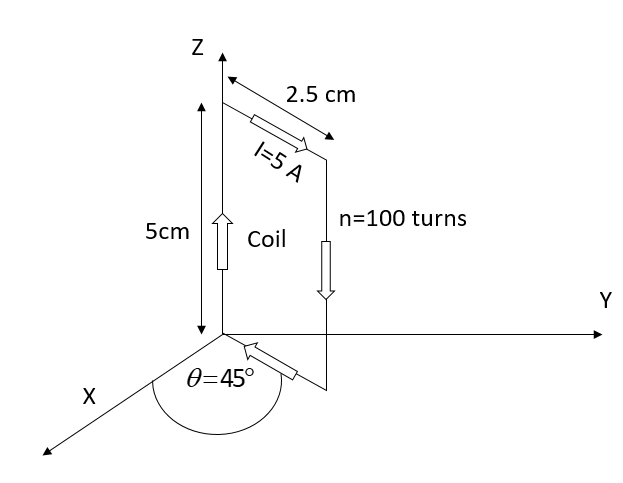
We know torque$(\vec \tau )$$ = \left| {{\rm{\vec M}} \times {\rm{\vec B}}} \right|$
Where M is the magnetic moment and B is the magnetic field.
$ \Rightarrow \vec \tau = {\rm{I(\vec A}} \times {\rm{\vec B)}}$ (Where A is the area of cross-section)
If the loop has N turns, then the net torque acting on the loop
$\tau = {\rm{NIABsin}}\theta $
$ \Rightarrow \tau = 100 \times 3 \times 12.5 \times {\rm{sin45}}^\circ $
$ \Rightarrow \tau = 0.27Nm$
The torque of the coil is 0.27Nm. Hence, option (B) is correct.
Additional information:
If the current-carrying loop is aligned in such a way that the plane of the loop is parallel to the direction of the magnetic field, so the torque acting on the loop $\tau = {\rm{NIAB}}$
If the current-carrying loop aligned in such way that the plane of the loop is perpendicular in the direction of the magnetic field then $\tau = 0$
Note:
The maximum torque acts on the loop or coil. The magnetic field which is parallel to the plane of the loop is called the radial magnetic field. When torque acting on the coil is zero, the loop in the position of equilibrium. Thus torque acting in a uniform magnetic field may or may not zero.
Complete step by step answer:
According to question here we have N (no. of turns) = 100turns, I (current) =3A, B (magnetic field) = 1T
And $\theta $(angle) =$45^\circ $
Area of the rectangular loop (A) $ = 5cm \times 2.5cm = 12.5 c{m^{ - 2}}$
We know torque$(\vec \tau )$$ = \left| {{\rm{\vec M}} \times {\rm{\vec B}}} \right|$
Where M is the magnetic moment and B is the magnetic field.
$ \Rightarrow \vec \tau = {\rm{I(\vec A}} \times {\rm{\vec B)}}$ (Where A is the area of cross-section)
If the loop has N turns, then the net torque acting on the loop
$\tau = {\rm{NIABsin}}\theta $
$ \Rightarrow \tau = 100 \times 3 \times 12.5 \times {\rm{sin45}}^\circ $
$ \Rightarrow \tau = 0.27Nm$
The torque of the coil is 0.27Nm. Hence, option (B) is correct.
Additional information:
If the current-carrying loop is aligned in such a way that the plane of the loop is parallel to the direction of the magnetic field, so the torque acting on the loop $\tau = {\rm{NIAB}}$
If the current-carrying loop aligned in such way that the plane of the loop is perpendicular in the direction of the magnetic field then $\tau = 0$
Note:
The maximum torque acts on the loop or coil. The magnetic field which is parallel to the plane of the loop is called the radial magnetic field. When torque acting on the coil is zero, the loop in the position of equilibrium. Thus torque acting in a uniform magnetic field may or may not zero.
Recently Updated Pages
Master Class 12 Social Science: Engaging Questions & Answers for Success

Master Class 12 Physics: Engaging Questions & Answers for Success
Master Class 12 Maths: Engaging Questions & Answers for Success
Master Class 12 Economics: Engaging Questions & Answers for Success
Master Class 12 Chemistry: Engaging Questions & Answers for Success
Master Class 12 Business Studies: Engaging Questions & Answers for Success
Trending doubts
Which are the Top 10 Largest Countries of the World?
Draw a labelled sketch of the human eye class 12 physics CBSE
Explain the structure of megasporangium class 12 biology CBSE
What are the major means of transport Explain each class 12 social science CBSE
How many chromosomes are found in human ovum a 46 b class 12 biology CBSE
The diagram of the section of a maize grain is given class 12 biology CBSE