




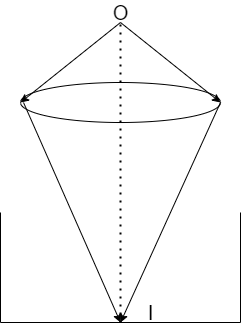
A real image of an object is formed by a convex lens at the bottom of an empty beaker. The beaker is now filled with a liquid of refractive index $1.4$ to a depth of $7cm$. In order to get the image at the bottom, the beaker should be moved
A) Downward by $2cm$
B) Upward by $2cm$
C) Downward by $3cm$
D) Upward by $3cm$
Answer
 Verified
603k+ views
Hint: Refraction is defined as the phenomenon of bending of light rays. When the light rays travel from one medium to the other medium of different refractive index and densities, then the ray of light bends. It changes the wavelength and the speed of light.
Complete step by step answer:
Given that the beaker was empty but later on it was filled with a liquid. When the light rays strike on the surface of the liquid, then they bend and the image of the object will appear to be at some point the bottom of the beaker below point I.
The light rays follow Snell’s Law. According to this law, for a given pair of mediums, the ratio of sine of angle of incidence to the sine of angle of refraction is constant. It is written as:
$\dfrac{{\sin i}}{{\sin r}} = \mu $
Where $\mu $is the constant. It is called the refractive index of the second medium with respect to first.
When an observer and the object are in two different mediums, then the image of the object seems like it has been shifted from its normal position. It is known as normal shift.
It’s formula is
$d = t(1 - \dfrac{1}{\mu })$
The thickness of the liquid is $t = 7cm$
The refractive index is $\mu = 1.4$
Substituting the given values in the formula and solving,
$\Rightarrow d = 7(1 - \dfrac{1}{{1.4}})$
On simplification,
$\Rightarrow d = 7(1 - 0.71)$
On further simplification,
$\Rightarrow d = 7 \times 0.29$
$\Rightarrow d = 2.03 \approx 2cm$
The image at the bottom of the beaker should be moved downwards by $2cm$. Therefore Option A is the right answer.
Note:
It is to be noted that there is a difference between the terms lateral shift and normal shift. Lateral shift is defined as the perpendicular distance between the incident and the emergent rays. But normal shift is the shifting in the position of the object.
Complete step by step answer:
Given that the beaker was empty but later on it was filled with a liquid. When the light rays strike on the surface of the liquid, then they bend and the image of the object will appear to be at some point the bottom of the beaker below point I.
The light rays follow Snell’s Law. According to this law, for a given pair of mediums, the ratio of sine of angle of incidence to the sine of angle of refraction is constant. It is written as:
$\dfrac{{\sin i}}{{\sin r}} = \mu $
Where $\mu $is the constant. It is called the refractive index of the second medium with respect to first.
When an observer and the object are in two different mediums, then the image of the object seems like it has been shifted from its normal position. It is known as normal shift.
It’s formula is
$d = t(1 - \dfrac{1}{\mu })$
The thickness of the liquid is $t = 7cm$
The refractive index is $\mu = 1.4$
Substituting the given values in the formula and solving,
$\Rightarrow d = 7(1 - \dfrac{1}{{1.4}})$
On simplification,
$\Rightarrow d = 7(1 - 0.71)$
On further simplification,
$\Rightarrow d = 7 \times 0.29$
$\Rightarrow d = 2.03 \approx 2cm$
The image at the bottom of the beaker should be moved downwards by $2cm$. Therefore Option A is the right answer.
Note:
It is to be noted that there is a difference between the terms lateral shift and normal shift. Lateral shift is defined as the perpendicular distance between the incident and the emergent rays. But normal shift is the shifting in the position of the object.
Recently Updated Pages
Master Class 12 Business Studies: Engaging Questions & Answers for Success

Master Class 12 Biology: Engaging Questions & Answers for Success
Master Class 12 Chemistry: Engaging Questions & Answers for Success
Class 12 Question and Answer - Your Ultimate Solutions Guide
Master Class 11 Social Science: Engaging Questions & Answers for Success
Master Class 11 English: Engaging Questions & Answers for Success
Trending doubts
Which is more stable and why class 12 chemistry CBSE
Which are the Top 10 Largest Countries of the World?
Draw a labelled sketch of the human eye class 12 physics CBSE
Differentiate between homogeneous and heterogeneous class 12 chemistry CBSE
What are the major means of transport Explain each class 12 social science CBSE
Sulphuric acid is known as the king of acids State class 12 chemistry CBSE