




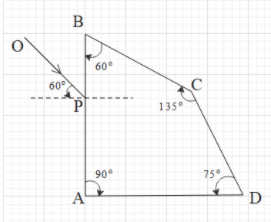
A ray OP of monochromatic light is incident on the face AB of prism ABCD near vertex B at an incident angle of ${{60}^{\circ }}$ (see figure). If the refractive index of the material of the prism is $\sqrt{3}$, which of the following is (are) correct?
Answer
 Verified
579.3k+ views
Hint: Use the Snell’s law and find the angle of refraction at face AB. Then find the angle of incidence at face CD. Calculate the critical angle for these mediums and check whether the ray reflects internally.
Formula used:
${{\mu }_{i}}\sin i={{\mu }_{r}}\sin r$
${{\theta }_{c}}={{\sin }^{-1}}\left( \dfrac{1}{\mu } \right)$
Complete answer:
In this solution, we will use Snell's law for refraction of light at the interface of two mediums when the light ray passes from one medium into another medium.
i.e. ${{\mu }_{i}}\sin i={{\mu }_{r}}\sin r$ ….. (i),
where i and r are the angle of incidence and angle of refraction at the interface. ${{\mu }_{i}}$ is the refractive index of the medium from which the ray incidents and ${{\mu }_{r}}$ is the refractive index of the medium into which the ray passes after refraction.
First, the light ray enters from air into the glass prism from face AB. The ray is incident on AB at angle of incidence of ${{60}^{\circ }}$. Therefore, for this case, $i={{60}^{\circ }}$, ${{\mu }_{i}}=1$ and ${{\mu }_{r}}=\sqrt{3}$. Let the angle of refraction at this face be ${{r}_{1}}$.
Substitute the values in equation (i).
$\Rightarrow 1.\sin {{60}^{\circ }}=\sqrt{3}\sin {{r}_{1}}$
$\Rightarrow \dfrac{\sqrt{3}}{2}=\sqrt{3}\sin {{r}_{1}}$
$\Rightarrow \sin {{r}_{1}}=\dfrac{1}{2}$
$\Rightarrow {{r}_{1}}={{\sin }^{-1}}\left( \dfrac{1}{2} \right)={{30}^{\circ }}$.
Let us assume that the refracted ray falls on the face CD.
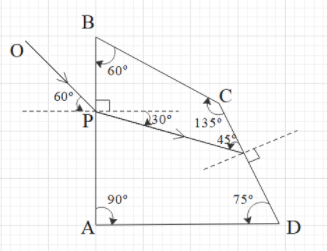
From the figure, we get the angle of incidence at face CD is ${{45}^{\circ }}$.
Now, the light ray is passing through glass (denser medium) and it will be entering the air (rarer medium) after refraction.
When a light rays travelling in a denser medium hits the interface of the denser and a rarer medium, it may refract and pass into the rarer medium or may reflect internally.
The condition for total internal reflection of the light ray is that the angle of incidence at the interface must be more than the critical angle. The critical angle for the interface of air and a denser medium is given as ${{\theta }_{c}}={{\sin }^{-1}}\left( \dfrac{1}{\mu } \right)$, where $\mu $ is the refractive index of the denser medium.
Therefore, the critical angle in the given case is ${{\theta }_{c}}={{\sin }^{-1}}\left( \dfrac{1}{\sqrt{3}} \right)={{35.26}^{\circ }}$.
Now we know that the angle of incidence at CD is more than the critical angle. Therefore, the ray will undergo total internal reflection.
Therefore, option A is correct.
After reflecting at CD, the ray will fall on the face AD.
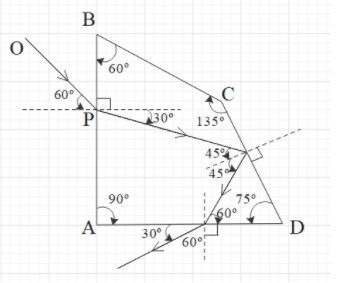
From the figure, we get the angle of incidence at AD is ${{30}^{\circ }}$.
Since the angle of incidence at AD is less than the critical angle, the ray will come out from AD.
Therefore, option B is correct.
This means that $i={{30}^{\circ }}$, ${{\mu }_{i}}=\sqrt{3}$ and ${{\mu }_{r}}=1$. Let the angle of refraction at this face be ${{r}_{2}}$.
Substitute the values in equation (i).
$\Rightarrow \sqrt{3}.\sin {{30}^{\circ }}=1.\sin {{r}_{2}}$
$\Rightarrow \dfrac{\sqrt{3}}{2}=\sin {{r}_{2}}$
$\Rightarrow {{r}_{2}}={{\sin }^{-1}}\dfrac{\sqrt{3}}{2}={{60}^{\circ }}$.
The first incident ray at AB makes an angle of ${{60}^{\circ }}$ with the horizontal and the emergent at D is making an angle of ${{30}^{\circ }}$ as shown.
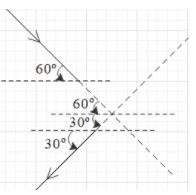
Therefore, the angle between the incident ray and the emergent ray is ${{90}^{\circ }}$.
This means that the option C is correct.
Hence, the correct options are A, B and C.
Note:
Even if we do not know about the critical angle, we can still figure out whether the light ray will pass into the rarer medium or it will reflect into the same medium.
For this, assume that the ray passes into the other medium and apply Snell’s law. If the light ray really passes into the rarer medium, we will get a possible value of the angle of refraction. If not, then we will not have any possible value for the angle of refraction.
Formula used:
${{\mu }_{i}}\sin i={{\mu }_{r}}\sin r$
${{\theta }_{c}}={{\sin }^{-1}}\left( \dfrac{1}{\mu } \right)$
Complete answer:
In this solution, we will use Snell's law for refraction of light at the interface of two mediums when the light ray passes from one medium into another medium.
i.e. ${{\mu }_{i}}\sin i={{\mu }_{r}}\sin r$ ….. (i),
where i and r are the angle of incidence and angle of refraction at the interface. ${{\mu }_{i}}$ is the refractive index of the medium from which the ray incidents and ${{\mu }_{r}}$ is the refractive index of the medium into which the ray passes after refraction.
First, the light ray enters from air into the glass prism from face AB. The ray is incident on AB at angle of incidence of ${{60}^{\circ }}$. Therefore, for this case, $i={{60}^{\circ }}$, ${{\mu }_{i}}=1$ and ${{\mu }_{r}}=\sqrt{3}$. Let the angle of refraction at this face be ${{r}_{1}}$.
Substitute the values in equation (i).
$\Rightarrow 1.\sin {{60}^{\circ }}=\sqrt{3}\sin {{r}_{1}}$
$\Rightarrow \dfrac{\sqrt{3}}{2}=\sqrt{3}\sin {{r}_{1}}$
$\Rightarrow \sin {{r}_{1}}=\dfrac{1}{2}$
$\Rightarrow {{r}_{1}}={{\sin }^{-1}}\left( \dfrac{1}{2} \right)={{30}^{\circ }}$.
Let us assume that the refracted ray falls on the face CD.
From the figure, we get the angle of incidence at face CD is ${{45}^{\circ }}$.
Now, the light ray is passing through glass (denser medium) and it will be entering the air (rarer medium) after refraction.
When a light rays travelling in a denser medium hits the interface of the denser and a rarer medium, it may refract and pass into the rarer medium or may reflect internally.
The condition for total internal reflection of the light ray is that the angle of incidence at the interface must be more than the critical angle. The critical angle for the interface of air and a denser medium is given as ${{\theta }_{c}}={{\sin }^{-1}}\left( \dfrac{1}{\mu } \right)$, where $\mu $ is the refractive index of the denser medium.
Therefore, the critical angle in the given case is ${{\theta }_{c}}={{\sin }^{-1}}\left( \dfrac{1}{\sqrt{3}} \right)={{35.26}^{\circ }}$.
Now we know that the angle of incidence at CD is more than the critical angle. Therefore, the ray will undergo total internal reflection.
Therefore, option A is correct.
After reflecting at CD, the ray will fall on the face AD.
From the figure, we get the angle of incidence at AD is ${{30}^{\circ }}$.
Since the angle of incidence at AD is less than the critical angle, the ray will come out from AD.
Therefore, option B is correct.
This means that $i={{30}^{\circ }}$, ${{\mu }_{i}}=\sqrt{3}$ and ${{\mu }_{r}}=1$. Let the angle of refraction at this face be ${{r}_{2}}$.
Substitute the values in equation (i).
$\Rightarrow \sqrt{3}.\sin {{30}^{\circ }}=1.\sin {{r}_{2}}$
$\Rightarrow \dfrac{\sqrt{3}}{2}=\sin {{r}_{2}}$
$\Rightarrow {{r}_{2}}={{\sin }^{-1}}\dfrac{\sqrt{3}}{2}={{60}^{\circ }}$.
The first incident ray at AB makes an angle of ${{60}^{\circ }}$ with the horizontal and the emergent at D is making an angle of ${{30}^{\circ }}$ as shown.
Therefore, the angle between the incident ray and the emergent ray is ${{90}^{\circ }}$.
This means that the option C is correct.
Hence, the correct options are A, B and C.
Note:
Even if we do not know about the critical angle, we can still figure out whether the light ray will pass into the rarer medium or it will reflect into the same medium.
For this, assume that the ray passes into the other medium and apply Snell’s law. If the light ray really passes into the rarer medium, we will get a possible value of the angle of refraction. If not, then we will not have any possible value for the angle of refraction.
Recently Updated Pages
Master Class 12 Economics: Engaging Questions & Answers for Success

Master Class 12 Physics: Engaging Questions & Answers for Success
Master Class 12 English: Engaging Questions & Answers for Success
Master Class 12 Social Science: Engaging Questions & Answers for Success
Master Class 12 Maths: Engaging Questions & Answers for Success
Master Class 12 Business Studies: Engaging Questions & Answers for Success
Trending doubts
Which are the Top 10 Largest Countries of the World?
What are the major means of transport Explain each class 12 social science CBSE
Draw a labelled sketch of the human eye class 12 physics CBSE
Why cannot DNA pass through cell membranes class 12 biology CBSE
Differentiate between insitu conservation and exsitu class 12 biology CBSE
Draw a neat and well labeled diagram of TS of ovary class 12 biology CBSE