




A ray of light is normally incident on one face of an equilateral glass prism. What is the angle of incidence on the other face of the prism?
(A) \[{0{^\circ }}\]
(B) \[{30{^\circ }}\]
(C) \[{45{^\circ }}\]
(D) \[{90{^\circ }}\]
Answer
 Verified
606k+ views
Hint:First of all, we will draw the diagram, which will show that the light ray enters at the right angle in the first face. Then we will use the angle sum property of a triangle, from where we can find the third angle, when we know the two angles of a triangle.
Complete step by step answer:
In the given problem, we are supplied with the following data:
A ray of light ray hits the face of the prism in a direction perpendicular to the plane.
Also given that the prism is an equilateral prism. We are asked to find the angle of incidence of the other face.To begin with, we will draw the diagram of the prism to have a better understanding.
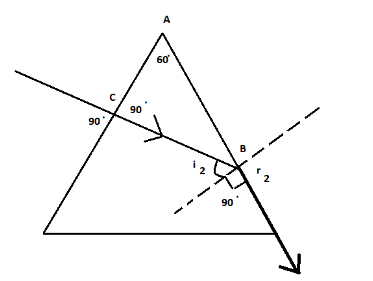
From the diagram, we can say that the incident ray is normal to the plane. Hence, there is no phenomenon of refraction on this face because the incident ray hit this face in perpendicular direction, so we can write:
Angle of incidence on this face is \[{i_1} = {0{^\circ }}\] .
Angle of refraction on this face \[{r_1} = {0{^\circ }}\] .
Now, from the diagram, we need to find the angle \[ABC\] .
From the triangle \[ABC\], it is quite obvious that angle \[ACB\] is \[{90{^\circ }}\]. Since, the prism was an equilateral prism, so angle \[BAC\] is \[{60{^\circ }}\] .
So, by the angle sum property, which states that the sum of all the angles of a triangle is always \[{180{^\circ }}\] .
Now, we carry out the manipulations, which is given below:
$
\angle ABC + \angle BAC + \angle ACB = {180{^\circ }} \\
\Rightarrow\angle ABC + {60{^\circ }} + {90{^\circ }} = {180{^\circ }} \\
\Rightarrow\angle ABC = {180{^\circ }} - {60{^\circ }} - {90{^\circ }} \\
\therefore\angle ABC = {30{^\circ }} \\
$
Hence, the angle of incidence on the other face of the prism \[{30{^\circ }}\]. Thus, the correct option is B.
Note: It is important to note that you have seen that the light ray enters the prism at right angle, so it is quite obvious that the light ray had not suffered refraction. The light ray is undeviating in nature. So, remember that in this case, the angle of incidence and the angle of refraction on this face are both zero.
Complete step by step answer:
In the given problem, we are supplied with the following data:
A ray of light ray hits the face of the prism in a direction perpendicular to the plane.
Also given that the prism is an equilateral prism. We are asked to find the angle of incidence of the other face.To begin with, we will draw the diagram of the prism to have a better understanding.
From the diagram, we can say that the incident ray is normal to the plane. Hence, there is no phenomenon of refraction on this face because the incident ray hit this face in perpendicular direction, so we can write:
Angle of incidence on this face is \[{i_1} = {0{^\circ }}\] .
Angle of refraction on this face \[{r_1} = {0{^\circ }}\] .
Now, from the diagram, we need to find the angle \[ABC\] .
From the triangle \[ABC\], it is quite obvious that angle \[ACB\] is \[{90{^\circ }}\]. Since, the prism was an equilateral prism, so angle \[BAC\] is \[{60{^\circ }}\] .
So, by the angle sum property, which states that the sum of all the angles of a triangle is always \[{180{^\circ }}\] .
Now, we carry out the manipulations, which is given below:
$
\angle ABC + \angle BAC + \angle ACB = {180{^\circ }} \\
\Rightarrow\angle ABC + {60{^\circ }} + {90{^\circ }} = {180{^\circ }} \\
\Rightarrow\angle ABC = {180{^\circ }} - {60{^\circ }} - {90{^\circ }} \\
\therefore\angle ABC = {30{^\circ }} \\
$
Hence, the angle of incidence on the other face of the prism \[{30{^\circ }}\]. Thus, the correct option is B.
Note: It is important to note that you have seen that the light ray enters the prism at right angle, so it is quite obvious that the light ray had not suffered refraction. The light ray is undeviating in nature. So, remember that in this case, the angle of incidence and the angle of refraction on this face are both zero.
Recently Updated Pages
Master Class 12 Business Studies: Engaging Questions & Answers for Success

Master Class 12 Biology: Engaging Questions & Answers for Success
Master Class 12 Chemistry: Engaging Questions & Answers for Success
Class 12 Question and Answer - Your Ultimate Solutions Guide
Master Class 11 Social Science: Engaging Questions & Answers for Success
Master Class 11 English: Engaging Questions & Answers for Success
Trending doubts
Which is more stable and why class 12 chemistry CBSE
Which are the Top 10 Largest Countries of the World?
Draw a labelled sketch of the human eye class 12 physics CBSE
Differentiate between homogeneous and heterogeneous class 12 chemistry CBSE
What are the major means of transport Explain each class 12 social science CBSE
Sulphuric acid is known as the king of acids State class 12 chemistry CBSE