




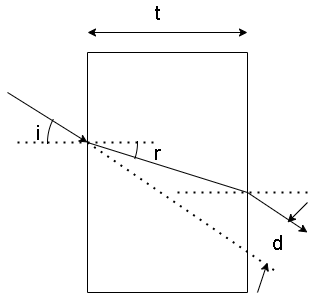
A ray of light is incident on a thick slab of a glass of thickness t as shown in the figure. The emergent ray is parallel to the incident ray but displaced sideways by a distance d. If the angles are small then $d$ is
A) $T(1 - \dfrac{i}{r})$
B) $Rt(1 - \dfrac{i}{r})$
C) $it(1 - \dfrac{r}{i})$
D) $T(\dfrac{{ - r}}{i})$
Answer
 Verified
612k+ views
Hint: When the emergent ray is displaced then the phenomenon of lateral shift is observed. Lateral shift is the perpendicular distance between the incident ray and the emergent ray when the light ray undergoes refraction from a glass slab. The lateral displacement depends upon the thickness and the refractive index of the glass slab and the angle at which the incident ray enters the glass slab.
Formula used:
The formula of lateral displacement can be written as
$D = \dfrac{{t\sin (i - r)}}{{\cos r}}$
Where $D$ is the lateral displacement
$t$ is the thickness of the slab
$i$ is the angle of incidence
$r$ is the angle of refraction
Complete step by step answer:
The ray of light incident on the glass slab undergoes refraction twice and comes out from the other side of the slab as an emergent ray.
The formula of lateral displacement $D = \dfrac{{t\sin (i - r)}}{{\cos r}}$
Since the angle made by the incident and emergent ray, the angle is very small and when the angle is small then it can be written that
$\sin (i - r) \cong i - r$
And $\cos r \cong 1$
Substituting the values in the formula, and solving for the value of lateral displacement
$D = \dfrac{{t(i - r)}}{1}$
Taking ‘$i$’ common from the bracket, the equation reduces to the form
$D = it(1 - \dfrac{r}{i})$
Therefore, Option C is the right answer.
Note:
It is to be noted that the emergent ray shows a lateral shift of the ray from the original path. When the Light is passing through the glass its velocity decreases but when it comes out of the glass slab, its velocity increases. The light ray then follows the same direction in the air.
Formula used:
The formula of lateral displacement can be written as
$D = \dfrac{{t\sin (i - r)}}{{\cos r}}$
Where $D$ is the lateral displacement
$t$ is the thickness of the slab
$i$ is the angle of incidence
$r$ is the angle of refraction
Complete step by step answer:
The ray of light incident on the glass slab undergoes refraction twice and comes out from the other side of the slab as an emergent ray.
The formula of lateral displacement $D = \dfrac{{t\sin (i - r)}}{{\cos r}}$
Since the angle made by the incident and emergent ray, the angle is very small and when the angle is small then it can be written that
$\sin (i - r) \cong i - r$
And $\cos r \cong 1$
Substituting the values in the formula, and solving for the value of lateral displacement
$D = \dfrac{{t(i - r)}}{1}$
Taking ‘$i$’ common from the bracket, the equation reduces to the form
$D = it(1 - \dfrac{r}{i})$
Therefore, Option C is the right answer.
Note:
It is to be noted that the emergent ray shows a lateral shift of the ray from the original path. When the Light is passing through the glass its velocity decreases but when it comes out of the glass slab, its velocity increases. The light ray then follows the same direction in the air.
Recently Updated Pages
Master Class 12 Economics: Engaging Questions & Answers for Success

Master Class 12 English: Engaging Questions & Answers for Success
Master Class 12 Social Science: Engaging Questions & Answers for Success
Master Class 12 Maths: Engaging Questions & Answers for Success
Master Class 12 Physics: Engaging Questions & Answers for Success
Master Class 9 General Knowledge: Engaging Questions & Answers for Success
Trending doubts
Which are the Top 10 Largest Countries of the World?
Draw a labelled sketch of the human eye class 12 physics CBSE
Differentiate between homogeneous and heterogeneous class 12 chemistry CBSE
Sulphuric acid is known as the king of acids State class 12 chemistry CBSE
Why is the cell called the structural and functional class 12 biology CBSE
A dentist uses a small mirror that gives a magnification class 12 physics CBSE