




A ray incident parallel to principal axis on a concave mirror at an angle $\theta $ after two reflections, reflected ray becomes parallel to incident ray. If $\theta =\dfrac{\pi }{N}$ (in radian) then find the value of N.
Answer
 Verified
604.5k+ views
Hint:As the ray becomes parallel after two reflections, so the sum of all the angles it made on the same side of the parallel lines is 180°.The centre of the reflecting surface of a sphere of which a spherical mirror is made up of is called the centre of curvature of the spherical mirror. The centre of curvature of a concave mirror lies in front of it.
Complete step by step answer:
Let a ray parallel to the principal axis PQ meet the mirror at A as shown in the figure. After reflection from the surface it meets at B. After reflection from B it emerges parallel to the principal axis. It is given that $\theta $ is the angle made by the incident ray with the centre of curvature.
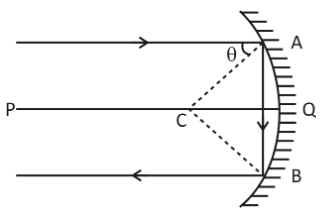
As the ray incident parallel to the principal axis on a concave mirror at an angle after two reflections, reflected ray becomes parallel to incident ray. So taking the centre of curvature as reference(refer the following figure), the sum of the interior opposite angles on the same side of parallel lines is 180°.
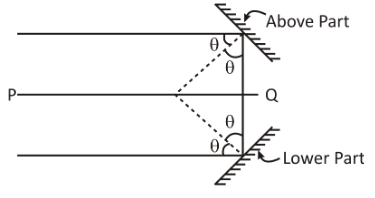
Therefore, we have
$4\theta = 180 \\
\Rightarrow 4\theta = \pi $ (In radians)
$ \therefore \theta =\dfrac{\pi }{4}$
Comparing it with the equation $\theta =\dfrac{\pi }{N}$, we get N = 4
Hence, the value of N is 4.
Note:In a concave mirror, a ray parallel to the principal axis, after reflection, will pass through the principal focus. In case of a convex mirror it appears to diverge from the principal focus. A ray passing through the principal focus of a concave mirror after reflection, will emerge parallel to the principal axis. So after first reflection the given ray will pass through the principal focus and after second reflection, it will emerge parallel to the principal axis.
Complete step by step answer:
Let a ray parallel to the principal axis PQ meet the mirror at A as shown in the figure. After reflection from the surface it meets at B. After reflection from B it emerges parallel to the principal axis. It is given that $\theta $ is the angle made by the incident ray with the centre of curvature.
As the ray incident parallel to the principal axis on a concave mirror at an angle after two reflections, reflected ray becomes parallel to incident ray. So taking the centre of curvature as reference(refer the following figure), the sum of the interior opposite angles on the same side of parallel lines is 180°.
Therefore, we have
$4\theta = 180 \\
\Rightarrow 4\theta = \pi $ (In radians)
$ \therefore \theta =\dfrac{\pi }{4}$
Comparing it with the equation $\theta =\dfrac{\pi }{N}$, we get N = 4
Hence, the value of N is 4.
Note:In a concave mirror, a ray parallel to the principal axis, after reflection, will pass through the principal focus. In case of a convex mirror it appears to diverge from the principal focus. A ray passing through the principal focus of a concave mirror after reflection, will emerge parallel to the principal axis. So after first reflection the given ray will pass through the principal focus and after second reflection, it will emerge parallel to the principal axis.
Recently Updated Pages
Master Class 12 Business Studies: Engaging Questions & Answers for Success

Master Class 12 Biology: Engaging Questions & Answers for Success
Master Class 12 Chemistry: Engaging Questions & Answers for Success
Class 12 Question and Answer - Your Ultimate Solutions Guide
Master Class 11 English: Engaging Questions & Answers for Success
Master Class 11 Social Science: Engaging Questions & Answers for Success
Trending doubts
Which are the Top 10 Largest Countries of the World?
Draw a labelled sketch of the human eye class 12 physics CBSE
Differentiate between homogeneous and heterogeneous class 12 chemistry CBSE
Why is the cell called the structural and functional class 12 biology CBSE
Draw ray diagrams each showing i myopic eye and ii class 12 physics CBSE
Which is the correct genotypic ratio of mendel dihybrid class 12 biology CBSE