




A radio station surveyed 190 students to determine the types of music they liked. The survey revealed that 114 liked rock music, 50 liked folk music and 41 liked classical music, 14 liked rock music and folk music, 15 liked rock music and classical music, 11 liked classical music and folk music, 5 liked all three of music.
Find:
(i) How many did not like any of the 3 types?
(ii) How many liked any two types only?
(iii) How many liked folk music but not rock music?
Answer
 Verified
687.9k+ views
Hint: To solve this question, we will use a Venn diagram. We will draw a Venn diagram according to the conditions given in the question and solve the given problem step by step.
Complete step-by-step solution:
Now, there are a total of 190 students.
Now, 114 like rock music, 50 like folk music and 41 like classical music. So, we will draw a Venn diagram.
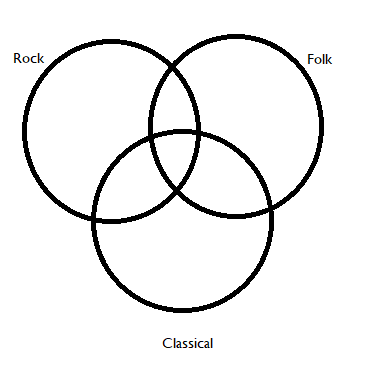
Let a be students who only like rock music, b be students who only like folk music and c be students who only like classical music. Also, let d be students who like both rock and folk, f be students who like both folk and classical and g be students who like rock and classical and e be students who like all the three types of music. So, Venn diagram is
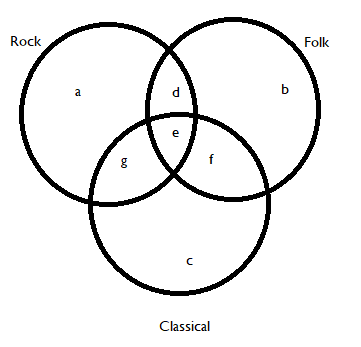
Now, according to the question, we get
a + d + e + g = 114
b + d + e + f = 50
c + g + e + f = 41
Now, we are given that 14 like rock and folk music, 15 like rock and classical, 11 like classical and folk and 5 like all the three types of music.
Therefore, d = 14, g = 15, f = 11, e = 5
Therefore, we get
a + 14 + 5 + 15 = 114 $ \Rightarrow $ a = 80
b + 14 + 5 + 11 = 50 $ \Rightarrow $ b = 20
c + 15 + 5 + 11 = 41 $ \Rightarrow $ c = 10
So, number of students who likes at least one type of music = a + b + c + d + e + f + g = 80 + 20 + 10 + 14 + 5 + 11 + 15 = 155
(i) number of students who did not like any type of music = 190 – 155 = 35 students
(ii) number of students who like any two types only = d + g + f = 14 + 15 + 11 = 40 students
(iii) number of students who like folk music but not rock music = b + f = 20 + 11 = 31 students
Note: When we come up with such types of questions, we have to draw a Venn diagram to solve the question. We have to let variables according to question and solve them to find their values. After it, we will solve each part of the given problem with the help of the variables found.
Complete step-by-step solution:
Now, there are a total of 190 students.
Now, 114 like rock music, 50 like folk music and 41 like classical music. So, we will draw a Venn diagram.
Let a be students who only like rock music, b be students who only like folk music and c be students who only like classical music. Also, let d be students who like both rock and folk, f be students who like both folk and classical and g be students who like rock and classical and e be students who like all the three types of music. So, Venn diagram is
Now, according to the question, we get
a + d + e + g = 114
b + d + e + f = 50
c + g + e + f = 41
Now, we are given that 14 like rock and folk music, 15 like rock and classical, 11 like classical and folk and 5 like all the three types of music.
Therefore, d = 14, g = 15, f = 11, e = 5
Therefore, we get
a + 14 + 5 + 15 = 114 $ \Rightarrow $ a = 80
b + 14 + 5 + 11 = 50 $ \Rightarrow $ b = 20
c + 15 + 5 + 11 = 41 $ \Rightarrow $ c = 10
So, number of students who likes at least one type of music = a + b + c + d + e + f + g = 80 + 20 + 10 + 14 + 5 + 11 + 15 = 155
(i) number of students who did not like any type of music = 190 – 155 = 35 students
(ii) number of students who like any two types only = d + g + f = 14 + 15 + 11 = 40 students
(iii) number of students who like folk music but not rock music = b + f = 20 + 11 = 31 students
Note: When we come up with such types of questions, we have to draw a Venn diagram to solve the question. We have to let variables according to question and solve them to find their values. After it, we will solve each part of the given problem with the help of the variables found.
Recently Updated Pages
Which of the following graphs shows the variation of class 12 physics CBSE

Draw a labelled diagram of the human male reproductive class 12 biology CBSE
Describe the experiment to compare the emf of two cells class 12 physics CBSE
What is standard hydrogen electrode
What is conventional current and electric current class 12 physics CBSE
2Bromopentane is treated with an alcoholic KOH solution class 12 chemistry CBSE
Trending doubts
Draw a labelled sketch of the human eye class 12 physics CBSE
Which are the Top 10 Largest Countries of the World?
Draw ray diagrams each showing i myopic eye and ii class 12 physics CBSE
Which is the correct genotypic ratio of mendel dihybrid class 12 biology CBSE
Which is the strongest oxidising agent out of the following class 12 chemistry CBSE
Differentiate between homogeneous and heterogeneous class 12 chemistry CBSE