




A proton is released from rest, $10cm$ from a charged sheet carrying charged density of $ - 2.21 \times {10^{ - 9}}C/{m^2}$. It will strike the sheet after time (approximately)
(a). $4\mu s$
(b). $2\mu s$
(c). $2\sqrt 2 \mu s$
(d). $4\sqrt 2 \mu s$
Answer
 Verified
655.2k+ views
- Hint: The force that a charge experiences in the presence of another charge is known as electrostatic force. This force is also known as Coulomb force, after the name of its discoverer Charles-Augustin de Coulomb.
Complete step-by-step answer:
The charge experiences Coulomb’s force due to the formation of an electric field around the other charge. Imagine a fisherman entrapping a fish in its net and pulling it, this is somewhat how electric fields trap a charge.
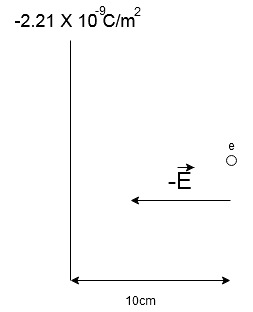
We know that the magnitude of the electric field due to a charged sheet is given by the equation
$E = \dfrac{\sigma }{{2{\varepsilon _0}}}$
Here $E = $ Electric field, $\sigma = $ Surface charge density and ${\varepsilon _0} = $ Permittivity of free space.
$E = \dfrac{{2.21 \times {{10}^{ - 9}}}}{{2 \times 8.85 \times {{10}^{ - 12}}}}$
$E = 124.86N/C$
This electric field formed will exert an electrostatic force of attraction on the proton, which will be given by the equation
$F = eE$
Here, $e = $ Charge of proton $ = 1.6 \times {10^{ - 19}}C$
$F = 1.6 \times {10^{ - 19}} \times 124.86N$ (Equation 1)
We know by Newton’s second law that,
$F = ma$
Here, $m = 1.67 \times {10^{ - 27}}kg = $ Mass of proton and $a = $ Acceleration of the proton
$1.67 \times {10^{ - 27}} \times a = 1.6 \times {10^{ - 19}} \times 124.86$
$a = \dfrac{{1.6 \times {{10}^{ - 19}} \times 124.86}}{{1.67 \times {{10}^{ - 27}}}}$
$a = 1.2 \times {10^{10}}m/{s^2}$
Now, using the second equation of motion we know that
$s = ut + \dfrac{1}{2}a{t^2}$
Here, $s = $ distance $ = 10cm = 0.1m$ , $u = $ initial velocity of proton $ = 0$ (proton is at rest), $t = $ time and $a = $ Acceleration of the proton
So, $0.1 = 0 \times t + \dfrac{1}{2} \times 1.2 \times {10^{10}} \times {t^2}$
${t^2} = \dfrac{{0.2}}{{1.2 \times {{10}^{10}}}}$
$t = \sqrt {\dfrac{{0.2}}{{1.2 \times {{10}^{10}}}}} $
$t = 4.08 \times {10^{ - 6}}\sec \sim 4\mu s$
Hence, option A is the correct choice.
Note: In the problem we are given a charged sheet carrying a charged density of $ - 2.21 \times {10^{ - 9}}C/{m^2}$. But while attempting the solution we mostly ignore the minus sign because the negative sign only represents the nature of the charge and this does not affect the magnitude of the electric field, the electrostatic force or time.
Complete step-by-step answer:
The charge experiences Coulomb’s force due to the formation of an electric field around the other charge. Imagine a fisherman entrapping a fish in its net and pulling it, this is somewhat how electric fields trap a charge.
We know that the magnitude of the electric field due to a charged sheet is given by the equation
$E = \dfrac{\sigma }{{2{\varepsilon _0}}}$
Here $E = $ Electric field, $\sigma = $ Surface charge density and ${\varepsilon _0} = $ Permittivity of free space.
$E = \dfrac{{2.21 \times {{10}^{ - 9}}}}{{2 \times 8.85 \times {{10}^{ - 12}}}}$
$E = 124.86N/C$
This electric field formed will exert an electrostatic force of attraction on the proton, which will be given by the equation
$F = eE$
Here, $e = $ Charge of proton $ = 1.6 \times {10^{ - 19}}C$
$F = 1.6 \times {10^{ - 19}} \times 124.86N$ (Equation 1)
We know by Newton’s second law that,
$F = ma$
Here, $m = 1.67 \times {10^{ - 27}}kg = $ Mass of proton and $a = $ Acceleration of the proton
$1.67 \times {10^{ - 27}} \times a = 1.6 \times {10^{ - 19}} \times 124.86$
$a = \dfrac{{1.6 \times {{10}^{ - 19}} \times 124.86}}{{1.67 \times {{10}^{ - 27}}}}$
$a = 1.2 \times {10^{10}}m/{s^2}$
Now, using the second equation of motion we know that
$s = ut + \dfrac{1}{2}a{t^2}$
Here, $s = $ distance $ = 10cm = 0.1m$ , $u = $ initial velocity of proton $ = 0$ (proton is at rest), $t = $ time and $a = $ Acceleration of the proton
So, $0.1 = 0 \times t + \dfrac{1}{2} \times 1.2 \times {10^{10}} \times {t^2}$
${t^2} = \dfrac{{0.2}}{{1.2 \times {{10}^{10}}}}$
$t = \sqrt {\dfrac{{0.2}}{{1.2 \times {{10}^{10}}}}} $
$t = 4.08 \times {10^{ - 6}}\sec \sim 4\mu s$
Hence, option A is the correct choice.
Note: In the problem we are given a charged sheet carrying a charged density of $ - 2.21 \times {10^{ - 9}}C/{m^2}$. But while attempting the solution we mostly ignore the minus sign because the negative sign only represents the nature of the charge and this does not affect the magnitude of the electric field, the electrostatic force or time.
Recently Updated Pages
Explain the structure of megasporangium class 12 biology CBSE

Why is chloroform kept in dark coloured bottles class 12 chemistry CBSE
Derive the balancing condition of a Wheatstone bri class 12 physics CBSE
Draw VI characteristics of a pn junction diode Explain class 12 physics CBSE
Is it possible to carry pride in ones language too class 12 english CBSE
In a population at Hardy Weinberg equilibrium the allele class 12 biology CBSE
Trending doubts
Draw a labelled sketch of the human eye class 12 physics CBSE
Which are the Top 10 Largest Countries of the World?
Draw ray diagrams each showing i myopic eye and ii class 12 physics CBSE
Which is the correct genotypic ratio of mendel dihybrid class 12 biology CBSE
Differentiate between homogeneous and heterogeneous class 12 chemistry CBSE
Which animal never drinks water in its entire life class 12 biology CBSE