




A projectile is fired with a speed $u$ at an angle $\theta $ with the horizontal. Its speed when is direction of motion makes an angle $\alpha $ with the horizontal is
(A). $u\sec \theta \cos \alpha $
(B). $u\sec \theta \sin \alpha $
(C). $u\cos \theta \sec \alpha $
(D). $u\sin \theta \sec \alpha $
Answer
 Verified
572.1k+ views
Hint: A particle follows a projectile under the acceleration of gravity. We can resolve the velocity into its horizontal and vertical components. The horizontal component will remain constant throughout the motion as no acceleration is acting on it in the horizontal direction. At the point where the velocity of the particle makes $\alpha $, we can use trigonometric ratios and components to calculate the magnitude of velocity.
Formulas used:
$\cos \alpha =\dfrac{u\cos \theta }{u'}$
Complete step-by-step solution:
When a particle is thrown at an angle with the horizontal, the motion is called projectile motion. It follows a parabola.
Let the particle make angle $\alpha $ with the horizontal at point P.
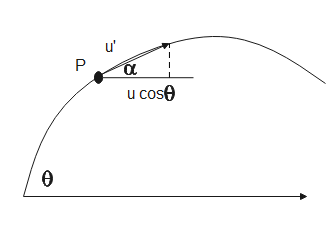
At the starting point, the initial velocity of the particle can be resolved into its components of which the horizontal component remains constant equal to $u\cos \theta $
At point P,
$\cos \alpha =\dfrac{u\cos \theta }{u'}$
Let $u'$ be the velocity at point P, therefore, from the above equation, we get,
$\begin{align}
& \cos \alpha =\dfrac{u\cos \theta }{u'} \\
& \Rightarrow u'=\dfrac{u\cos \theta }{\cos \alpha } \\
& \therefore u'=u\sec \alpha \cos \theta \\
\end{align}$
Therefore, the velocity of the particle at the point where it makes $\alpha $ with the horizontal is $u\sec \alpha \cos \theta $. Hence, the correct option is (C).
Additional information:
As the acceleration of the particle is constant, we can apply equations of motion to calculate the different parameters of projectile motion. The range can be calculated as
$R=\dfrac{{{u}^{2}}\sin 2\theta }{g}$ and the height can be calculated as $\dfrac{{{(u\sin \theta )}^{2}}}{2g}$ and the time taken for the complete motion is $t=\dfrac{u\sin \theta }{g}$.
Note:
At the highest point, $\alpha =0$, $u'=u\cos \theta $ and the vertical component vanishes. In projectile motion, we can analyse the vertical motion and the horizontal motion separately. In the vertical motion, the acceleration due to gravity acts on the particle. At the highest point of the projectile, potential energy is maximum and at the lowest point kinetic energy is maximum.
Formulas used:
$\cos \alpha =\dfrac{u\cos \theta }{u'}$
Complete step-by-step solution:
When a particle is thrown at an angle with the horizontal, the motion is called projectile motion. It follows a parabola.
Let the particle make angle $\alpha $ with the horizontal at point P.
At the starting point, the initial velocity of the particle can be resolved into its components of which the horizontal component remains constant equal to $u\cos \theta $
At point P,
$\cos \alpha =\dfrac{u\cos \theta }{u'}$
Let $u'$ be the velocity at point P, therefore, from the above equation, we get,
$\begin{align}
& \cos \alpha =\dfrac{u\cos \theta }{u'} \\
& \Rightarrow u'=\dfrac{u\cos \theta }{\cos \alpha } \\
& \therefore u'=u\sec \alpha \cos \theta \\
\end{align}$
Therefore, the velocity of the particle at the point where it makes $\alpha $ with the horizontal is $u\sec \alpha \cos \theta $. Hence, the correct option is (C).
Additional information:
As the acceleration of the particle is constant, we can apply equations of motion to calculate the different parameters of projectile motion. The range can be calculated as
$R=\dfrac{{{u}^{2}}\sin 2\theta }{g}$ and the height can be calculated as $\dfrac{{{(u\sin \theta )}^{2}}}{2g}$ and the time taken for the complete motion is $t=\dfrac{u\sin \theta }{g}$.
Note:
At the highest point, $\alpha =0$, $u'=u\cos \theta $ and the vertical component vanishes. In projectile motion, we can analyse the vertical motion and the horizontal motion separately. In the vertical motion, the acceleration due to gravity acts on the particle. At the highest point of the projectile, potential energy is maximum and at the lowest point kinetic energy is maximum.
Recently Updated Pages
Basicity of sulphurous acid and sulphuric acid are

Master Class 12 English: Engaging Questions & Answers for Success
Master Class 12 Social Science: Engaging Questions & Answers for Success
Master Class 12 Maths: Engaging Questions & Answers for Success
Master Class 12 Economics: Engaging Questions & Answers for Success
Master Class 12 Physics: Engaging Questions & Answers for Success
Trending doubts
Which are the Top 10 Largest Countries of the World?
Draw a labelled sketch of the human eye class 12 physics CBSE
Which country did Danny Casey play for class 12 english CBSE
Give 10 examples of unisexual and bisexual flowers
Coming together federation is practiced in A India class 12 social science CBSE
Write the formula to find the shortest distance between class 12 maths CBSE