




A prism of refractive index 1.53 is placed in water of refractive index 1.33. If the angle of the prism is $60^\circ$, calculate the angle of minimum deviation in water.
Answer
 Verified
638.1k+ views
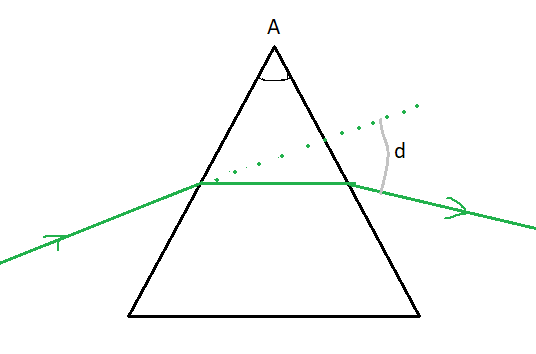
Hint: The angle of deviation ($\delta$) depends upon the angle of incidence, if the angle of incidence of the light increases, the angle of deviation (δm) decreases till it becomes minimum at a particular angle of incidence. The minimum value of the angle of deviation is called the angle of minimum deviation ($\delta_m$).
Complete step by step answer:
According to question we have,
Angle of prism($A$) = $60^\circ$
Refractive index of glass $\mu_g$ = 1.53
(Because prism is made up of glass that is why we write refractive index of glass)
Refractive index of water $\mu_w$ = 1.33
Now, the refractive index (n) = $\dfrac{{{\mu _g}}}{{{\mu _w}}}$
$ \Rightarrow n = \dfrac{{1.53}}{{1.33}} = 1.15$
Now we apply the prism formula to find the minimum angle of deviation (δm).
$n = \dfrac{{\sin [(A + {\delta _m})/2]}}{{\sin (A/2)}}$
$ \Rightarrow 1.15 = \dfrac{{\sin [(60^\circ + {\delta _m})/2]}}{{\sin (60^\circ /2)}}$
$ \Rightarrow \dfrac{{{\text{60}}^\circ {\text{ + }}{\delta _{\text{m}}}}}{2} = {\sin ^{ - 1}}\left( {1.15 \times \sin \dfrac{{60^\circ }}{2}} \right)$
$ \Rightarrow \dfrac{{{\text{60}}^\circ {\text{ + }}{\delta _{\text{m}}}}}{2} = {\sin ^{ - 1}}\left( {1.15 \times \sin 30^\circ } \right)$
$ \Rightarrow \dfrac{{{\text{60}}^\circ {\text{ + }}{\delta _{\text{m}}}}}{2} = {\sin ^{ - 1}}\left( {1.15 \times \dfrac{1}{2}} \right)$ $\because \left( {\sin 30^\circ = \dfrac{1}{2}} \right)$
$ \Rightarrow \dfrac{{{\text{60}}^\circ {\text{ + }}{\delta _{\text{m}}}}}{2} = {\sin ^{ - 1}}\left( {0.575} \right) = 35.1^\circ $
$ \Rightarrow 60^\circ + {\delta _m} = 35.1^\circ \times 2$
$\therefore {\delta _m} = 70.2^\circ - 60^\circ = 10.2^\circ $
Therefore the angle of minimum deviation in water $({\delta _m}) = 10.2^\circ $
Additional information:
There is a necessary condition for the minimum deviation, the prism lies symmetrically with respect to the incident ray and the emergent ray i.e.($ i=e$). The angle between the emergent ray and the direction of the incident ray is called the angle of deviation. There is one and only one angle of incidence for which the deviation produced by the prism is minimum. For any other angle of deviation, there are two values of ($i$) and ($e$).
Note:
The angle of minimum deviation (\delta_m) is also denoted by( $D_m$). Deviation produced by a very thin prism does not depend upon the angle of incidence i.e., it is a constant quantity for a given prism. A thin prism gives deviation of light.
Complete step by step answer:
According to question we have,
Angle of prism($A$) = $60^\circ$
Refractive index of glass $\mu_g$ = 1.53
(Because prism is made up of glass that is why we write refractive index of glass)
Refractive index of water $\mu_w$ = 1.33
Now, the refractive index (n) = $\dfrac{{{\mu _g}}}{{{\mu _w}}}$
$ \Rightarrow n = \dfrac{{1.53}}{{1.33}} = 1.15$
Now we apply the prism formula to find the minimum angle of deviation (δm).
$n = \dfrac{{\sin [(A + {\delta _m})/2]}}{{\sin (A/2)}}$
$ \Rightarrow 1.15 = \dfrac{{\sin [(60^\circ + {\delta _m})/2]}}{{\sin (60^\circ /2)}}$
$ \Rightarrow \dfrac{{{\text{60}}^\circ {\text{ + }}{\delta _{\text{m}}}}}{2} = {\sin ^{ - 1}}\left( {1.15 \times \sin \dfrac{{60^\circ }}{2}} \right)$
$ \Rightarrow \dfrac{{{\text{60}}^\circ {\text{ + }}{\delta _{\text{m}}}}}{2} = {\sin ^{ - 1}}\left( {1.15 \times \sin 30^\circ } \right)$
$ \Rightarrow \dfrac{{{\text{60}}^\circ {\text{ + }}{\delta _{\text{m}}}}}{2} = {\sin ^{ - 1}}\left( {1.15 \times \dfrac{1}{2}} \right)$ $\because \left( {\sin 30^\circ = \dfrac{1}{2}} \right)$
$ \Rightarrow \dfrac{{{\text{60}}^\circ {\text{ + }}{\delta _{\text{m}}}}}{2} = {\sin ^{ - 1}}\left( {0.575} \right) = 35.1^\circ $
$ \Rightarrow 60^\circ + {\delta _m} = 35.1^\circ \times 2$
$\therefore {\delta _m} = 70.2^\circ - 60^\circ = 10.2^\circ $
Therefore the angle of minimum deviation in water $({\delta _m}) = 10.2^\circ $
Additional information:
There is a necessary condition for the minimum deviation, the prism lies symmetrically with respect to the incident ray and the emergent ray i.e.($ i=e$). The angle between the emergent ray and the direction of the incident ray is called the angle of deviation. There is one and only one angle of incidence for which the deviation produced by the prism is minimum. For any other angle of deviation, there are two values of ($i$) and ($e$).
Note:
The angle of minimum deviation (\delta_m) is also denoted by( $D_m$). Deviation produced by a very thin prism does not depend upon the angle of incidence i.e., it is a constant quantity for a given prism. A thin prism gives deviation of light.
Recently Updated Pages
Basicity of sulphurous acid and sulphuric acid are

Master Class 12 Economics: Engaging Questions & Answers for Success
Master Class 12 Biology: Engaging Questions & Answers for Success
Master Class 11 English: Engaging Questions & Answers for Success
Master Class 11 Physics: Engaging Questions & Answers for Success
Master Class 11 Computer Science: Engaging Questions & Answers for Success
Trending doubts
Draw a labelled sketch of the human eye class 12 physics CBSE
The chemical formula of tear gas is A CO Cl 2 B C 10 class 12 chemistry CBSE
Draw ray diagrams each showing i myopic eye and ii class 12 physics CBSE
Which are the Top 10 Largest Countries of the World?
Differentiate between homogeneous and heterogeneous class 12 chemistry CBSE
Which is the correct genotypic ratio of mendel dihybrid class 12 biology CBSE