




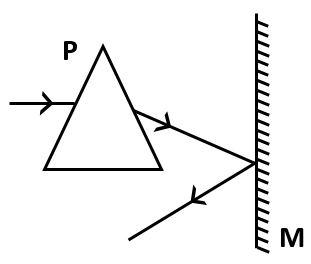
A prism having an apex angle of $4^\circ $ and a refractive index of $1.50$ is located in front of a vertical plane mirror as shown. A horizontal ray of light is incident on the prism. The total angle through which the ray is deviated is:
A. $4^\circ clockwise$
B. $178^\circ clockwise$
C. $2^\circ clockwise$
D. $8^\circ clockwise$
Answer
 Verified
594.9k+ views
Hint: Use deviation formula to calculate deviation by prism. Then use the concept that the initial light ray and the normal of the mirror will be parallel to each other.
Formula used:
$\delta = \left( {\mu - 1} \right)A$
Where,
$A$ is apex angle
$\mu $ is refractive index
$\delta $ is the angle of deviation
Complete step by step answer:
It is given in the question that the prism has an apex angle of ${4^0}$
And the refractive index of $1.50$
This mirror is located in front of a mirror, M
Light ray is falling on the prism, horizontally.
We know that,
$\delta = \left( {\mu - 1} \right)A$
Where,
$A$ is apex angle
$\mu $ is refractive index
$\delta $ is the angle of deviation
Let, ${\delta _1}$ be the angle of deviation for the given prism when it refracts through the prism
Then we have
${\delta _1} = \left( {\mu - 1} \right)A$
Substitute the given values in the above equation. We get
\[{\delta _1} = (1.5 - 1)4\]
$ = 0.5 \times 4$
$ \Rightarrow {\delta _1} = {2^0}$
This light ray will fall on the mirror and reflect.
Now observe the diagram
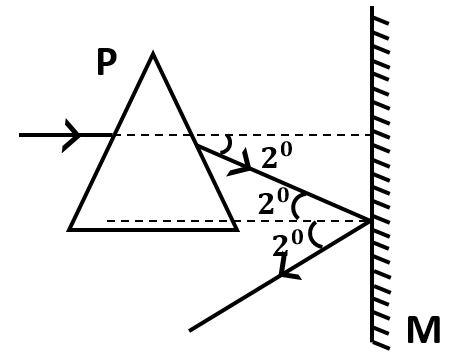
Since, the light ray was horizontal initially, it will be parallel to the normal to the mirror. Therefore, the angle of deviation will be equal to the angle of incidence.
And according to the law of reflection, the angle of incidence is equal to the angle or reflection.
Therefore, the deviation in the reflected ray from the mirror will be
${\delta _2} = {180^0} - 2 \times {2^0}$
$ \Rightarrow {\delta _2} = {176^0}$
Now, the total deviation of the light ray will be the sum of the deviation from the prism and the deviation from the mirror.
Therefore, the total deviation of the light will be
$\delta = {\delta _1} + {\delta _2}$
$ = {176^0} + {2^0}$
$ \Rightarrow \delta = {178^0}$
Thus the total deviation is ${178^0}$.
From the diagram we can clearly observe that the deviation is in the clockwise direction.
Therefore, from the above explanation, the correct answer is, option (B) $178^\circ clockwise$
Note:In this equation, you need to understand how deviation would work in case of reflection. It was necessary to understand that the angle of deviation through prism is equal to the angle of incidence.
Formula used:
$\delta = \left( {\mu - 1} \right)A$
Where,
$A$ is apex angle
$\mu $ is refractive index
$\delta $ is the angle of deviation
Complete step by step answer:
It is given in the question that the prism has an apex angle of ${4^0}$
And the refractive index of $1.50$
This mirror is located in front of a mirror, M
Light ray is falling on the prism, horizontally.
We know that,
$\delta = \left( {\mu - 1} \right)A$
Where,
$A$ is apex angle
$\mu $ is refractive index
$\delta $ is the angle of deviation
Let, ${\delta _1}$ be the angle of deviation for the given prism when it refracts through the prism
Then we have
${\delta _1} = \left( {\mu - 1} \right)A$
Substitute the given values in the above equation. We get
\[{\delta _1} = (1.5 - 1)4\]
$ = 0.5 \times 4$
$ \Rightarrow {\delta _1} = {2^0}$
This light ray will fall on the mirror and reflect.
Now observe the diagram
Since, the light ray was horizontal initially, it will be parallel to the normal to the mirror. Therefore, the angle of deviation will be equal to the angle of incidence.
And according to the law of reflection, the angle of incidence is equal to the angle or reflection.
Therefore, the deviation in the reflected ray from the mirror will be
${\delta _2} = {180^0} - 2 \times {2^0}$
$ \Rightarrow {\delta _2} = {176^0}$
Now, the total deviation of the light ray will be the sum of the deviation from the prism and the deviation from the mirror.
Therefore, the total deviation of the light will be
$\delta = {\delta _1} + {\delta _2}$
$ = {176^0} + {2^0}$
$ \Rightarrow \delta = {178^0}$
Thus the total deviation is ${178^0}$.
From the diagram we can clearly observe that the deviation is in the clockwise direction.
Therefore, from the above explanation, the correct answer is, option (B) $178^\circ clockwise$
Note:In this equation, you need to understand how deviation would work in case of reflection. It was necessary to understand that the angle of deviation through prism is equal to the angle of incidence.
Recently Updated Pages
Master Class 12 Social Science: Engaging Questions & Answers for Success

Master Class 12 Physics: Engaging Questions & Answers for Success
Master Class 12 Maths: Engaging Questions & Answers for Success
Master Class 12 Economics: Engaging Questions & Answers for Success
Master Class 12 Chemistry: Engaging Questions & Answers for Success
Master Class 12 Business Studies: Engaging Questions & Answers for Success
Trending doubts
Which are the Top 10 Largest Countries of the World?
Draw a labelled sketch of the human eye class 12 physics CBSE
Explain the structure of megasporangium class 12 biology CBSE
What are the major means of transport Explain each class 12 social science CBSE
How many chromosomes are found in human ovum a 46 b class 12 biology CBSE
The diagram of the section of a maize grain is given class 12 biology CBSE