




A potentiometer wire of length 10 m and resistance \[30\text{ }\Omega\] is connected in series with a battery of emf 2.5 V, internal resistance 5 Ω, and an external resistance R. If the fall of potential along the potentiometer wire is \[50\mu Vm{{m}^{-1}}\], then the value of R is found to be 23n Ω. What is n?
Answer
 Verified
610.2k+ views
Hint: At first, we have to understand which system is given. Accordingly, write all given information and using standard formulas, calculate the required answer. Potential gradient is the ratio of potential difference and the length of potentiometer wire.
Complete answer:
Let I be the current in the circuit. E be emf, r is internal resistance and ${{R}_{s}}$ is the resistance of wire connected in series with battery.
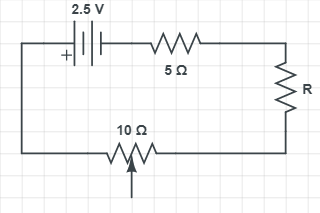
We know that the equation of emf,
\[E=I(R+{{R}_{s}}+r)\]
So, we can rearrange it to determine current I as
\[I=\dfrac{E}{(R+{{R}_{s}}+r)}..........(1)\]
The potential gradient k of the wire is
\[k=\dfrac{I{{R}_{s}}}{L}......(2)\]
where L is the length of the potentiometer wire.
Substituting value of I from equation (1) in equation (2) we get,
\[k=\dfrac{E{{R}_{s}}}{(R+{{R}_{s}}+r)L}..........(3)\]
Here it is given that, \[L=10m,\text{ }E=2.5V,\text{ }r=5\Omega ,\text{ }{{R}_{s}}=30\Omega ,\text{ }k=50\mu Vm{{m}^{-1}}\text{, }R=23n\Omega \]
Putting all these values in equation (3) we get,
\[\dfrac{50\times {{10}^{-6}}}{{{10}^{-3}}}=\dfrac{2.5\times 30}{(R+30+5)10}\]
Solving above equation and doing correct calculations we get,
\[\begin{align}
& 50\times {{10}^{-6+3}}=\dfrac{2.5\times 3}{(R+35)} \\
& \Rightarrow (R+35)=\dfrac{7.5}{50\times {{10}^{-3}}} \\
& \Rightarrow (R+35)=0.15\times {{10}^{3}} \\
& \Rightarrow R=150-35=115 \\
\end{align}\]
But given R = 23n, so above equation can be written as,
\[23n=115\]
Dividing throughout by 23, we get
\[n=5\]
Note:
Students must remember to convert the unit of potential gradient into SI unit because all the remaining values are in SI unit. Don’t forget to add internal resistance with the resistance R because they are in series with battery. Do calculations accurately otherwise it leads to wrong answers.
Students sometimes just take E = IR and ignore internal resistance, this will lead to wrong answers.
Complete answer:
Let I be the current in the circuit. E be emf, r is internal resistance and ${{R}_{s}}$ is the resistance of wire connected in series with battery.
We know that the equation of emf,
\[E=I(R+{{R}_{s}}+r)\]
So, we can rearrange it to determine current I as
\[I=\dfrac{E}{(R+{{R}_{s}}+r)}..........(1)\]
The potential gradient k of the wire is
\[k=\dfrac{I{{R}_{s}}}{L}......(2)\]
where L is the length of the potentiometer wire.
Substituting value of I from equation (1) in equation (2) we get,
\[k=\dfrac{E{{R}_{s}}}{(R+{{R}_{s}}+r)L}..........(3)\]
Here it is given that, \[L=10m,\text{ }E=2.5V,\text{ }r=5\Omega ,\text{ }{{R}_{s}}=30\Omega ,\text{ }k=50\mu Vm{{m}^{-1}}\text{, }R=23n\Omega \]
Putting all these values in equation (3) we get,
\[\dfrac{50\times {{10}^{-6}}}{{{10}^{-3}}}=\dfrac{2.5\times 30}{(R+30+5)10}\]
Solving above equation and doing correct calculations we get,
\[\begin{align}
& 50\times {{10}^{-6+3}}=\dfrac{2.5\times 3}{(R+35)} \\
& \Rightarrow (R+35)=\dfrac{7.5}{50\times {{10}^{-3}}} \\
& \Rightarrow (R+35)=0.15\times {{10}^{3}} \\
& \Rightarrow R=150-35=115 \\
\end{align}\]
But given R = 23n, so above equation can be written as,
\[23n=115\]
Dividing throughout by 23, we get
\[n=5\]
Note:
Students must remember to convert the unit of potential gradient into SI unit because all the remaining values are in SI unit. Don’t forget to add internal resistance with the resistance R because they are in series with battery. Do calculations accurately otherwise it leads to wrong answers.
Students sometimes just take E = IR and ignore internal resistance, this will lead to wrong answers.
Recently Updated Pages
Master Class 12 Business Studies: Engaging Questions & Answers for Success

Master Class 12 Chemistry: Engaging Questions & Answers for Success
Master Class 12 Biology: Engaging Questions & Answers for Success
Class 12 Question and Answer - Your Ultimate Solutions Guide
Master Class 7 Science: Engaging Questions & Answers for Success
Master Class 7 English: Engaging Questions & Answers for Success
Trending doubts
Which are the Top 10 Largest Countries of the World?
Draw a labelled sketch of the human eye class 12 physics CBSE
Name the crygenes that control cotton bollworm and class 12 biology CBSE
Differentiate between homogeneous and heterogeneous class 12 chemistry CBSE
In a transcription unit the promoter is said to be class 12 biology CBSE
Sulphuric acid is known as the king of acids State class 12 chemistry CBSE