




A potentiometer wire has a resistance per unit length $0.1\Omega {m^{ - 1}}$. A cell of e.m.f \[1.5V\] balances against $300cm$ length of the wire. Find the current through potentiometer wire.
Answer
 Verified
611.1k+ views
Hint: The current is passed through a uniform wire, there is a potential drop across the portion of the wire is directly proportional to the length of that portion.
Formula used:
The current through potentiometer wire $I = \dfrac{\varepsilon }{{lr}}$
Where $\varepsilon $ is the emf of the cell, $r$ is the resistance per unit length, $l$ is the balancing length.
Complete step by step answer:
Complete step by step answer:
Given, emf of the cell.
$ \Rightarrow \varepsilon = 1.5V$
Resistance per unit length,
$ \Rightarrow r = 0.1\Omega {m^{ - 1}}$
Balancing length,
\[ \Rightarrow l = 300cm = 3m\]
When the given network or circuit is balanced then there is no current through the galvanometer.
Which implies, the potential difference across the initial length of the wire to the point where it shows balancing length is equal to emf of the secondary cell that is \[1.5V\]
Potential difference across AC = (current through potentiometer wire) $ \times $ (resistance of the potentiometer wire of length AC).
Therefore, $r$ is the resistance per unit length of the wire and $I$ is the current passing through wire, then
$Ilr = \varepsilon $
$I = \dfrac{\varepsilon }{{lr}}$
$ \Rightarrow \dfrac{{1.5}}{{3 \times 0.1}}$
$\therefore 5A$
Thus, the current through potentiometer wire is $5A$.
Additional information:
The potentiometer consists of a wooden board on which many numbers of uniform wires are stretched parallel to each other. The wire is made of manganin or nichrome. The end terminals of the wires are provided with a connecting screw. A meter scale is fixed on the wooden board parallel to wires. A jockey or sliding contact is provided with the arrangement. The jockey has a pointer which can slide over the meter scale. In Figures A and C are the ends of the wire.
if a wire of uniform area of cross-section is carrying a steady current then fall of potential across any portion of the wire is directly proportional to the length of that portion. $\varepsilon = \phi l$
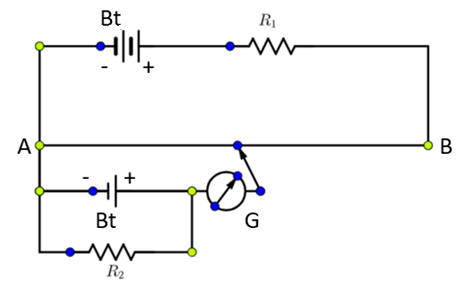
In the diagram $Bt$- batteries, \[{R_1}{R_2}\]- Resistances, $G$- galvanometer.
Note:
The potentiometer is basically measuring the potential difference between the two points but on this basis, it can be used to make several other measurements.
The main advantage of this potentiometer is that it can measure potential differences without drawing a current.
Formula used:
The current through potentiometer wire $I = \dfrac{\varepsilon }{{lr}}$
Where $\varepsilon $ is the emf of the cell, $r$ is the resistance per unit length, $l$ is the balancing length.
Complete step by step answer:
Complete step by step answer:
Given, emf of the cell.
$ \Rightarrow \varepsilon = 1.5V$
Resistance per unit length,
$ \Rightarrow r = 0.1\Omega {m^{ - 1}}$
Balancing length,
\[ \Rightarrow l = 300cm = 3m\]
When the given network or circuit is balanced then there is no current through the galvanometer.
Which implies, the potential difference across the initial length of the wire to the point where it shows balancing length is equal to emf of the secondary cell that is \[1.5V\]
Potential difference across AC = (current through potentiometer wire) $ \times $ (resistance of the potentiometer wire of length AC).
Therefore, $r$ is the resistance per unit length of the wire and $I$ is the current passing through wire, then
$Ilr = \varepsilon $
$I = \dfrac{\varepsilon }{{lr}}$
$ \Rightarrow \dfrac{{1.5}}{{3 \times 0.1}}$
$\therefore 5A$
Thus, the current through potentiometer wire is $5A$.
Additional information:
The potentiometer consists of a wooden board on which many numbers of uniform wires are stretched parallel to each other. The wire is made of manganin or nichrome. The end terminals of the wires are provided with a connecting screw. A meter scale is fixed on the wooden board parallel to wires. A jockey or sliding contact is provided with the arrangement. The jockey has a pointer which can slide over the meter scale. In Figures A and C are the ends of the wire.
if a wire of uniform area of cross-section is carrying a steady current then fall of potential across any portion of the wire is directly proportional to the length of that portion. $\varepsilon = \phi l$
In the diagram $Bt$- batteries, \[{R_1}{R_2}\]- Resistances, $G$- galvanometer.
Note:
The potentiometer is basically measuring the potential difference between the two points but on this basis, it can be used to make several other measurements.
The main advantage of this potentiometer is that it can measure potential differences without drawing a current.
Recently Updated Pages
Master Class 12 Economics: Engaging Questions & Answers for Success

Master Class 12 English: Engaging Questions & Answers for Success
Master Class 12 Social Science: Engaging Questions & Answers for Success
Master Class 12 Maths: Engaging Questions & Answers for Success
Master Class 12 Physics: Engaging Questions & Answers for Success
Master Class 9 General Knowledge: Engaging Questions & Answers for Success
Trending doubts
Which are the Top 10 Largest Countries of the World?
Draw a labelled sketch of the human eye class 12 physics CBSE
Differentiate between homogeneous and heterogeneous class 12 chemistry CBSE
Sulphuric acid is known as the king of acids State class 12 chemistry CBSE
Why is the cell called the structural and functional class 12 biology CBSE
Draw ray diagrams each showing i myopic eye and ii class 12 physics CBSE