




A positively charged body has deficiency of:
(A) electrons
(B) protons
(C) neutrons
(D) holes
Answer
 Verified
588.3k+ views
Hint: Charge is a property of matter by the virtue of which all types of electric and magnetic phenomenon are produced. Naturally everybody is made of atoms in which both positive and negative charge are there in the form of electrons and protons are in equal quantity that’s why by nature everybody is electrically neutral. Body can be charged by exchange of electrons only.
Complete answer:
All matter is made up of tiny indivisible units called atoms. Naturally all atoms are electrically neutral; it means having equal amounts of positive and negative charge. In common practice a body can be charged by the exchange of electrons as protons are confined within the nucleus of an atom and in general cases it requires a huge amount of energy to extract or add a single proton from the nucleus of an atom which is classically not possible.
In general whenever we talk about a positively charged body then it means the body is electron deficient and if we talk about a negatively charged body then we consider there are excess electrons on the body.
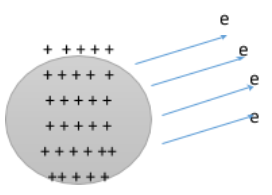
Hence option (A) is the correct answer.
Note: When a body is charged in the state of rest or motion it exhibits several different phenomena and effects, applications of which are used in many practical cases in our surrounding. All the phenomena concerned with charges including electricity and magnetism are broadly classified into two parts- Electrostatics and Electrodynamics. Electrostatics deals with the study, effects and the applications of charges at rest.
Complete answer:
All matter is made up of tiny indivisible units called atoms. Naturally all atoms are electrically neutral; it means having equal amounts of positive and negative charge. In common practice a body can be charged by the exchange of electrons as protons are confined within the nucleus of an atom and in general cases it requires a huge amount of energy to extract or add a single proton from the nucleus of an atom which is classically not possible.
In general whenever we talk about a positively charged body then it means the body is electron deficient and if we talk about a negatively charged body then we consider there are excess electrons on the body.
Hence option (A) is the correct answer.
Note: When a body is charged in the state of rest or motion it exhibits several different phenomena and effects, applications of which are used in many practical cases in our surrounding. All the phenomena concerned with charges including electricity and magnetism are broadly classified into two parts- Electrostatics and Electrodynamics. Electrostatics deals with the study, effects and the applications of charges at rest.
Recently Updated Pages
Master Class 12 Business Studies: Engaging Questions & Answers for Success

Master Class 12 Chemistry: Engaging Questions & Answers for Success
Master Class 12 Biology: Engaging Questions & Answers for Success
Class 12 Question and Answer - Your Ultimate Solutions Guide
Master Class 11 English: Engaging Questions & Answers for Success
Master Class 11 Maths: Engaging Questions & Answers for Success
Trending doubts
Which is more stable and why class 12 chemistry CBSE
Which are the Top 10 Largest Countries of the World?
Draw a labelled sketch of the human eye class 12 physics CBSE
Differentiate between homogeneous and heterogeneous class 12 chemistry CBSE
What are the major means of transport Explain each class 12 social science CBSE
Sulphuric acid is known as the king of acids State class 12 chemistry CBSE