




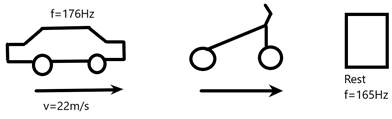
A police car moving at 22 \[m{{s}^{-1}}\] chases a motorcyclist. The policeman sounds his horn at 176 Hz, while both of them move towards a stationary siren frequency 165 Hz. Calculate the speed of the motorcyclist, if he does not observe any beats (velocity of sound in air is 330 \[m{{s}^{-1}}\]).
A) 33 \[m{{s}^{-1}}\]
B) 22 \[m{{s}^{-1}}\]
C) Zero
D) 11 \[m{{s}^{-1}}\]
Answer
 Verified
561.6k+ views
Hint: We need to understand the dependence of the motion of a listener and source with the resultant frequency of sound heard by the listener. Here, two sources which are in relative motion are to be considered for the same in order to solve.
Complete Solution Step-by-Step:
We are given that a police car is moving with a siren towards a bike which is moving away from the car. Both these vehicles are moving towards a stationary source of sound. We need to calculate the speed of the motorcyclist when he doesn’t here beat due to the two sound frequencies.
We need to use the Doppler’s apparent frequency method to find the solution here.
Consider the police car and the bike. The apparent frequency heard by the motorcyclist can be given as –
\[\begin{align}
& f'=f\left( \dfrac{v-{{v}_{l}}}{v-{{v}_{s}}} \right) \\
& \therefore f'={{f}_{siren}}\left( \dfrac{v-{{v}_{m}}}{v-{{v}_{p}}} \right) \\
\end{align}\]
Where, f’ is the apparent frequency heard by the motorcyclist due to the siren, \[{{v}_{m}}\] is the velocity of the motorcycle, \[{{v}_{p}}\] is the velocity of the police car and v is the velocity of sound in air.
Now, consider the motorcycle and the stationary sound, i.e.,
\[f''=f\left( \dfrac{v+{{v}_{m}}}{v} \right)\]
We are told that the two sounds don’t produce a beat for the motorcyclist. Therefore, the difference between them should be zero. i.e.,
\[\begin{align}
& f''=f' \\
& \Rightarrow f\left( \dfrac{v+{{v}_{m}}}{v} \right)={{f}_{siren}}\left( \dfrac{v-{{v}_{m}}}{v-{{v}_{p}}} \right) \\
& \text{given,} \\
& {{f}_{siren}}=176Hz,f=165Hz,v=330m{{s}^{-1}},{{v}_{p}}=22m{{s}^{-1}} \\
& \Rightarrow 165\left( \dfrac{330+{{v}_{m}}}{330} \right)=176\left( \dfrac{330-{{v}_{m}}}{330-22} \right) \\
& \Rightarrow \dfrac{330+{{v}_{m}}}{330-{{v}_{m}}}=\dfrac{176}{165}\times \dfrac{330}{308} \\
& \Rightarrow \dfrac{330+{{v}_{m}}}{330-{{v}_{m}}}=\dfrac{8}{7} \\
& \Rightarrow 2310+7{{v}_{m}}=2640-8{{v}_{m}} \\
& \Rightarrow 15{{v}_{m}}=330 \\
& \therefore {{v}_{m}}=22m{{s}^{-1}} \\
\end{align}\]
So, the police car and the motorcyclist are moving at the same speed.
The correct answer is option B.
Note:
We can see that the motorcyclist and the police car are moving at the same speed. In this case, there is no relative motion between the two – the source and the listener, i.e., the frequency will be the same for both the people irrespective of the gap between them, which is always a constant.
Complete Solution Step-by-Step:
We are given that a police car is moving with a siren towards a bike which is moving away from the car. Both these vehicles are moving towards a stationary source of sound. We need to calculate the speed of the motorcyclist when he doesn’t here beat due to the two sound frequencies.
We need to use the Doppler’s apparent frequency method to find the solution here.
Consider the police car and the bike. The apparent frequency heard by the motorcyclist can be given as –
\[\begin{align}
& f'=f\left( \dfrac{v-{{v}_{l}}}{v-{{v}_{s}}} \right) \\
& \therefore f'={{f}_{siren}}\left( \dfrac{v-{{v}_{m}}}{v-{{v}_{p}}} \right) \\
\end{align}\]
Where, f’ is the apparent frequency heard by the motorcyclist due to the siren, \[{{v}_{m}}\] is the velocity of the motorcycle, \[{{v}_{p}}\] is the velocity of the police car and v is the velocity of sound in air.
Now, consider the motorcycle and the stationary sound, i.e.,
\[f''=f\left( \dfrac{v+{{v}_{m}}}{v} \right)\]
We are told that the two sounds don’t produce a beat for the motorcyclist. Therefore, the difference between them should be zero. i.e.,
\[\begin{align}
& f''=f' \\
& \Rightarrow f\left( \dfrac{v+{{v}_{m}}}{v} \right)={{f}_{siren}}\left( \dfrac{v-{{v}_{m}}}{v-{{v}_{p}}} \right) \\
& \text{given,} \\
& {{f}_{siren}}=176Hz,f=165Hz,v=330m{{s}^{-1}},{{v}_{p}}=22m{{s}^{-1}} \\
& \Rightarrow 165\left( \dfrac{330+{{v}_{m}}}{330} \right)=176\left( \dfrac{330-{{v}_{m}}}{330-22} \right) \\
& \Rightarrow \dfrac{330+{{v}_{m}}}{330-{{v}_{m}}}=\dfrac{176}{165}\times \dfrac{330}{308} \\
& \Rightarrow \dfrac{330+{{v}_{m}}}{330-{{v}_{m}}}=\dfrac{8}{7} \\
& \Rightarrow 2310+7{{v}_{m}}=2640-8{{v}_{m}} \\
& \Rightarrow 15{{v}_{m}}=330 \\
& \therefore {{v}_{m}}=22m{{s}^{-1}} \\
\end{align}\]
So, the police car and the motorcyclist are moving at the same speed.
The correct answer is option B.
Note:
We can see that the motorcyclist and the police car are moving at the same speed. In this case, there is no relative motion between the two – the source and the listener, i.e., the frequency will be the same for both the people irrespective of the gap between them, which is always a constant.
Recently Updated Pages
Master Class 12 Economics: Engaging Questions & Answers for Success

Master Class 12 Physics: Engaging Questions & Answers for Success
Master Class 12 English: Engaging Questions & Answers for Success
Master Class 12 Social Science: Engaging Questions & Answers for Success
Master Class 12 Maths: Engaging Questions & Answers for Success
Master Class 12 Business Studies: Engaging Questions & Answers for Success
Trending doubts
Which are the Top 10 Largest Countries of the World?
What are the major means of transport Explain each class 12 social science CBSE
Draw a labelled sketch of the human eye class 12 physics CBSE
Why cannot DNA pass through cell membranes class 12 biology CBSE
Differentiate between insitu conservation and exsitu class 12 biology CBSE
Draw a neat and well labeled diagram of TS of ovary class 12 biology CBSE