




A polaroid making an angle 60° with electric vector then intensity reduced by a factor of:-
A.$\dfrac {1}{4}$
B.$\dfrac {3}{4}$
C.$\dfrac {1}{2}$
D.$\dfrac {1}{3}$
Answer
 Verified
618.9k+ views
Hint: To solve this problem, use the equation for Malus’s law. It states that when completely plane polarized light incidents on an analyzer, the intensity of the light transmitted by the analyzer is directly proportional to the square of the cosine of angle between transmission axes of polarizer and analyzer. Substitute the value in the equation and find the factor by which intensity decreases.
Formula used:
$I ={I}_{0} {\cos}^{2}{\theta}$
Complete answer:
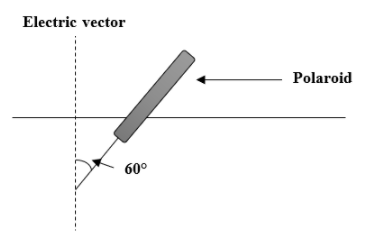
Given: $\theta$ = 60°
Malus’s law is given by,
$I ={I}_{0} {\cos}^{2}{\theta}$
Where, I is the intensity after polarization
${I}_{0}$ is the initial intensity
Substituting the value in above equation we get,
$I ={I}_{0}\times {\cos}^{2}{60°}$
$\Rightarrow I ={I}_{0}\times \dfrac {1}{4}$
$\Rightarrow \dfrac {I}{{I}_{0}}= \dfrac {1}{4}$
Hence, the intensity is reduced by a factor of $\dfrac {1}{4}$.
So, the correct answer is option A i.e. $\dfrac {1}{4}$.
Additional Information:
Polaroids are the materials used to restrict vibrations of waves from many planes to a single plane. The unpolarized lights are not confined to any particular plane, So, to restrict these vibrations to a single plane polaroid are used. It passes only the waves which vibrate in a single plane.
Note:
If the $\theta$= 0 or 180°, then $I = {I}_{0}$. That is the intensity of transmitted light is maximum when transmission axes of analyzer and polarizer are parallel to each other. Initial intensity and initial after polarization remain the same.
If the $\theta$= 90°, then $I = 0$. That is the intensity of transmitted light is minimum when transmission axes of analyzer and polarizer are perpendicular to each other. The intensity of light after polarization becomes zero.
Formula used:
$I ={I}_{0} {\cos}^{2}{\theta}$
Complete answer:
Given: $\theta$ = 60°
Malus’s law is given by,
$I ={I}_{0} {\cos}^{2}{\theta}$
Where, I is the intensity after polarization
${I}_{0}$ is the initial intensity
Substituting the value in above equation we get,
$I ={I}_{0}\times {\cos}^{2}{60°}$
$\Rightarrow I ={I}_{0}\times \dfrac {1}{4}$
$\Rightarrow \dfrac {I}{{I}_{0}}= \dfrac {1}{4}$
Hence, the intensity is reduced by a factor of $\dfrac {1}{4}$.
So, the correct answer is option A i.e. $\dfrac {1}{4}$.
Additional Information:
Polaroids are the materials used to restrict vibrations of waves from many planes to a single plane. The unpolarized lights are not confined to any particular plane, So, to restrict these vibrations to a single plane polaroid are used. It passes only the waves which vibrate in a single plane.
Note:
If the $\theta$= 0 or 180°, then $I = {I}_{0}$. That is the intensity of transmitted light is maximum when transmission axes of analyzer and polarizer are parallel to each other. Initial intensity and initial after polarization remain the same.
If the $\theta$= 90°, then $I = 0$. That is the intensity of transmitted light is minimum when transmission axes of analyzer and polarizer are perpendicular to each other. The intensity of light after polarization becomes zero.
Recently Updated Pages
Master Class 12 Business Studies: Engaging Questions & Answers for Success

Master Class 12 Chemistry: Engaging Questions & Answers for Success
Master Class 12 Biology: Engaging Questions & Answers for Success
Class 12 Question and Answer - Your Ultimate Solutions Guide
Master Class 11 English: Engaging Questions & Answers for Success
Master Class 11 Social Science: Engaging Questions & Answers for Success
Trending doubts
Which are the Top 10 Largest Countries of the World?
Draw a labelled sketch of the human eye class 12 physics CBSE
Differentiate between homogeneous and heterogeneous class 12 chemistry CBSE
Why is the cell called the structural and functional class 12 biology CBSE
Draw ray diagrams each showing i myopic eye and ii class 12 physics CBSE
Which is the correct genotypic ratio of mendel dihybrid class 12 biology CBSE