




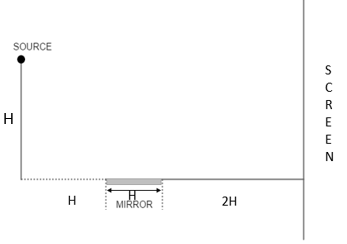
A point source has been placed as shown in figure. What is the length on the screen that will receive reflected light from the mirror?
A) 2H
B) 3H
C) H
D) None
Answer
 Verified
610.5k+ views
Hint: A point source is to be reflected along the mirror. The reflected ray will be obtained on the screen. With the help of triangles and equal angles, we can find the length of the screen, which will receive the reflected light.
Complete answer:
As we know that, a point source has been placed H distance from a perpendicular plane along which a mirror has been placed vertically H distance from the point source (E).
Firstly, we obtain the path of incident light and reflected light. In the figure, we see that when light rays EA and EG from point E are incident on the mirror AG, it is reflected on the screen at point C and D respectively.
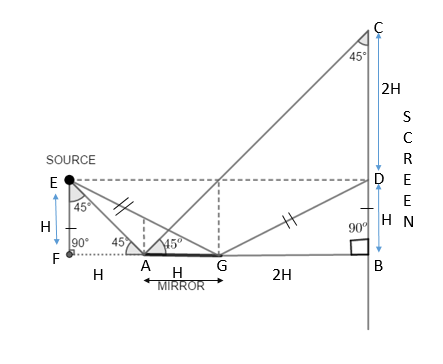
As EF and FA are both equal to H distance and \[\angle \text{EFA}={{90}^{\text{o}}}\], so \[\angle \text{FEA}=\angle \text{EAF}={{45}^{\text{o}}}\]
Now, \[\angle \text{EAC}={{90}^{\text{o}}}\], so \[\angle \text{CAB}={{45}^{\text{o}}}\]
In \[\Delta \text{CAB}\], \[\angle \text{CBA}={{90}^{\text{o}}}\] and \[\angle \text{CAB}={{45}^{\text{o}}}\], so \[\angle \text{BCA}={{45}^{\text{o}}}\].
Therefore, \[\Delta \text{CAB}\] is isosceles. As AB = 3H so, \[\text{AB}=\text{BC}=3\text{H}\]
From the figure, point D is formed directly opposite to E, on the screen, at H distance from B.
Therefore,
\[\begin{align}
& \text{BC}=\text{CD + DB }=\text{ }3\text{H} \\
& \text{CD}=\text{2H} \\
\end{align}\]
Therefore, option A is the correct option.
Note:
While drawing the diagram, we should be careful with the scaling. Try taking H = 2 cm, then 2H = 4 cm. Then the screen will be horizontally 4H = 8 cm from the source, and the screen will be 3H = 6 cm in height. Then the incident and reflected light ray will be at the appropriate angle.
Complete answer:
As we know that, a point source has been placed H distance from a perpendicular plane along which a mirror has been placed vertically H distance from the point source (E).
Firstly, we obtain the path of incident light and reflected light. In the figure, we see that when light rays EA and EG from point E are incident on the mirror AG, it is reflected on the screen at point C and D respectively.
As EF and FA are both equal to H distance and \[\angle \text{EFA}={{90}^{\text{o}}}\], so \[\angle \text{FEA}=\angle \text{EAF}={{45}^{\text{o}}}\]
Now, \[\angle \text{EAC}={{90}^{\text{o}}}\], so \[\angle \text{CAB}={{45}^{\text{o}}}\]
In \[\Delta \text{CAB}\], \[\angle \text{CBA}={{90}^{\text{o}}}\] and \[\angle \text{CAB}={{45}^{\text{o}}}\], so \[\angle \text{BCA}={{45}^{\text{o}}}\].
Therefore, \[\Delta \text{CAB}\] is isosceles. As AB = 3H so, \[\text{AB}=\text{BC}=3\text{H}\]
From the figure, point D is formed directly opposite to E, on the screen, at H distance from B.
Therefore,
\[\begin{align}
& \text{BC}=\text{CD + DB }=\text{ }3\text{H} \\
& \text{CD}=\text{2H} \\
\end{align}\]
Therefore, option A is the correct option.
Note:
While drawing the diagram, we should be careful with the scaling. Try taking H = 2 cm, then 2H = 4 cm. Then the screen will be horizontally 4H = 8 cm from the source, and the screen will be 3H = 6 cm in height. Then the incident and reflected light ray will be at the appropriate angle.
Recently Updated Pages
Master Class 12 Business Studies: Engaging Questions & Answers for Success

Master Class 12 Chemistry: Engaging Questions & Answers for Success
Master Class 12 Biology: Engaging Questions & Answers for Success
Class 12 Question and Answer - Your Ultimate Solutions Guide
Master Class 11 English: Engaging Questions & Answers for Success
Master Class 11 Social Science: Engaging Questions & Answers for Success
Trending doubts
Which are the Top 10 Largest Countries of the World?
Draw a labelled sketch of the human eye class 12 physics CBSE
Differentiate between homogeneous and heterogeneous class 12 chemistry CBSE
Differentiate between Pyramid of energy and pyramid class 12 biology CBSE
Why is the cell called the structural and functional class 12 biology CBSE
Draw the diagram of the pyramid of energy Explain In class 12 biology CBSE