




A point object is moving on a principal axis of a concave mirror of focal length 24 cm towards the mirror. When it is at a distance of 60 cm from the mirror, its velocity is 9 cm/sec. What is the velocity of the image at that instant?
A. 5 cm/sec
B. 12 cm/sec
C. 4 cm/sec
D. 9 cm/sec
Answer
 Verified
619.5k+ views
Hint: First, we need to find the distance of image $v$, using mirror’ formula, then we can find the velocity of image of the object $v'$ using the formula of velocities of image and the object for a mirror.
Formula used:
Mirror formula:
$\dfrac{1}{v}+\dfrac{1}{u}=\dfrac{1}{f}$, where $v$ is distance of image from the mirror, $u$ is distance of object from the mirror and $f$ is focal length of the mirror.
The second formula we will be using will be:
$\dfrac{v'}{{{v}^{2}}}+\dfrac{u'}{{{u}^{2}}}=0$, where, $v'$is velocity of image and \[u'\]is velocity of the object.
Complete step by step answer:
We can see the following figure of a concave mirror.
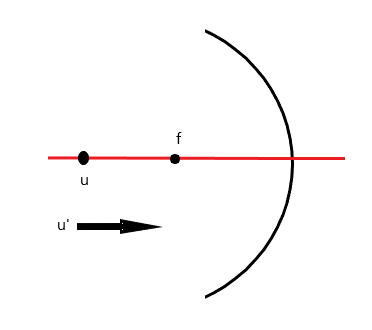
We can see that the sign of $f$and $u$is negative as the right side is taken positive.
Now, using the mirror formula:
$\dfrac{1}{v}+\dfrac{1}{u}=\dfrac{1}{f}$
We can put $f=-24$cm and $u=-60$cm and we will get
$\dfrac{1}{v}-\dfrac{1}{60}=-\dfrac{1}{24}$
Or
$\dfrac{1}{v}=-\left( \dfrac{1}{24}-\dfrac{1}{60} \right)$
Which will give us,
$v=-40$cm.
Now, we can put the values of $u$, $v$and object velocity $u'=9$cm/sec in the velocity formula to get the image velocity $v'$.
$\dfrac{v'}{{{v}^{2}}}+\dfrac{u'}{{{u}^{2}}}=0$
By rearranging the expression, we will get
$v'=-\dfrac{{{v}^{2}}}{{{u}^{2}}}u'$
Or
$v'=-\dfrac{{{40}^{2}}}{{{60}^{2}}}\times 9$
Or
$v'=-\dfrac{1600}{3600}\times 9$
$v'=-4$cm/sec or simply 4 cm/sec
Hence, the correct answer is option C.
Additional Information
The formula used for finding the velocities can be derived by differentiating the mirror formula with respect to time. We can derive it as follows,
$\dfrac{1}{v}+\dfrac{1}{u}=\dfrac{1}{f}$
Now, differentiating with respect to time:
$\dfrac{d}{dt}\left( \dfrac{1}{v} \right)+\dfrac{d}{dt}\left( \dfrac{1}{u} \right)=\dfrac{d}{dt}\left( \dfrac{1}{f} \right)$
We know that $f$is constant for a mirror hence, so will be $\dfrac{1}{f}$. Hence, its derivative will be 0. Furthermore, for a variable function we know that, $\dfrac{d}{dt}\left( \dfrac{1}{g(t)} \right)=-\dfrac{1}{g{{(t)}^{2}}}\left( \dfrac{dg(t)}{dt} \right)$.
So, we get
$-\dfrac{1}{{{v}^{2}}}v'-\dfrac{1}{{{u}^{2}}}u'=0$.
Note:
Students can confuse the lens formula and the mirror formula. The sign convention must be kept in mind while finding the position of the image, otherwise the answer will give an incorrect value.
Formula used:
Mirror formula:
$\dfrac{1}{v}+\dfrac{1}{u}=\dfrac{1}{f}$, where $v$ is distance of image from the mirror, $u$ is distance of object from the mirror and $f$ is focal length of the mirror.
The second formula we will be using will be:
$\dfrac{v'}{{{v}^{2}}}+\dfrac{u'}{{{u}^{2}}}=0$, where, $v'$is velocity of image and \[u'\]is velocity of the object.
Complete step by step answer:
We can see the following figure of a concave mirror.
We can see that the sign of $f$and $u$is negative as the right side is taken positive.
Now, using the mirror formula:
$\dfrac{1}{v}+\dfrac{1}{u}=\dfrac{1}{f}$
We can put $f=-24$cm and $u=-60$cm and we will get
$\dfrac{1}{v}-\dfrac{1}{60}=-\dfrac{1}{24}$
Or
$\dfrac{1}{v}=-\left( \dfrac{1}{24}-\dfrac{1}{60} \right)$
Which will give us,
$v=-40$cm.
Now, we can put the values of $u$, $v$and object velocity $u'=9$cm/sec in the velocity formula to get the image velocity $v'$.
$\dfrac{v'}{{{v}^{2}}}+\dfrac{u'}{{{u}^{2}}}=0$
By rearranging the expression, we will get
$v'=-\dfrac{{{v}^{2}}}{{{u}^{2}}}u'$
Or
$v'=-\dfrac{{{40}^{2}}}{{{60}^{2}}}\times 9$
Or
$v'=-\dfrac{1600}{3600}\times 9$
$v'=-4$cm/sec or simply 4 cm/sec
Hence, the correct answer is option C.
Additional Information
The formula used for finding the velocities can be derived by differentiating the mirror formula with respect to time. We can derive it as follows,
$\dfrac{1}{v}+\dfrac{1}{u}=\dfrac{1}{f}$
Now, differentiating with respect to time:
$\dfrac{d}{dt}\left( \dfrac{1}{v} \right)+\dfrac{d}{dt}\left( \dfrac{1}{u} \right)=\dfrac{d}{dt}\left( \dfrac{1}{f} \right)$
We know that $f$is constant for a mirror hence, so will be $\dfrac{1}{f}$. Hence, its derivative will be 0. Furthermore, for a variable function we know that, $\dfrac{d}{dt}\left( \dfrac{1}{g(t)} \right)=-\dfrac{1}{g{{(t)}^{2}}}\left( \dfrac{dg(t)}{dt} \right)$.
So, we get
$-\dfrac{1}{{{v}^{2}}}v'-\dfrac{1}{{{u}^{2}}}u'=0$.
Note:
Students can confuse the lens formula and the mirror formula. The sign convention must be kept in mind while finding the position of the image, otherwise the answer will give an incorrect value.
Recently Updated Pages
Master Class 12 Business Studies: Engaging Questions & Answers for Success

Master Class 12 Biology: Engaging Questions & Answers for Success
Master Class 12 Chemistry: Engaging Questions & Answers for Success
Class 12 Question and Answer - Your Ultimate Solutions Guide
Master Class 11 Social Science: Engaging Questions & Answers for Success
Master Class 11 English: Engaging Questions & Answers for Success
Trending doubts
Which are the Top 10 Largest Countries of the World?
Draw a labelled sketch of the human eye class 12 physics CBSE
Differentiate between homogeneous and heterogeneous class 12 chemistry CBSE
Sulphuric acid is known as the king of acids State class 12 chemistry CBSE
Why is the cell called the structural and functional class 12 biology CBSE
Which is the correct genotypic ratio of mendel dihybrid class 12 biology CBSE