




A point charge q moves from point P to a point S along a path PQRS in a uniform electric field E pointing parallel to the x-axis. The coordinates of P, Q, R and S are (a,b,0), (2a,0,0), (a,-b,0) and (0,0,0). The work done by the field in the above process is:
A.Zero
B.qEB
C.qEa
D.-qEa
Answer
 Verified
633.6k+ views
Hint: Recall that the work done is a product of the force and the force-induced displacement in the direction of applied force. Also, electric force is a conservative force, so work done by this force is path independent. Using the above two statements, first determine the component of displacement of the charge that is in the direction of the electric field, and finally determine the work done in the direction of the applied field, i.e., along the x-axis.
Formula Used:
Work done $W = \vec{F}.d\vec{r}$
Electric force $\vec{F} = q\vec{E}$
Complete Solution answer:
We have a point charge q that moves in a path as shown in the figure in a uniform electric field directed along the x-axis $\vec{E} = E\hat{x}$,
Recall that the electric field exerts a coulombic force on the moving point charge. This is given as:
$\vec{F} = q\vec{E} = qE\hat{x}$
Now, the work done by this force on q is independent of the path taken, and depends only on the initial and final position of the charge in the field. The charge moves from P to Q to R and finally to S. This means that the work done by the force on the charge as it moves from $P \rightarrow Q \rightarrow R \rightarrow S$ is same as the work done by the force as if the charge moved from $P\rightarrow S$.
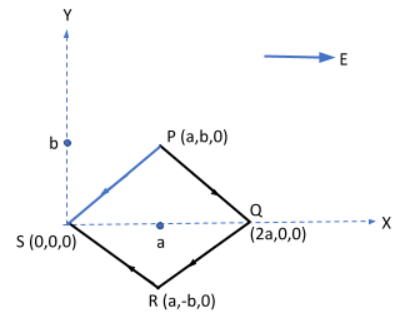
We know that the initial position was P(a,b,0) or ($\vec{P} = a\hat{x}+b\hat{y}+0\hat{z}$), and the final position was S(0,0,0) or ($\vec{S}=0\hat{x}+0\hat{y}+0\hat{z}$). In such a case, the displacement vector of the charge q will be difference in the position vectors at P and S:
$\vec{r} = \vec{PS} = \vec{S} - \vec{P} = (0\hat{x}+0\hat{y}+0\hat{z}) – (a\hat{x}+b\hat{y}+0\hat{z})$
$\Rightarrow \vec{r} = -a\hat{x}-b\hat{y}$
Therefore, the work done by the force can be given as:
Work done $W = \vec{F}.\vec{r} = q(E\hat{x}).(-a\hat{x}-b\hat{y}) = q (E)(-a) = -qEa$
Therefore, the correct choice would be D. -qEa
Note:
It is important to remember the distinction between conservative and non-conservative forces. A conservative force “conserves” the energy of the system by not spending it on collateral processes, whereas a non-conservative force does not shy away from energy expenditures on such processes via heat, sound, light, etc.
Irrespective of the fact that work done is generally a path function, the work done by a conservative force is independent of the path taken and depends only on the initial and final position of the body whereas the work done by a non-conservative force is dependent on the path taken. Note that if the path taken by an object is closed, then the work done by a conservative force is zero, since the displacement of the object is zero.
Formula Used:
Work done $W = \vec{F}.d\vec{r}$
Electric force $\vec{F} = q\vec{E}$
Complete Solution answer:
We have a point charge q that moves in a path as shown in the figure in a uniform electric field directed along the x-axis $\vec{E} = E\hat{x}$,
Recall that the electric field exerts a coulombic force on the moving point charge. This is given as:
$\vec{F} = q\vec{E} = qE\hat{x}$
Now, the work done by this force on q is independent of the path taken, and depends only on the initial and final position of the charge in the field. The charge moves from P to Q to R and finally to S. This means that the work done by the force on the charge as it moves from $P \rightarrow Q \rightarrow R \rightarrow S$ is same as the work done by the force as if the charge moved from $P\rightarrow S$.
We know that the initial position was P(a,b,0) or ($\vec{P} = a\hat{x}+b\hat{y}+0\hat{z}$), and the final position was S(0,0,0) or ($\vec{S}=0\hat{x}+0\hat{y}+0\hat{z}$). In such a case, the displacement vector of the charge q will be difference in the position vectors at P and S:
$\vec{r} = \vec{PS} = \vec{S} - \vec{P} = (0\hat{x}+0\hat{y}+0\hat{z}) – (a\hat{x}+b\hat{y}+0\hat{z})$
$\Rightarrow \vec{r} = -a\hat{x}-b\hat{y}$
Therefore, the work done by the force can be given as:
Work done $W = \vec{F}.\vec{r} = q(E\hat{x}).(-a\hat{x}-b\hat{y}) = q (E)(-a) = -qEa$
Therefore, the correct choice would be D. -qEa
Note:
It is important to remember the distinction between conservative and non-conservative forces. A conservative force “conserves” the energy of the system by not spending it on collateral processes, whereas a non-conservative force does not shy away from energy expenditures on such processes via heat, sound, light, etc.
Irrespective of the fact that work done is generally a path function, the work done by a conservative force is independent of the path taken and depends only on the initial and final position of the body whereas the work done by a non-conservative force is dependent on the path taken. Note that if the path taken by an object is closed, then the work done by a conservative force is zero, since the displacement of the object is zero.
Recently Updated Pages
Explain the structure of megasporangium class 12 biology CBSE

Why is chloroform kept in dark coloured bottles class 12 chemistry CBSE
Derive the balancing condition of a Wheatstone bri class 12 physics CBSE
Draw VI characteristics of a pn junction diode Explain class 12 physics CBSE
Is it possible to carry pride in ones language too class 12 english CBSE
In a population at Hardy Weinberg equilibrium the allele class 12 biology CBSE
Trending doubts
Draw a labelled sketch of the human eye class 12 physics CBSE
Which are the Top 10 Largest Countries of the World?
Draw ray diagrams each showing i myopic eye and ii class 12 physics CBSE
One megawatt is equal to how many units of electri class 12 physics CBSE
Which is the correct genotypic ratio of mendel dihybrid class 12 biology CBSE
Give 10 examples of unisexual and bisexual flowers