




A point charge Q lies on the perpendicular bisector of an electric dipole of dipole p. If the distance of Q from the dipole is r (much larger than the size of the dipole), then the electric field at \[\theta \] is proportional to:
A. \[{P^2}\] and \[{r^{ - 3}}\]
B. \[{P^2}\] and \[{r^{ - 2}}\]
C. \[{P^{ - 1}}\] and \[{r^{ - 3}}\]
D. \[P\] and \[{r^{ - 3}}\]
Answer
 Verified
602.7k+ views
Hint: Express the electric field at point charge Q. It will have only a horizontal component of electric field. In the expression, neglect the higher term of dipole distance. Use the expression for dipole moment , \[p = qa\], where, q is the charge and a is the dipole distance.
Formula used:
The electric field at a distance r from the point charge q is expressed as,
\[E = \dfrac{1}{{4\pi {\varepsilon _0}}}\dfrac{q}{{{r^2}}}\]
Here, \[{\varepsilon _0}\] is the permittivity of the free space.
Complete step by step answer:
We have given that the point charge Q lies on the perpendicular bisector and the distance between the point charge Q and dipole is much larger than the size of the dipole as shown in the figure below.
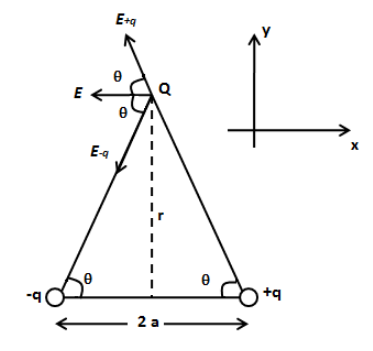
In the above figure, \[{E_{ - q}}\] is the electric field due to charge \[ - q\] and \[{E_{ + q}}\] is the electric field due to charge \[ + q\]. The vertical component of \[{E_{ - q}}\] is along the negative y-axis and vertical component of \[{E_{ + q}}\] is along the positive y-axis. Hence we can say they cancel out. Now, the net electric field of the dipole at point charge Q is due the horizontal components of \[{E_{ + q}}\] and \[{E_{ - q}}\]. Therefore, we see that the electric field at \[\theta \] is the sum of horizontal components of \[{E_{ + q}}\] and \[{E_{ - q}}\].
We can express the magnitude of electric field at point charge Q due to charge \[ - q\] as follows,
\[\left| {{E_{ - q}}} \right| = k\dfrac{q}{{{r^2} + {a^2}}}\] …… (1)
Here, k is the constant and it has the value \[k = \dfrac{1}{{4\pi {\varepsilon _0}}}\].
We can express the magnitude of electric field at point charge Q due to charge \[ + q\] as follows,
\[\left| {{E_{ + q}}} \right| = k\dfrac{q}{{{r^2} + {a^2}}}\] …… (2)
Since the electric field at Q is the sum of horizontal components of electric field along the negative x-axis, we can write,
\[\vec E = \left| {{E_{ + q}}} \right|\cos \theta \left( { - \hat i} \right) + \left| {{E_{ - q}}} \right|\cos \theta \left( { - \hat i} \right)\]
\[ \Rightarrow \vec E = k\dfrac{q}{{{r^2} + {a^2}}}\cos \theta \left( { - \hat i} \right) + k\dfrac{q}{{{r^2} + {a^2}}}\cos \theta \left( { - \hat i} \right)\]
\[ \Rightarrow \vec E = k\dfrac{{2q}}{{{r^2} + {a^2}}}\cos \theta \left( { - \hat i} \right)\] …… (3)
From the trigonometry of the above figure, we can express the \[\cos \theta \] as follows,
\[\cos \theta = \dfrac{a}{{\sqrt {{r^2} + {a^2}} }}\]
Therefore, we can rewrite equation (3) as,
\[\vec E = k\left( {\dfrac{{2q}}{{{r^2} + {a^2}}}} \right)\left( {\dfrac{a}{{\sqrt {{r^2} + {a^2}} }}} \right)\left( { - \hat i} \right)\]
\[ \Rightarrow \vec E = k\dfrac{{2qa}}{{{{\left( {{r^2} + {a^2}} \right)}^{3/2}}}}\left( { - \hat i} \right)\]
But we know that the dipole moment of an electric dipole is expressed as,
\[\hat P = qa\,\hat i\]
Therefore, the above equation becomes,
\[\vec E = - k\dfrac{{2P}}{{{{\left( {{r^2} + {a^2}} \right)}^{3/2}}}}\]
Now, we have given that the distance h is very much larger than the distance a. Therefore, we can neglect the term \[{a^2}\] in the denominator.
\[\vec E = - k\dfrac{{2P}}{{{{\left( {{r^2}} \right)}^{3/2}}}}\]
\[ \therefore \vec E = - k\dfrac{{2P}}{{{r^3}}}\]
Thus, from the above equation, we can infer that the electric field is proportional to P and \[{r^{ - 3}}\].
So, the correct answer is option D.
Note: Remember, dipole moment is a vector quantity which directs from negative charge to positive charge along the dipole. In our solution, since the dipole is along the positive x-axis, we have expressed it as \[\hat P = qa\,\hat i\]. If the negative charge is on the right side and positive on the left, we would have \[\hat P = qa\left( { - \,\hat i} \right)\].
Formula used:
The electric field at a distance r from the point charge q is expressed as,
\[E = \dfrac{1}{{4\pi {\varepsilon _0}}}\dfrac{q}{{{r^2}}}\]
Here, \[{\varepsilon _0}\] is the permittivity of the free space.
Complete step by step answer:
We have given that the point charge Q lies on the perpendicular bisector and the distance between the point charge Q and dipole is much larger than the size of the dipole as shown in the figure below.
In the above figure, \[{E_{ - q}}\] is the electric field due to charge \[ - q\] and \[{E_{ + q}}\] is the electric field due to charge \[ + q\]. The vertical component of \[{E_{ - q}}\] is along the negative y-axis and vertical component of \[{E_{ + q}}\] is along the positive y-axis. Hence we can say they cancel out. Now, the net electric field of the dipole at point charge Q is due the horizontal components of \[{E_{ + q}}\] and \[{E_{ - q}}\]. Therefore, we see that the electric field at \[\theta \] is the sum of horizontal components of \[{E_{ + q}}\] and \[{E_{ - q}}\].
We can express the magnitude of electric field at point charge Q due to charge \[ - q\] as follows,
\[\left| {{E_{ - q}}} \right| = k\dfrac{q}{{{r^2} + {a^2}}}\] …… (1)
Here, k is the constant and it has the value \[k = \dfrac{1}{{4\pi {\varepsilon _0}}}\].
We can express the magnitude of electric field at point charge Q due to charge \[ + q\] as follows,
\[\left| {{E_{ + q}}} \right| = k\dfrac{q}{{{r^2} + {a^2}}}\] …… (2)
Since the electric field at Q is the sum of horizontal components of electric field along the negative x-axis, we can write,
\[\vec E = \left| {{E_{ + q}}} \right|\cos \theta \left( { - \hat i} \right) + \left| {{E_{ - q}}} \right|\cos \theta \left( { - \hat i} \right)\]
\[ \Rightarrow \vec E = k\dfrac{q}{{{r^2} + {a^2}}}\cos \theta \left( { - \hat i} \right) + k\dfrac{q}{{{r^2} + {a^2}}}\cos \theta \left( { - \hat i} \right)\]
\[ \Rightarrow \vec E = k\dfrac{{2q}}{{{r^2} + {a^2}}}\cos \theta \left( { - \hat i} \right)\] …… (3)
From the trigonometry of the above figure, we can express the \[\cos \theta \] as follows,
\[\cos \theta = \dfrac{a}{{\sqrt {{r^2} + {a^2}} }}\]
Therefore, we can rewrite equation (3) as,
\[\vec E = k\left( {\dfrac{{2q}}{{{r^2} + {a^2}}}} \right)\left( {\dfrac{a}{{\sqrt {{r^2} + {a^2}} }}} \right)\left( { - \hat i} \right)\]
\[ \Rightarrow \vec E = k\dfrac{{2qa}}{{{{\left( {{r^2} + {a^2}} \right)}^{3/2}}}}\left( { - \hat i} \right)\]
But we know that the dipole moment of an electric dipole is expressed as,
\[\hat P = qa\,\hat i\]
Therefore, the above equation becomes,
\[\vec E = - k\dfrac{{2P}}{{{{\left( {{r^2} + {a^2}} \right)}^{3/2}}}}\]
Now, we have given that the distance h is very much larger than the distance a. Therefore, we can neglect the term \[{a^2}\] in the denominator.
\[\vec E = - k\dfrac{{2P}}{{{{\left( {{r^2}} \right)}^{3/2}}}}\]
\[ \therefore \vec E = - k\dfrac{{2P}}{{{r^3}}}\]
Thus, from the above equation, we can infer that the electric field is proportional to P and \[{r^{ - 3}}\].
So, the correct answer is option D.
Note: Remember, dipole moment is a vector quantity which directs from negative charge to positive charge along the dipole. In our solution, since the dipole is along the positive x-axis, we have expressed it as \[\hat P = qa\,\hat i\]. If the negative charge is on the right side and positive on the left, we would have \[\hat P = qa\left( { - \,\hat i} \right)\].
Recently Updated Pages
Master Class 12 Economics: Engaging Questions & Answers for Success

Master Class 12 English: Engaging Questions & Answers for Success
Master Class 12 Social Science: Engaging Questions & Answers for Success
Master Class 12 Maths: Engaging Questions & Answers for Success
Master Class 12 Physics: Engaging Questions & Answers for Success
Master Class 12 Business Studies: Engaging Questions & Answers for Success
Trending doubts
Which are the Top 10 Largest Countries of the World?
Draw a labelled sketch of the human eye class 12 physics CBSE
Differentiate between homogeneous and heterogeneous class 12 chemistry CBSE
Sulphuric acid is known as the king of acids State class 12 chemistry CBSE
Why is the cell called the structural and functional class 12 biology CBSE
Draw ray diagrams each showing i myopic eye and ii class 12 physics CBSE