




A point charge $q$ is located at the center of a thin ring of radius $R$ with uniformly distributed charge $-q$. Find the magnitude of the electric field strength vector at the point lying on the axis of the ring at a distance $x$ from its center if $x>>R$.
Answer
 Verified
606.9k+ views
Hint: The net electric field strength at the point lying on the axis of the ring at a distance $x$ is equal to the sum of electric field strengths at that point due to the point charge $q$ at the center of the ring, as well as the ring of uniformly distributed charge $-q$, itself. Since $x>>R$, binomial approximation can be used while simplifying this net electric field strength.
Formula used:
$1){{E}_{c}}=\dfrac{kq}{{{x}^{2}}}$
$2){{E}_{r}}=\dfrac{-kqx}{{{\left( {{x}^{2}}+{{R}^{2}} \right)}^{\dfrac{3}{2}}}}$
$3){{E}_{P}}={{E}_{c}}+{{E}_{r}}$
Complete answer:
We are provided with a point charge $q$, located at the center of a thin ring of radius $R$ with uniformly distributed charge $-q$. We are required to find the magnitude of the electric field strength vector at a point lying on the axis of the ring at a distance $x$ from its center, if $x>>R$.
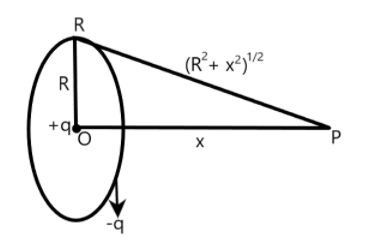
From the diagram given above, it is clear that we have to find the magnitude of electric field strength at point $P$. Also, the center of the ring where a charge $q$ is located is denoted as $O$. The distance between center of the ring $O$ and the point on the axis of the ring $P$ is given by
$OP=x$
and radius of the ring $OR$ is given by
$OR=R$
Now, if we draw a right triangle $ORP$, then
$RP={{({{R}^{2}}+{{x}^{2}})}^{\dfrac{1}{2}}}$
where
$RP$ is the distance of the ring from the point lying on the axis of the ring
The net electric field strength at the point $(P)$, lying on the axis of the ring at a distance $x$ is equal to the sum of electric field strengths at that point due to the point charge $q$ at the center of the ring as well as the ring of uniformly distributed charge $-q$, itself.
If ${{E}_{c}}$ denotes the electric field string at $P$ due to charge $q$at the center of the ring, then, ${{E}_{c}}$ is given by
${{E}_{c}}=\dfrac{kq}{{{x}^{2}}}$
where
${{E}_{c}}$ is the electric field string at point $P$ due to charge $q$
$k=\dfrac{1}{4\pi {{\varepsilon }_{0}}}$, is the electrostatic constant
$q$ is the point charge on the center of the ring $O$
$x$ is the distance between the center of the ring and the point $P$, lying on the axis of the ring $(=OP)$
Let this be equation 1.
Similarly, if ${{E}_{r}}$ represents the electric field strength at $P$ due to the ring of uniformly distributed charge $q$, then, ${{E}_{r}}$ is given by
${{E}_{r}}=\dfrac{k(-q)x}{{{\left( {{x}^{2}}+{{R}^{2}} \right)}^{\dfrac{3}{2}}}}=\dfrac{-kqx}{{{\left( {{x}^{2}}+{{R}^{2}} \right)}^{\dfrac{3}{2}}}}$
where
${{E}_{r}}$ is the electric field string at point $P$ due to the ring of uniformly distributed charge $-q$
$k=\dfrac{1}{4\pi {{\varepsilon }_{0}}}$, is the electrostatic constant
$x$ is the distance between the center of the ring and the point $P$, lying on the axis of the ring $(=OP)$
$R$ is the radius of the ring $(=OR)$
Let this be equation 2.
Now, using equation 1 and equation 2, we have
${{E}_{P}}={{E}_{c}}+{{E}_{r}}=\dfrac{kq}{{{x}^{2}}}-\dfrac{kqx}{{{\left( {{x}^{2}}+{{R}^{2}} \right)}^{\dfrac{3}{2}}}}$
where
${{E}_{P}}$ is the net electric field strength at point $P$
Let this be equation 3.
Simplifying equation 3, we have
\[{{E}_{P}}=\dfrac{kq}{{{x}^{2}}}-\dfrac{kqx}{{{\left( {{x}^{2}}+{{R}^{2}} \right)}^{\dfrac{3}{2}}}}=\dfrac{kq}{{{x}^{3}}}\left( x-\dfrac{x}{{{\left( 1+{{\left( \dfrac{R}{x} \right)}^{2}} \right)}^{\dfrac{3}{2}}}} \right)=\dfrac{kq}{{{x}^{2}}}\left( 1-{{\left( 1+{{\left( \dfrac{R}{x} \right)}^{2}} \right)}^{-\dfrac{3}{2}}} \right)\]
Now, we are given that $x>>R$. Therefore, we have
$x>>R\Rightarrow \dfrac{R}{x}<<1$
Hence, we can use the binomial approximation given by
${{(1+a)}^{-n}}=1-na$ for $a>1$
in the above equation.
Using this binomial approximation in the above simplification of ${{E}_{P}}$, we have
\[{{E}_{P}}=\dfrac{kq}{{{x}^{2}}}\left( 1-{{\left( 1+{{\left( \dfrac{R}{x} \right)}^{2}} \right)}^{-\dfrac{3}{2}}} \right)=\dfrac{kq}{{{x}^{2}}}\left( 1-\left( 1-\dfrac{3}{2}{{\left( \dfrac{R}{x} \right)}^{2}} \right) \right)=\dfrac{kq}{{{x}^{2}}}\left( 1-1+\dfrac{3}{2}{{\left( \dfrac{R}{x} \right)}^{2}} \right)=\dfrac{3kq{{R}^{2}}}{2{{x}^{4}}}\]
Let this be equation 4.
Substituting the expression for electrostatic constant $k=\dfrac{1}{4\pi {{\varepsilon }_{0}}}$ in equation 4, we have
\[{{E}_{P}}=\dfrac{3kq{{R}^{2}}}{2{{x}^{4}}}=\dfrac{3q{{R}^{2}}}{8\pi {{\varepsilon }_{0}}{{x}^{4}}}\]
Therefore, if $x>>R$, the magnitude of electric field strength vector at a point lying on the axis of the ring ( of uniformly distributed charge $-q$), at a distance $x$ from its center (of charge $q$) is equal to \[\dfrac{3q{{R}^{2}}}{8\pi {{\varepsilon }_{0}}{{x}^{4}}}\].
Note:
Students need to be aware of the formula for electric field strength due to a ring or a coil, at a point on the axis of the ring or the coil. As already mentioned, it is given by
$E=\dfrac{kqx}{{{\left( {{x}^{2}}+{{R}^{2}} \right)}^{\dfrac{3}{2}}}}$
where
$E$ is the electric field strength due to a ring carrying a charge $q$ at a point on the axis of the ring
$x$ is the distance of the point on the axis of the ring from the center of the ring
$R$ is the radius of the ring
$k=\dfrac{1}{4\pi {{\varepsilon }_{0}}}$, is the electrostatic constant
This is a standard definition and can be easily derived by considering a small charge element $(dq)$on the ring and deducing the electric field strength due to this charge element at a point on the axis of the ring. Integrating this field strength over the circumference of the ring will give the expression for field strength due to the whole ring at this point on its axis, as given above.
Formula used:
$1){{E}_{c}}=\dfrac{kq}{{{x}^{2}}}$
$2){{E}_{r}}=\dfrac{-kqx}{{{\left( {{x}^{2}}+{{R}^{2}} \right)}^{\dfrac{3}{2}}}}$
$3){{E}_{P}}={{E}_{c}}+{{E}_{r}}$
Complete answer:
We are provided with a point charge $q$, located at the center of a thin ring of radius $R$ with uniformly distributed charge $-q$. We are required to find the magnitude of the electric field strength vector at a point lying on the axis of the ring at a distance $x$ from its center, if $x>>R$.
From the diagram given above, it is clear that we have to find the magnitude of electric field strength at point $P$. Also, the center of the ring where a charge $q$ is located is denoted as $O$. The distance between center of the ring $O$ and the point on the axis of the ring $P$ is given by
$OP=x$
and radius of the ring $OR$ is given by
$OR=R$
Now, if we draw a right triangle $ORP$, then
$RP={{({{R}^{2}}+{{x}^{2}})}^{\dfrac{1}{2}}}$
where
$RP$ is the distance of the ring from the point lying on the axis of the ring
The net electric field strength at the point $(P)$, lying on the axis of the ring at a distance $x$ is equal to the sum of electric field strengths at that point due to the point charge $q$ at the center of the ring as well as the ring of uniformly distributed charge $-q$, itself.
If ${{E}_{c}}$ denotes the electric field string at $P$ due to charge $q$at the center of the ring, then, ${{E}_{c}}$ is given by
${{E}_{c}}=\dfrac{kq}{{{x}^{2}}}$
where
${{E}_{c}}$ is the electric field string at point $P$ due to charge $q$
$k=\dfrac{1}{4\pi {{\varepsilon }_{0}}}$, is the electrostatic constant
$q$ is the point charge on the center of the ring $O$
$x$ is the distance between the center of the ring and the point $P$, lying on the axis of the ring $(=OP)$
Let this be equation 1.
Similarly, if ${{E}_{r}}$ represents the electric field strength at $P$ due to the ring of uniformly distributed charge $q$, then, ${{E}_{r}}$ is given by
${{E}_{r}}=\dfrac{k(-q)x}{{{\left( {{x}^{2}}+{{R}^{2}} \right)}^{\dfrac{3}{2}}}}=\dfrac{-kqx}{{{\left( {{x}^{2}}+{{R}^{2}} \right)}^{\dfrac{3}{2}}}}$
where
${{E}_{r}}$ is the electric field string at point $P$ due to the ring of uniformly distributed charge $-q$
$k=\dfrac{1}{4\pi {{\varepsilon }_{0}}}$, is the electrostatic constant
$x$ is the distance between the center of the ring and the point $P$, lying on the axis of the ring $(=OP)$
$R$ is the radius of the ring $(=OR)$
Let this be equation 2.
Now, using equation 1 and equation 2, we have
${{E}_{P}}={{E}_{c}}+{{E}_{r}}=\dfrac{kq}{{{x}^{2}}}-\dfrac{kqx}{{{\left( {{x}^{2}}+{{R}^{2}} \right)}^{\dfrac{3}{2}}}}$
where
${{E}_{P}}$ is the net electric field strength at point $P$
Let this be equation 3.
Simplifying equation 3, we have
\[{{E}_{P}}=\dfrac{kq}{{{x}^{2}}}-\dfrac{kqx}{{{\left( {{x}^{2}}+{{R}^{2}} \right)}^{\dfrac{3}{2}}}}=\dfrac{kq}{{{x}^{3}}}\left( x-\dfrac{x}{{{\left( 1+{{\left( \dfrac{R}{x} \right)}^{2}} \right)}^{\dfrac{3}{2}}}} \right)=\dfrac{kq}{{{x}^{2}}}\left( 1-{{\left( 1+{{\left( \dfrac{R}{x} \right)}^{2}} \right)}^{-\dfrac{3}{2}}} \right)\]
Now, we are given that $x>>R$. Therefore, we have
$x>>R\Rightarrow \dfrac{R}{x}<<1$
Hence, we can use the binomial approximation given by
${{(1+a)}^{-n}}=1-na$ for $a>1$
in the above equation.
Using this binomial approximation in the above simplification of ${{E}_{P}}$, we have
\[{{E}_{P}}=\dfrac{kq}{{{x}^{2}}}\left( 1-{{\left( 1+{{\left( \dfrac{R}{x} \right)}^{2}} \right)}^{-\dfrac{3}{2}}} \right)=\dfrac{kq}{{{x}^{2}}}\left( 1-\left( 1-\dfrac{3}{2}{{\left( \dfrac{R}{x} \right)}^{2}} \right) \right)=\dfrac{kq}{{{x}^{2}}}\left( 1-1+\dfrac{3}{2}{{\left( \dfrac{R}{x} \right)}^{2}} \right)=\dfrac{3kq{{R}^{2}}}{2{{x}^{4}}}\]
Let this be equation 4.
Substituting the expression for electrostatic constant $k=\dfrac{1}{4\pi {{\varepsilon }_{0}}}$ in equation 4, we have
\[{{E}_{P}}=\dfrac{3kq{{R}^{2}}}{2{{x}^{4}}}=\dfrac{3q{{R}^{2}}}{8\pi {{\varepsilon }_{0}}{{x}^{4}}}\]
Therefore, if $x>>R$, the magnitude of electric field strength vector at a point lying on the axis of the ring ( of uniformly distributed charge $-q$), at a distance $x$ from its center (of charge $q$) is equal to \[\dfrac{3q{{R}^{2}}}{8\pi {{\varepsilon }_{0}}{{x}^{4}}}\].
Note:
Students need to be aware of the formula for electric field strength due to a ring or a coil, at a point on the axis of the ring or the coil. As already mentioned, it is given by
$E=\dfrac{kqx}{{{\left( {{x}^{2}}+{{R}^{2}} \right)}^{\dfrac{3}{2}}}}$
where
$E$ is the electric field strength due to a ring carrying a charge $q$ at a point on the axis of the ring
$x$ is the distance of the point on the axis of the ring from the center of the ring
$R$ is the radius of the ring
$k=\dfrac{1}{4\pi {{\varepsilon }_{0}}}$, is the electrostatic constant
This is a standard definition and can be easily derived by considering a small charge element $(dq)$on the ring and deducing the electric field strength due to this charge element at a point on the axis of the ring. Integrating this field strength over the circumference of the ring will give the expression for field strength due to the whole ring at this point on its axis, as given above.
Recently Updated Pages
Master Class 12 Business Studies: Engaging Questions & Answers for Success

Master Class 12 Chemistry: Engaging Questions & Answers for Success
Master Class 12 Biology: Engaging Questions & Answers for Success
Class 12 Question and Answer - Your Ultimate Solutions Guide
Master Class 11 English: Engaging Questions & Answers for Success
Master Class 11 Maths: Engaging Questions & Answers for Success
Trending doubts
Which is more stable and why class 12 chemistry CBSE
Which are the Top 10 Largest Countries of the World?
Draw a labelled sketch of the human eye class 12 physics CBSE
Differentiate between homogeneous and heterogeneous class 12 chemistry CBSE
What are the major means of transport Explain each class 12 social science CBSE
Sulphuric acid is known as the king of acids State class 12 chemistry CBSE