




A point charge $50\mu C$ is located in the $XY$ plane at the point of position vector ${\vec r_0} = 2\hat i + 3\hat j$. What is the electric field at the point vector ${\vec r_0} = 8\hat i - 5\hat j$.
(A) $1200\,V/m$
(B) $0.04\,V/m$
(C) $900\,V/m$
(D) $4500\,V/m$
Answer
 Verified
603k+ views
Hint:From the given two vectors, calculate the distance between the charge and the point where the electric field is calculated by subtracting those vectors. Use the formula of the distance calculated to substitute in the formula and calculate the value of the electric field.
Useful formula:
The electric field due to a point charge is given by
$E = \dfrac{q}{{4\pi { \in _0}{r^2}}}$
Where $E$ is the electric field due to a point charge, $q$ is the charge, ${ \in _0}$ is the permittivity of the free space and $r$ is the distance of the point from the charge.
Complete step by step solution:
First, the distance of the point from the charge is to be calculated. Taking the two vectors given for calculating the value of $r$.
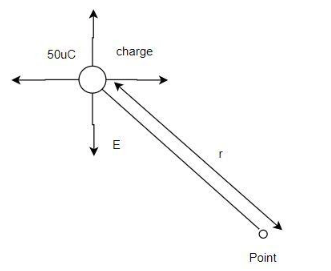
${\vec r_{}} = \left( {8 - 2} \right)\hat i - \left( {5 + 3} \right)\hat j$
Subtracting these two vectors gives the distance between them.
$\vec r = 6\hat i - 8\hat j$
In order to remove the vectors on both sides, take the modulus on both sides.
$\left| {\vec r} \right| = \left| {6\hat i - 8\hat j} \right|$
$r = \sqrt {\left( {{6^2} + {8^2}} \right)} $
By performing the simplification,
$r = 10\,m$
By using the formula of the electric field due to the point charge and substituting the required parameters there.
$E = \dfrac{{50 \times {{10}^{ - 6}}}}{{4\pi \times 8.854 \times {{10}^{ - 12}} \times {{10}^2}}}$
By performing the basic arithmetic operation,
$E = \dfrac{{50}}{{4 \times 3.14 \times 8.854 \times {{10}^{ - 4}}}}$
$E = 4496.15\,V{m^{ - 1}}$
$E \approx 4500\,V{m^{ - 1}}$.
Hence the electric field due to the point charge is $4500\,V{m^{ - 1}}$
Thus the option (D) is correct.
Note:The charge is given as $50\mu C$. It must be converted into coulomb to calculate in the formula as $50 \times {10^{ - 6\,}}\,C$. This is because micro denotes the value of ${10^{ - 6}}$. Remember that in order to calculate the distance between two vectors, the vector of the charge must be subtracted from the vector of the point.
Useful formula:
The electric field due to a point charge is given by
$E = \dfrac{q}{{4\pi { \in _0}{r^2}}}$
Where $E$ is the electric field due to a point charge, $q$ is the charge, ${ \in _0}$ is the permittivity of the free space and $r$ is the distance of the point from the charge.
Complete step by step solution:
First, the distance of the point from the charge is to be calculated. Taking the two vectors given for calculating the value of $r$.
${\vec r_{}} = \left( {8 - 2} \right)\hat i - \left( {5 + 3} \right)\hat j$
Subtracting these two vectors gives the distance between them.
$\vec r = 6\hat i - 8\hat j$
In order to remove the vectors on both sides, take the modulus on both sides.
$\left| {\vec r} \right| = \left| {6\hat i - 8\hat j} \right|$
$r = \sqrt {\left( {{6^2} + {8^2}} \right)} $
By performing the simplification,
$r = 10\,m$
By using the formula of the electric field due to the point charge and substituting the required parameters there.
$E = \dfrac{{50 \times {{10}^{ - 6}}}}{{4\pi \times 8.854 \times {{10}^{ - 12}} \times {{10}^2}}}$
By performing the basic arithmetic operation,
$E = \dfrac{{50}}{{4 \times 3.14 \times 8.854 \times {{10}^{ - 4}}}}$
$E = 4496.15\,V{m^{ - 1}}$
$E \approx 4500\,V{m^{ - 1}}$.
Hence the electric field due to the point charge is $4500\,V{m^{ - 1}}$
Thus the option (D) is correct.
Note:The charge is given as $50\mu C$. It must be converted into coulomb to calculate in the formula as $50 \times {10^{ - 6\,}}\,C$. This is because micro denotes the value of ${10^{ - 6}}$. Remember that in order to calculate the distance between two vectors, the vector of the charge must be subtracted from the vector of the point.
Recently Updated Pages
Master Class 12 Business Studies: Engaging Questions & Answers for Success

Master Class 12 Biology: Engaging Questions & Answers for Success
Master Class 12 Chemistry: Engaging Questions & Answers for Success
Class 12 Question and Answer - Your Ultimate Solutions Guide
Master Class 11 Social Science: Engaging Questions & Answers for Success
Master Class 11 English: Engaging Questions & Answers for Success
Trending doubts
Which is more stable and why class 12 chemistry CBSE
Which are the Top 10 Largest Countries of the World?
Draw a labelled sketch of the human eye class 12 physics CBSE
Differentiate between homogeneous and heterogeneous class 12 chemistry CBSE
What are the major means of transport Explain each class 12 social science CBSE
Sulphuric acid is known as the king of acids State class 12 chemistry CBSE