




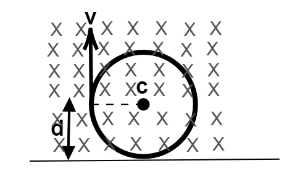
A plane metallic sheet is placed with its face parallel to lines of the magnetic induction $ B $ of a uniform field. A particle of mass $ m $ and charge $ q $ is projected with a velocity $ v $ from a distance $ d $ from the plane normal to the lines of induction. Then the maximum velocity of projection for which the particle does not hit the plane is,
(A) $ \dfrac{{2Bqd}}{m} $
(B) $ \dfrac{{Bqd}}{m} $
(C) $ \dfrac{{Bqd}}{{2m}} $
(D) $ \dfrac{{2Bqm}}{d} $
Answer
 Verified
562.8k+ views
Hint: In the diagram, the bottom line represents the plane metallic sheet that is faced parallel to the magnetic field lines. If a charge is projected upwards, the magnetic force acts on it and deflects it in such a way that it follows a circular path, the radius of this path depends on the velocity of the charged particles, therefore the maximum radius of this circle can be $ d $ .
Complete Step by step solution:
It is given in the question that,
The magnetic field strength is, $ B $
The mass of the particle is, $ m $
The charge of the particle is, $ q $
Let the velocity of the particle be $ v $ , and the distance from where it is projected be $ d $ .
Then this charge will experience a force in a direction perpendicular to both the direction of the magnetic field and the velocity of charge, which will cause it to follow a circular path.
This force is given by,
$ F = qvB\sin \theta $
Where $ \theta $ is the angle between the velocity of the particle and the magnetic field lines, since it moves perpendicular to the field, the angle $ \theta $ is,
$ \theta = \dfrac{\pi }{2} $
We know that, $ \sin \dfrac{\pi }{2} = 1 $
Putting this value in the formula of force on the charged particle,
$ F = qvB \times 1 $
$ \Rightarrow F = qvB $
This force acts as a centripetal force causing the circular motion of the charged particle, as a reaction, a centrifugal force acts on the charge as well,
This centrifugal force is given by,
$ {F_c} = \dfrac{{m{v^2}}}{r} $
Where $ r $ is the radius of the circle.
We know that to avoid the circle touching the plane, the maximum radius of the circle should be equal to $ d $ .
Therefore, equating both forces,
$ F = {F_c} $
$ \Rightarrow qvB = \dfrac{{m{v^2}}}{d} $
Rearranging this equation, we get-
$ v = \dfrac{{Bdq}}{m} $
Thus, option (B) is the correct answer.
Note:
A charged particle does not experience a force as long as it is on rest, however when it is moved with a velocity, it experiences a magnetic force due to the field around it. A charged particle can move and still not experience magnetic force only when it moves parallel with the magnetic field lines and $ \sin \theta $ becomes zero.
Complete Step by step solution:
It is given in the question that,
The magnetic field strength is, $ B $
The mass of the particle is, $ m $
The charge of the particle is, $ q $
Let the velocity of the particle be $ v $ , and the distance from where it is projected be $ d $ .
Then this charge will experience a force in a direction perpendicular to both the direction of the magnetic field and the velocity of charge, which will cause it to follow a circular path.
This force is given by,
$ F = qvB\sin \theta $
Where $ \theta $ is the angle between the velocity of the particle and the magnetic field lines, since it moves perpendicular to the field, the angle $ \theta $ is,
$ \theta = \dfrac{\pi }{2} $
We know that, $ \sin \dfrac{\pi }{2} = 1 $
Putting this value in the formula of force on the charged particle,
$ F = qvB \times 1 $
$ \Rightarrow F = qvB $
This force acts as a centripetal force causing the circular motion of the charged particle, as a reaction, a centrifugal force acts on the charge as well,
This centrifugal force is given by,
$ {F_c} = \dfrac{{m{v^2}}}{r} $
Where $ r $ is the radius of the circle.
We know that to avoid the circle touching the plane, the maximum radius of the circle should be equal to $ d $ .
Therefore, equating both forces,
$ F = {F_c} $
$ \Rightarrow qvB = \dfrac{{m{v^2}}}{d} $
Rearranging this equation, we get-
$ v = \dfrac{{Bdq}}{m} $
Thus, option (B) is the correct answer.
Note:
A charged particle does not experience a force as long as it is on rest, however when it is moved with a velocity, it experiences a magnetic force due to the field around it. A charged particle can move and still not experience magnetic force only when it moves parallel with the magnetic field lines and $ \sin \theta $ becomes zero.
Recently Updated Pages
Master Class 12 Economics: Engaging Questions & Answers for Success

Master Class 12 Physics: Engaging Questions & Answers for Success
Master Class 12 English: Engaging Questions & Answers for Success
Master Class 12 Social Science: Engaging Questions & Answers for Success
Master Class 12 Maths: Engaging Questions & Answers for Success
Master Class 12 Business Studies: Engaging Questions & Answers for Success
Trending doubts
Which are the Top 10 Largest Countries of the World?
What are the major means of transport Explain each class 12 social science CBSE
Draw a labelled sketch of the human eye class 12 physics CBSE
Why cannot DNA pass through cell membranes class 12 biology CBSE
Differentiate between insitu conservation and exsitu class 12 biology CBSE
Draw a neat and well labeled diagram of TS of ovary class 12 biology CBSE