




A pitch ball covered with a tin foil having a mass m kg hangs by a fine silk thread of length l meter in an electric field E. When the ball is given an electric charge of q coulomb, it stands out d meter apart from the vertical line. The magnitude of the electric force will be:
A. $\dfrac{mgd}{\sqrt{{{l}^{2}}-{{d}^{2}}}}$
B. $\dfrac{mgd}{al}$
C.$\dfrac{mgl}{q\sqrt{{{l}^{2}}-{{d}^{2}}}}$
D.$\dfrac{mg{{l}^{2}}}{q\left( \sqrt{{{l}^{2}}-{{d}^{2}}} \right)}$
Answer
 Verified
645k+ views
Hint: Firstly, you could make a neat diagram of the given situation. Then, you could mark all the forces that are acting on the ball under the given conditions. After that you could balance all these forces. Now, you could rearrange the terms to get the required electric force. Also, get help from the Pythagorean theorem to find the unknown side.
Complete Step by step solution:
In the question, we are given a pitch ball covered with a tin foil of mass m kg that hangs on a fine silk thread of l meter in the presence of electric field E. We are also said that when this ball is given some electric charge q coulomb then it stands out d meters from the vertical line. We are supposed to find the magnitude of electric force.
As a first step, let us make a neat diagram of the given situation marking all the forces that are acting on the pitch ball.
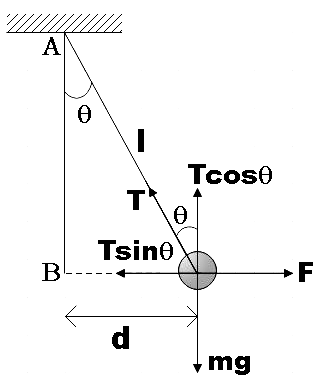
Forces acting on the ball are the electric force due to the applied charge q, the tension along the thread and weight mg acting downwards. We have also resolved the Tension into its sine and cosine components. Also, in the right angled triangle in the picture where AB forms the vertical line, by Pythagorean theorem we have,
${{l}^{2}}-{{d}^{2}}=A{{B}^{2}}$
$\Rightarrow AB=\sqrt{{{l}^{2}}-{{d}^{2}}}$ …………………………………………. (1)
On balancing the forces acting on the ball we have,
$T\sin \theta =F$ ……………………………… (2)
$T\cos \theta =mg$ ……………………………… (3)
Dividing equation (2) by (3), we have,
$\tan \theta =\dfrac{F}{mg}$
$\Rightarrow F=mg\tan \theta $ …………………………………….. (4)
From the figure,
$\tan \theta =\dfrac{d}{AB}$
Substituting (1), we get,
$\tan \theta =\dfrac{d}{\sqrt{{{l}^{2}}-{{d}^{2}}}}$ ……………………………………. (5)
Now let us substitute (5) in (4) to get,
$F=\dfrac{mgd}{\sqrt{{{l}^{2}}-{{d}^{2}}}}$
Therefore, we found that the magnitude of the electric force on the ball due to the applied charge will be,
$F=\dfrac{mgd}{\sqrt{{{l}^{2}}-{{d}^{2}}}}$
Hence, option A is found to be the correct answer.
Note:
You may be wondering how we have taken or assumed the direction of the given electric force that occurs as the result of applied electric charge. We are directly given the question that the ball is displaced away from the vertical line. So, whatever be the force, be it attractive or repulsive, it will be directed outwards.
Complete Step by step solution:
In the question, we are given a pitch ball covered with a tin foil of mass m kg that hangs on a fine silk thread of l meter in the presence of electric field E. We are also said that when this ball is given some electric charge q coulomb then it stands out d meters from the vertical line. We are supposed to find the magnitude of electric force.
As a first step, let us make a neat diagram of the given situation marking all the forces that are acting on the pitch ball.
Forces acting on the ball are the electric force due to the applied charge q, the tension along the thread and weight mg acting downwards. We have also resolved the Tension into its sine and cosine components. Also, in the right angled triangle in the picture where AB forms the vertical line, by Pythagorean theorem we have,
${{l}^{2}}-{{d}^{2}}=A{{B}^{2}}$
$\Rightarrow AB=\sqrt{{{l}^{2}}-{{d}^{2}}}$ …………………………………………. (1)
On balancing the forces acting on the ball we have,
$T\sin \theta =F$ ……………………………… (2)
$T\cos \theta =mg$ ……………………………… (3)
Dividing equation (2) by (3), we have,
$\tan \theta =\dfrac{F}{mg}$
$\Rightarrow F=mg\tan \theta $ …………………………………….. (4)
From the figure,
$\tan \theta =\dfrac{d}{AB}$
Substituting (1), we get,
$\tan \theta =\dfrac{d}{\sqrt{{{l}^{2}}-{{d}^{2}}}}$ ……………………………………. (5)
Now let us substitute (5) in (4) to get,
$F=\dfrac{mgd}{\sqrt{{{l}^{2}}-{{d}^{2}}}}$
Therefore, we found that the magnitude of the electric force on the ball due to the applied charge will be,
$F=\dfrac{mgd}{\sqrt{{{l}^{2}}-{{d}^{2}}}}$
Hence, option A is found to be the correct answer.
Note:
You may be wondering how we have taken or assumed the direction of the given electric force that occurs as the result of applied electric charge. We are directly given the question that the ball is displaced away from the vertical line. So, whatever be the force, be it attractive or repulsive, it will be directed outwards.
Recently Updated Pages
Explain the structure of megasporangium class 12 biology CBSE

Why is chloroform kept in dark coloured bottles class 12 chemistry CBSE
Derive the balancing condition of a Wheatstone bri class 12 physics CBSE
Draw VI characteristics of a pn junction diode Explain class 12 physics CBSE
Is it possible to carry pride in ones language too class 12 english CBSE
In a population at Hardy Weinberg equilibrium the allele class 12 biology CBSE
Trending doubts
Draw a labelled sketch of the human eye class 12 physics CBSE
Which are the Top 10 Largest Countries of the World?
Draw ray diagrams each showing i myopic eye and ii class 12 physics CBSE
One megawatt is equal to how many units of electri class 12 physics CBSE
Which is the correct genotypic ratio of mendel dihybrid class 12 biology CBSE
Give 10 examples of unisexual and bisexual flowers