




A piece of wax floats in brine. The fraction X of its volume will be immersed. Find [10X]. Density of wax = 0.95$gc{{m}^{-3}}$, density of brine = 1.1$gc{{m}^{-3}}$, where, [] is a step function.
A. 8
B. 0
C. 9
D. 11
Answer
 Verified
595.8k+ views
Hint: When a body is immersed in a liquid, the liquid exerts a force of buoyancy on the body in the upward direction. Find the buoyancy force and the gravitational force on the iron piece by using the formulas ${{F}_{g}}=mg$ and ${{F}_{B}}=\rho {{V}_{s}}g$. Calculate the mass of the body by $Density=\dfrac{mass}{volume}$. Equate both the forces to find X. [10X] is equal to the largest integer less than or equal to 10X.
Formula used:
${{F}_{g}}=mg$
${{F}_{B}}=\rho {{V}_{s}}g$
$Density=\dfrac{mass}{volume}$
Complete step by step solution:
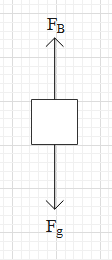
We know that earth exerts a force called gravitational force (${{F}_{g}}$) on a body within its gravity. The nature of this force is always attractive. Therefore, it is always directed downwards (i.e. is towards the centre of earth).
If the mass of the body is m, then the force gravity is equal to ${{F}_{g}}=mg$, where g is the acceleration of the body due to gravity.
When a body is put in water or any other liquid, the liquid exerts a force on the substance. This force is called upthrust or buoyancy force (${{F}_{B}}$). The direction of this force is always in the upward direction i.e. in the opposite direction of the gravitational force. The free body diagram of a body in water is shown in the figure below.
The value of buoyancy force is given as ${{F}_{B}}=\rho {{V}_{s}}g$.
Here, $\rho $ is the density of the liquid in which the body is immersed, V is the volume of the body that is submerged in the liquid.
Therefore, the net force on the body is ${{F}_{net}}={{F}_{g}}-{{F}_{B}}$.
Therefore, if ${{F}_{net}}=0$, then the body will float in liquid.
$\Rightarrow {{F}_{g}}-{{F}_{B}}=0$
$\Rightarrow {{F}_{g}}={{F}_{B}}$
Let us calculate the gravitational force on the wax. For that let us first calculate its mass (m).
We will use the formula for density, i.e. $Density=\dfrac{mass}{volume}$.
$\Rightarrow mass=density\times volume$
Here, the density of the wax is given as 0.95$gc{{m}^{-3}}$ and let its volume be V.
Hence,
$\Rightarrow m=0.95V$
This means that ${{F}_{g}}=mg=0.95Vg$ ….. (i).
Let us calculate the buoyancy force on the body. It is given that $\dfrac{{{V}_{s}}}{V}=X$.
$\Rightarrow {{V}_{s}}=XV$
The density of brine is 1.1$gc{{m}^{-3}}$. Hence, $\rho =1.1gc{{m}^{-3}}$.
Therefore,
${{F}_{B}}=\rho {{V}_{s}}g=1.1XVg$ …… (ii).
Equate (i) and (ii).
$\Rightarrow 0.95Vg=1.1XVg$
$\Rightarrow X=\dfrac{0.95}{1.1}=0.86$
The value of [10X] is the largest integer less than or equal to 10X.
We found that X=0.86. Hence, 10X=8.6.
The largest integer less than or equal to 8.6 is 8.
Therefore, [10X]=[8.6]=8.
Hence, the correct option A.
Note: Note that buoyant force is a variable force. It depends on the volume of the body submerged under the liquid. The maximum buoyant force is equal to ${{F}_{B}}=\rho Vg$, where V is the complete volume of the body.
If the gravitational force is less than or equal to the maximum buoyant force, then the body will float.
If the gravitational force is more than the maximum buoyant force, then the body will sink in the liquid.
Formula used:
${{F}_{g}}=mg$
${{F}_{B}}=\rho {{V}_{s}}g$
$Density=\dfrac{mass}{volume}$
Complete step by step solution:
We know that earth exerts a force called gravitational force (${{F}_{g}}$) on a body within its gravity. The nature of this force is always attractive. Therefore, it is always directed downwards (i.e. is towards the centre of earth).
If the mass of the body is m, then the force gravity is equal to ${{F}_{g}}=mg$, where g is the acceleration of the body due to gravity.
When a body is put in water or any other liquid, the liquid exerts a force on the substance. This force is called upthrust or buoyancy force (${{F}_{B}}$). The direction of this force is always in the upward direction i.e. in the opposite direction of the gravitational force. The free body diagram of a body in water is shown in the figure below.
The value of buoyancy force is given as ${{F}_{B}}=\rho {{V}_{s}}g$.
Here, $\rho $ is the density of the liquid in which the body is immersed, V is the volume of the body that is submerged in the liquid.
Therefore, the net force on the body is ${{F}_{net}}={{F}_{g}}-{{F}_{B}}$.
Therefore, if ${{F}_{net}}=0$, then the body will float in liquid.
$\Rightarrow {{F}_{g}}-{{F}_{B}}=0$
$\Rightarrow {{F}_{g}}={{F}_{B}}$
Let us calculate the gravitational force on the wax. For that let us first calculate its mass (m).
We will use the formula for density, i.e. $Density=\dfrac{mass}{volume}$.
$\Rightarrow mass=density\times volume$
Here, the density of the wax is given as 0.95$gc{{m}^{-3}}$ and let its volume be V.
Hence,
$\Rightarrow m=0.95V$
This means that ${{F}_{g}}=mg=0.95Vg$ ….. (i).
Let us calculate the buoyancy force on the body. It is given that $\dfrac{{{V}_{s}}}{V}=X$.
$\Rightarrow {{V}_{s}}=XV$
The density of brine is 1.1$gc{{m}^{-3}}$. Hence, $\rho =1.1gc{{m}^{-3}}$.
Therefore,
${{F}_{B}}=\rho {{V}_{s}}g=1.1XVg$ …… (ii).
Equate (i) and (ii).
$\Rightarrow 0.95Vg=1.1XVg$
$\Rightarrow X=\dfrac{0.95}{1.1}=0.86$
The value of [10X] is the largest integer less than or equal to 10X.
We found that X=0.86. Hence, 10X=8.6.
The largest integer less than or equal to 8.6 is 8.
Therefore, [10X]=[8.6]=8.
Hence, the correct option A.
Note: Note that buoyant force is a variable force. It depends on the volume of the body submerged under the liquid. The maximum buoyant force is equal to ${{F}_{B}}=\rho Vg$, where V is the complete volume of the body.
If the gravitational force is less than or equal to the maximum buoyant force, then the body will float.
If the gravitational force is more than the maximum buoyant force, then the body will sink in the liquid.
Recently Updated Pages
Master Class 12 Economics: Engaging Questions & Answers for Success

Master Class 12 Physics: Engaging Questions & Answers for Success
Master Class 12 English: Engaging Questions & Answers for Success
Master Class 12 Social Science: Engaging Questions & Answers for Success
Master Class 12 Maths: Engaging Questions & Answers for Success
Master Class 12 Business Studies: Engaging Questions & Answers for Success
Trending doubts
Which are the Top 10 Largest Countries of the World?
What are the major means of transport Explain each class 12 social science CBSE
Draw a labelled sketch of the human eye class 12 physics CBSE
Why cannot DNA pass through cell membranes class 12 biology CBSE
Differentiate between insitu conservation and exsitu class 12 biology CBSE
Draw a neat and well labeled diagram of TS of ovary class 12 biology CBSE