




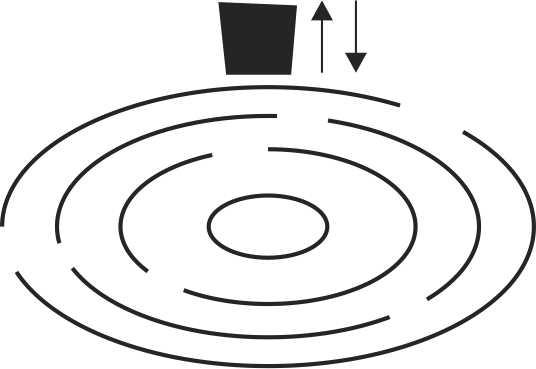
A piece of cork is floating on water in a small tank. The cork oscillates up and down vertically when small ripples pass over the surface of water. The velocity of the ripples being $0.21\;{\text{m}}{{\text{s}}^{ - 1}}$, wave length \[15{\text{ mm}}\] and amplitude \[5{\text{ mm}}\], the maximum velocity of the piece of cork is $\left( {\pi = \dfrac{{22}}{7}} \right)$.
Answer
 Verified
611.7k+ views
Hint: In this problem, first calculate the frequency of the cork by substituting the given values in the formula and then by using the calculated value of the frequency, find the maximum velocity of the cork.
Complete step-by-step solution:
As we know that the angular frequency is a frequency of a steadily recurring phenomenon, and it is expressed in radians per second.
The formula to calculate the angular frequency is given by, $\omega = 2\pi f$.
Here, $f$ is a linear frequency. We can define the linear frequency as the number of complete oscillations in each period, and it is expressed in hertz.
Now, substitute $2\pi f$ for $\omega $ in the equation ${v_{\max }} = \omega A$ to get the formula for ${v_{\max }}$ as,
${v_{\max }} = 2\pi fA$
Here, $A$ is the amplitude and it can be defined as the maximum extent of a vibration or oscillation, measured from the position of equilibrium and it is expressed in mm or m.
The formula to calculate the linear frequency is given by, $f = \dfrac{u}{\lambda }$.
Here, $\lambda $ is the wavelength which is defined as the distance measured between repeated crests of a wave, especially in case of a sound wave or electromagnetic wave, and $u$ is the velocity of ripples.
In the given problem, velocity of the ripple is $0.21\;{\text{m}}{{\text{s}}^{ - 1}}$, wavelength is \[15{\text{ mm}}\], and amplitude is \[5{\text{ mm}}\].
Now, find the linear frequency of the piece of cork by substituting $0.21\;{\text{m}}{{\text{s}}^{ - 1}}$ for $u$, and $0.015\;{\text{m}}$ for $\lambda $ in the formula as,
$
f = \dfrac{u}{\lambda } \\
= \dfrac{{0.21}}{{0.015}} \\
= 14\;{\text{Hz}} \\
$
Similarly, find the maximum velocity of the piece of cork by Substituting $\dfrac{{22}}{7}$ for $\pi $, $14\;{\text{Hz}}$ for $f$, and $0.005\;{\text{m}}$ for $A$ in the formula ${v_{\max }} = 2\pi fA$.
$
{v_{\max }} = 2\pi fA \\
= 2\left( {\dfrac{{22}}{7}} \right)\left( {14} \right)\left( {0.005} \right) \\
= 0.44\;{\text{m/s}} \\
$
Therefore, the maximum velocity of the piece of cork is $0.44\;{\text{m/s}}$.
Note:- Make sure that the maximum velocity of the piece of cork is the product of angular frequency, and amplitude where angular frequency is given by $\omega = 2\pi f$, and use the formula $f = \dfrac{u}{\lambda }$ to find the linear frequency.
Complete step-by-step solution:
As we know that the angular frequency is a frequency of a steadily recurring phenomenon, and it is expressed in radians per second.
The formula to calculate the angular frequency is given by, $\omega = 2\pi f$.
Here, $f$ is a linear frequency. We can define the linear frequency as the number of complete oscillations in each period, and it is expressed in hertz.
Now, substitute $2\pi f$ for $\omega $ in the equation ${v_{\max }} = \omega A$ to get the formula for ${v_{\max }}$ as,
${v_{\max }} = 2\pi fA$
Here, $A$ is the amplitude and it can be defined as the maximum extent of a vibration or oscillation, measured from the position of equilibrium and it is expressed in mm or m.
The formula to calculate the linear frequency is given by, $f = \dfrac{u}{\lambda }$.
Here, $\lambda $ is the wavelength which is defined as the distance measured between repeated crests of a wave, especially in case of a sound wave or electromagnetic wave, and $u$ is the velocity of ripples.
In the given problem, velocity of the ripple is $0.21\;{\text{m}}{{\text{s}}^{ - 1}}$, wavelength is \[15{\text{ mm}}\], and amplitude is \[5{\text{ mm}}\].
Now, find the linear frequency of the piece of cork by substituting $0.21\;{\text{m}}{{\text{s}}^{ - 1}}$ for $u$, and $0.015\;{\text{m}}$ for $\lambda $ in the formula as,
$
f = \dfrac{u}{\lambda } \\
= \dfrac{{0.21}}{{0.015}} \\
= 14\;{\text{Hz}} \\
$
Similarly, find the maximum velocity of the piece of cork by Substituting $\dfrac{{22}}{7}$ for $\pi $, $14\;{\text{Hz}}$ for $f$, and $0.005\;{\text{m}}$ for $A$ in the formula ${v_{\max }} = 2\pi fA$.
$
{v_{\max }} = 2\pi fA \\
= 2\left( {\dfrac{{22}}{7}} \right)\left( {14} \right)\left( {0.005} \right) \\
= 0.44\;{\text{m/s}} \\
$
Therefore, the maximum velocity of the piece of cork is $0.44\;{\text{m/s}}$.
Note:- Make sure that the maximum velocity of the piece of cork is the product of angular frequency, and amplitude where angular frequency is given by $\omega = 2\pi f$, and use the formula $f = \dfrac{u}{\lambda }$ to find the linear frequency.
Recently Updated Pages
Master Class 12 Business Studies: Engaging Questions & Answers for Success

Master Class 12 Biology: Engaging Questions & Answers for Success
Master Class 12 Chemistry: Engaging Questions & Answers for Success
Class 12 Question and Answer - Your Ultimate Solutions Guide
Master Class 11 Social Science: Engaging Questions & Answers for Success
Master Class 11 English: Engaging Questions & Answers for Success
Trending doubts
Which are the Top 10 Largest Countries of the World?
Draw a labelled sketch of the human eye class 12 physics CBSE
Differentiate between homogeneous and heterogeneous class 12 chemistry CBSE
Sulphuric acid is known as the king of acids State class 12 chemistry CBSE
Why is the cell called the structural and functional class 12 biology CBSE
Which is the correct genotypic ratio of mendel dihybrid class 12 biology CBSE