




A person lives in a high rise building on the bank of a 50m wide river. Across the river is a well-lit tower of height 40m. When the person, who is at height of 10m, looks through a polarizer at an appropriate angle at light of the tower reflecting from the river surface, he notes that intensity of the light coming from light bulb at height X from his building is the least and this corresponds to the light coming from light bulb at height Y on the tower. The values of X and Y are respectively close to (refractive index of water≈4/3)

A. 25m, 10m
B. 13m, 27m
C. 22m, 13m
D. 17m, 20m
Answer
 Verified
580.2k+ views
Hint: Polarizer is made of optical fiber through which light waves of specific polarization are viewed. When a person looks through the polarizer at some certain angle, then the Brewster angle is drawn. Brewster angle is equal to the tangent of the ratio of refractive indices of the mediums used.
Formula used:
Brewster angle is given by:
$\theta =\tan ({{n}_{1}}/{{n}_{2}})$
Complete answer:
Polarization is the process in which electromagnetic radiations are aligned in a specific manner. The polarization is of three types: plane polarization, circular polarization and elliptical polarization. Brewster angle states that at a particular angle of incidence, the reflected ray is linearly polarized and an angle between reflected and refracted ray is always 90°.
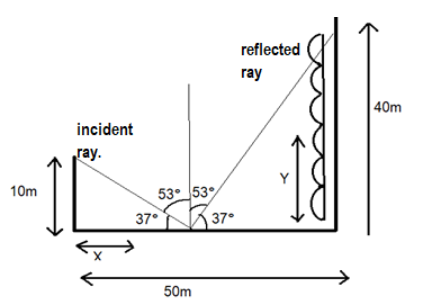
Brewster angle is given by:
$\theta =\tan ({{n}_{1}}/{{n}_{2}})$
Where, n1 represents the refractive index of the incident medium and n2 is the index of the other medium.
Now to find the angle of refraction, using the given μ=4/3.
$\begin{align}
& \theta =\tan (\mu ) \\
& \theta =\tan (4/3) \\
& \theta ={{53}^{0}} \\
\end{align}$
Here, we use the statement of Brewster angle i.e. the total angle should be 90°.
I.e. angle of incidence angle of refraction=90°.
\[\theta =90{}^\circ -53{}^\circ =37{}^\circ \]
Finding values of X and Y, We have:
Tangent of an angle=perpendicular/base.
$\begin{align}
& \tan {{37}^{0}}=P/B \\
& \tan {{37}^{0}}=10/X \\
& 3/4=10/X \\
& X=13m(approx.) \\
\end{align}$
Again,
$\begin{align}
& \tan {{37}^{0}}=P/B \\
& \tan {{37}^{0}}=Y/(50-X) \\
& 3/4=Y/(50-10) \\
& Y=27m(approx.) \\
\end{align}$
We have found the values of X and Y as 13m, and 27m respectively.
Therefore, option B is the correct option.
Note:
In polarization, both un-polarized and polarized forms of light which vibrate in an electric field. When polarized light is transmitted through a perfect transparent medium then angle with incident light is known as Brewster angle. It depends upon the refractive index of the medium used.
Formula used:
Brewster angle is given by:
$\theta =\tan ({{n}_{1}}/{{n}_{2}})$
Complete answer:
Polarization is the process in which electromagnetic radiations are aligned in a specific manner. The polarization is of three types: plane polarization, circular polarization and elliptical polarization. Brewster angle states that at a particular angle of incidence, the reflected ray is linearly polarized and an angle between reflected and refracted ray is always 90°.
Brewster angle is given by:
$\theta =\tan ({{n}_{1}}/{{n}_{2}})$
Where, n1 represents the refractive index of the incident medium and n2 is the index of the other medium.
Now to find the angle of refraction, using the given μ=4/3.
$\begin{align}
& \theta =\tan (\mu ) \\
& \theta =\tan (4/3) \\
& \theta ={{53}^{0}} \\
\end{align}$
Here, we use the statement of Brewster angle i.e. the total angle should be 90°.
I.e. angle of incidence angle of refraction=90°.
\[\theta =90{}^\circ -53{}^\circ =37{}^\circ \]
Finding values of X and Y, We have:
Tangent of an angle=perpendicular/base.
$\begin{align}
& \tan {{37}^{0}}=P/B \\
& \tan {{37}^{0}}=10/X \\
& 3/4=10/X \\
& X=13m(approx.) \\
\end{align}$
Again,
$\begin{align}
& \tan {{37}^{0}}=P/B \\
& \tan {{37}^{0}}=Y/(50-X) \\
& 3/4=Y/(50-10) \\
& Y=27m(approx.) \\
\end{align}$
We have found the values of X and Y as 13m, and 27m respectively.
Therefore, option B is the correct option.
Note:
In polarization, both un-polarized and polarized forms of light which vibrate in an electric field. When polarized light is transmitted through a perfect transparent medium then angle with incident light is known as Brewster angle. It depends upon the refractive index of the medium used.
Recently Updated Pages
Master Class 12 Economics: Engaging Questions & Answers for Success

Master Class 12 Physics: Engaging Questions & Answers for Success
Master Class 12 English: Engaging Questions & Answers for Success
Master Class 12 Social Science: Engaging Questions & Answers for Success
Master Class 12 Maths: Engaging Questions & Answers for Success
Master Class 12 Business Studies: Engaging Questions & Answers for Success
Trending doubts
Which are the Top 10 Largest Countries of the World?
What are the major means of transport Explain each class 12 social science CBSE
Draw a labelled sketch of the human eye class 12 physics CBSE
Why cannot DNA pass through cell membranes class 12 biology CBSE
Differentiate between insitu conservation and exsitu class 12 biology CBSE
Draw a neat and well labeled diagram of TS of ovary class 12 biology CBSE