




A person has an 18cm wide face and his two eyes are separated by 8cm. Find the minimum width of a mirror required for the person to view his face laterally.
A. 9cm
B. 4cm
C. 5cm
D. 13cm
Answer
 Verified
581.1k+ views
Hint: The law of reflection states that the angle of reflection and angle of incidence are equal after reflection from the plane mirror. Using this fact, draw the ray diagram of the image formation of the face in the plane mirror. Use the geometry of the figure to determine the width of the mirror.
Complete answer:
As we can see this question is based on the law of reflection which states that the angle of reflection and angle of incidence are equal after reflection from the plane mirror. Let us discuss the conditions for the minimum width of the mirror. The person must see the right edge of his face from the left eye at the end of the mirror and vice versa for the left edge of the face. Also, the centre of the face and mirror must lie on the perpendicular bisector of the line joining the two eyes.
Now, let us observe the following figure.
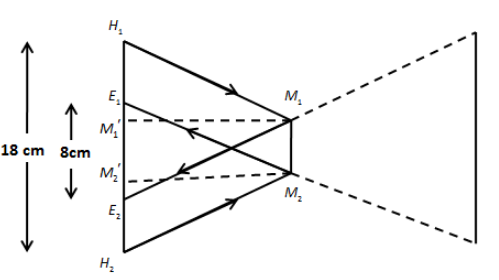
In the above figure, \[{H_1}\] is the left edge of the face and the light reflected from \[{H_1}\] again reflects at the end of the mirror \[{M_1}\] and then enters a right eye at \[{E_2}\]. \[{H_2}\] is the right edge of the face and the light reflected from \[{H_2}\] again reflects at the end of the mirror \[{M_2}\] and then enters a left eye at \[{E_1}\].
Let the distance \[{H_1}{H_2} = D\] and \[{E_1}{E_2} = d\].
From the above ray diagram and law of reflection stated above, we can write,
\[{H_1}{M_1}^\prime = \dfrac{{{H_1}{E_2}}}{2}\] and \[{H_2}{M_2}^\prime = \dfrac{{{H_2}{E_1}}}{2}\] …… (1)
We can write \[{H_1}{E_2}\] as,
\[{H_1}{E_2} = D - \dfrac{1}{2}\left( {D - d} \right)\]
\[ \Rightarrow {H_1}{E_2} = \dfrac{{D + d}}{2}\] …… (2)
Similarly,
\[{H_2}{E_1} = \dfrac{{D + d}}{2}\] …… (3)
We can express the distance \[{M_1}^\prime {M_2}^\prime \] as,
\[{M_1}^\prime {M_2}^\prime = D - {H_1}{M_1}^\prime - {H_2}{M_2}^\prime \]
Using equation (1), (2) and (3) in the above equation, we get,
\[{M_1}^\prime {M_2}^\prime = D - \dfrac{{D + d}}{4} - \dfrac{{D + d}}{4}\]
\[ \Rightarrow {M_1}^\prime {M_2}^\prime = D - \left( {D + d} \right)\left( {\dfrac{1}{4} + \dfrac{1}{4}} \right)\]
\[ \Rightarrow {M_1}^\prime {M_2}^\prime = D - \left( {\dfrac{{D + d}}{2}} \right)\]
\[ \Rightarrow {M_1}^\prime {M_2}^\prime = \dfrac{{D - d}}{2}\]
Substituting \[D = 18{\text{cm}}\] and \[d = 8\,{\text{cm}}\] in the above equation, we get,
\[{M_1}^\prime {M_2}^\prime = \dfrac{{18 - 8}}{2}\]
\[ \therefore {M_1}^\prime {M_2}^\prime = 5\,{\text{cm}}\]
Therefore, the width of the mirror should be 5cm.
So, the correct answer is option C.
Note: For the person to see his whole face in the mirror, the mirror should not necessarily have the same dimensions as that of the face. Since the ray reflected from the end of the mirror is reflected from the other end of the face, we can see the whole face in the mirror which has lower width than the dimensions of the face. The essential step in this solution is the use of the law of reflection.
Complete answer:
As we can see this question is based on the law of reflection which states that the angle of reflection and angle of incidence are equal after reflection from the plane mirror. Let us discuss the conditions for the minimum width of the mirror. The person must see the right edge of his face from the left eye at the end of the mirror and vice versa for the left edge of the face. Also, the centre of the face and mirror must lie on the perpendicular bisector of the line joining the two eyes.
Now, let us observe the following figure.
In the above figure, \[{H_1}\] is the left edge of the face and the light reflected from \[{H_1}\] again reflects at the end of the mirror \[{M_1}\] and then enters a right eye at \[{E_2}\]. \[{H_2}\] is the right edge of the face and the light reflected from \[{H_2}\] again reflects at the end of the mirror \[{M_2}\] and then enters a left eye at \[{E_1}\].
Let the distance \[{H_1}{H_2} = D\] and \[{E_1}{E_2} = d\].
From the above ray diagram and law of reflection stated above, we can write,
\[{H_1}{M_1}^\prime = \dfrac{{{H_1}{E_2}}}{2}\] and \[{H_2}{M_2}^\prime = \dfrac{{{H_2}{E_1}}}{2}\] …… (1)
We can write \[{H_1}{E_2}\] as,
\[{H_1}{E_2} = D - \dfrac{1}{2}\left( {D - d} \right)\]
\[ \Rightarrow {H_1}{E_2} = \dfrac{{D + d}}{2}\] …… (2)
Similarly,
\[{H_2}{E_1} = \dfrac{{D + d}}{2}\] …… (3)
We can express the distance \[{M_1}^\prime {M_2}^\prime \] as,
\[{M_1}^\prime {M_2}^\prime = D - {H_1}{M_1}^\prime - {H_2}{M_2}^\prime \]
Using equation (1), (2) and (3) in the above equation, we get,
\[{M_1}^\prime {M_2}^\prime = D - \dfrac{{D + d}}{4} - \dfrac{{D + d}}{4}\]
\[ \Rightarrow {M_1}^\prime {M_2}^\prime = D - \left( {D + d} \right)\left( {\dfrac{1}{4} + \dfrac{1}{4}} \right)\]
\[ \Rightarrow {M_1}^\prime {M_2}^\prime = D - \left( {\dfrac{{D + d}}{2}} \right)\]
\[ \Rightarrow {M_1}^\prime {M_2}^\prime = \dfrac{{D - d}}{2}\]
Substituting \[D = 18{\text{cm}}\] and \[d = 8\,{\text{cm}}\] in the above equation, we get,
\[{M_1}^\prime {M_2}^\prime = \dfrac{{18 - 8}}{2}\]
\[ \therefore {M_1}^\prime {M_2}^\prime = 5\,{\text{cm}}\]
Therefore, the width of the mirror should be 5cm.
So, the correct answer is option C.
Note: For the person to see his whole face in the mirror, the mirror should not necessarily have the same dimensions as that of the face. Since the ray reflected from the end of the mirror is reflected from the other end of the face, we can see the whole face in the mirror which has lower width than the dimensions of the face. The essential step in this solution is the use of the law of reflection.
Recently Updated Pages
Three beakers labelled as A B and C each containing 25 mL of water were taken A small amount of NaOH anhydrous CuSO4 and NaCl were added to the beakers A B and C respectively It was observed that there was an increase in the temperature of the solutions contained in beakers A and B whereas in case of beaker C the temperature of the solution falls Which one of the following statements isarecorrect i In beakers A and B exothermic process has occurred ii In beakers A and B endothermic process has occurred iii In beaker C exothermic process has occurred iv In beaker C endothermic process has occurred

Master Class 12 Social Science: Engaging Questions & Answers for Success
Master Class 12 Physics: Engaging Questions & Answers for Success
Master Class 12 Maths: Engaging Questions & Answers for Success
Master Class 12 Economics: Engaging Questions & Answers for Success
Master Class 12 Chemistry: Engaging Questions & Answers for Success
Three beakers labelled as A B and C each containing 25 mL of water were taken A small amount of NaOH anhydrous CuSO4 and NaCl were added to the beakers A B and C respectively It was observed that there was an increase in the temperature of the solutions contained in beakers A and B whereas in case of beaker C the temperature of the solution falls Which one of the following statements isarecorrect i In beakers A and B exothermic process has occurred ii In beakers A and B endothermic process has occurred iii In beaker C exothermic process has occurred iv In beaker C endothermic process has occurred
Master Class 12 Social Science: Engaging Questions & Answers for Success
Master Class 12 Physics: Engaging Questions & Answers for Success
Trending doubts
Which are the Top 10 Largest Countries of the World?
Draw a labelled sketch of the human eye class 12 physics CBSE
Differentiate between homogeneous and heterogeneous class 12 chemistry CBSE
What are the major means of transport Explain each class 12 social science CBSE
Sulphuric acid is known as the king of acids State class 12 chemistry CBSE
Why should a magnesium ribbon be cleaned before burning class 12 chemistry CBSE