




A permanent magnet is shaped as a ring with a narrow gap between the poles. The mean diameter of the ring equals d=20 cm. The width of the gap is equal to b=2.0 mm and that magnetic induction in the gap is equal to B=40 mT. Assuming that the scattering of the magnetic flux at the gap edges is negligible, then the modulus of the magnetic field strength vector inside the magnet is $1.01 \times {10^x}A/m$. Find $x$.
Answer
 Verified
585.6k+ views
Hint: When we place a nonmagnetic material which can be magnetized in an external magnetic field then there will be magnetic property induced in it. One noticeable thing over here is the amount of magnetic strength induced will be greater than the original applied magnetic field. That means the magnetism induction (B) in that material depends upon the intensity of magnetic field(H) and intensity of magnetization(I).
Formula used: $\oint {H.dl = 0} $
$B = {\mu _0}H$
Complete step by step answer:
we are given with the ring whose mean diameter is 20cm and there is the small gap in between the poles whose width is given as 2mm which is denoted as b and the mean diameter is denoted as d. we are also given with the magnetic induction at the gap which is B=40mT. we were asked to find the modulus of magnetic field vector i.e magnetic field intensity(H). since they told modulus we should find only the magnitude of it and not direction.
We will apply maxwell loop law to find out this
Since no current is enclosed with in the ring we can interpret the maxwell loop law as $\oint {H.dl = 0} $
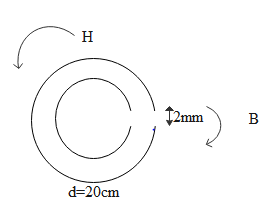
Total length of the ring will be $\pi d$ length of the gap is ‘b’ so effective length of the ring excluding the gap will be $\pi d - b$
We have $B = {\mu _0}H$
We know that $\mu = 4\pi \times 10^{-7}$
Now substituting all the known values on following formula-
From $\oint {H.dl = 0} $ we get
$\eqalign{
& H(\pi d - b) + \dfrac{B}{{{\mu _0}}}b = 0 \cr
& \Rightarrow H = \dfrac{{ - \dfrac{B}{{{\mu _0}}}b}}{{\pi d - b}} \cr
& \Rightarrow H = \dfrac{{\dfrac{{ - 40 \times {{10}^{ - 3}}}}{{4\pi \times {{10}^{ - 7}}}} \times 2 \times {{10}^{ - 3}}}}{{(\pi \times 20 \times {{10}^{ - 2}}) - (2 \times {{10}^{ - 3}})}} \cr
& \Rightarrow H = 101A/m \cr
& \Rightarrow H = 1.01 \times {10^2}A/m \cr} $
So the value of $x$ is 2
Note: Usually this maxwell law is used to find out the magnetic field produced due to the current carrying wire i.e a loop is imagined and we will find out the magnetic field induction at that loop. But here since enclosed current is zero we assume that loop as this ring and hence we equate the integral to zero otherwise it will be a product of permeability and enclosed current.
Formula used: $\oint {H.dl = 0} $
$B = {\mu _0}H$
Complete step by step answer:
we are given with the ring whose mean diameter is 20cm and there is the small gap in between the poles whose width is given as 2mm which is denoted as b and the mean diameter is denoted as d. we are also given with the magnetic induction at the gap which is B=40mT. we were asked to find the modulus of magnetic field vector i.e magnetic field intensity(H). since they told modulus we should find only the magnitude of it and not direction.
We will apply maxwell loop law to find out this
Since no current is enclosed with in the ring we can interpret the maxwell loop law as $\oint {H.dl = 0} $
Total length of the ring will be $\pi d$ length of the gap is ‘b’ so effective length of the ring excluding the gap will be $\pi d - b$
We have $B = {\mu _0}H$
We know that $\mu = 4\pi \times 10^{-7}$
Now substituting all the known values on following formula-
From $\oint {H.dl = 0} $ we get
$\eqalign{
& H(\pi d - b) + \dfrac{B}{{{\mu _0}}}b = 0 \cr
& \Rightarrow H = \dfrac{{ - \dfrac{B}{{{\mu _0}}}b}}{{\pi d - b}} \cr
& \Rightarrow H = \dfrac{{\dfrac{{ - 40 \times {{10}^{ - 3}}}}{{4\pi \times {{10}^{ - 7}}}} \times 2 \times {{10}^{ - 3}}}}{{(\pi \times 20 \times {{10}^{ - 2}}) - (2 \times {{10}^{ - 3}})}} \cr
& \Rightarrow H = 101A/m \cr
& \Rightarrow H = 1.01 \times {10^2}A/m \cr} $
So the value of $x$ is 2
Note: Usually this maxwell law is used to find out the magnetic field produced due to the current carrying wire i.e a loop is imagined and we will find out the magnetic field induction at that loop. But here since enclosed current is zero we assume that loop as this ring and hence we equate the integral to zero otherwise it will be a product of permeability and enclosed current.
Recently Updated Pages
Master Class 12 Economics: Engaging Questions & Answers for Success

Master Class 12 Physics: Engaging Questions & Answers for Success
Master Class 12 English: Engaging Questions & Answers for Success
Master Class 12 Social Science: Engaging Questions & Answers for Success
Master Class 12 Maths: Engaging Questions & Answers for Success
Master Class 12 Business Studies: Engaging Questions & Answers for Success
Trending doubts
Which are the Top 10 Largest Countries of the World?
What are the major means of transport Explain each class 12 social science CBSE
Draw a labelled sketch of the human eye class 12 physics CBSE
Why cannot DNA pass through cell membranes class 12 biology CBSE
Differentiate between insitu conservation and exsitu class 12 biology CBSE
Draw a neat and well labeled diagram of TS of ovary class 12 biology CBSE