




A permanent magnet is made of steel and loses its magnetism easily. Explain it.
Answer
 Verified
627k+ views
Hint: A permanent magnet is a magnet that doesn’t lose its magnetic strength. We must know that steel is an alloy of iron and carbon. Naturally steel is not magnetic in nature but it can be modified into one. If a material needs to be turned into a permanent magnet, it should have proper atomic orientation.
Complete solution: First of all, we need to understand why steel is used for making permanent magnets. When a nonmagnetic piece of steel is applied to a magnetic field, the atoms align and create a permanent magnet.
That means, steel is a ferromagnetic material and when a ferromagnetic material is imposed with a magnetic field in a particular direction, the magnetic moments will not come back to its original position when the applied field is withdrawn. The amount of how much the material is magnetized is known as remanence.
This magnetization could be reversed by applying an opposite field, this required field for demagnetization is known as coercivity. If we are applying an alternating field to the material, and plot the magnetization in a graph, it will trace a loop called hysteresis loop.
So, this hysteresis loop is related to the existence of magnetic domains in the material. Steel is a material with high coercivity. That means more fields are needed to demagnetize it. So it could be used for making a permanent magnet.
Now, it could lose its magnetism easily. This is due to the energy given to the material such as heat or demagnetizing the field. If we give these oriented magnetic moments an external opposing energy, they will be reversed again. This property of ferromagnetic materials can be called magnetic memory. The materials which retain much of their magnetization can be used as permanent magnets.
The hysteresis loop of steel is found to be,
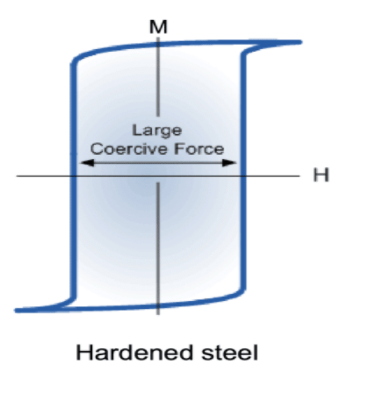
Note: Steel is one of the materials having high coercivity, That means more energy will be needed to demagnetize steel. So it is an ideal material for making permanent magnets. The case of electromagnets is just the opposite where those materials must have low coercivity and high permeability. We must know that steel is not magnetic in nature but it can be transformed.
Complete solution: First of all, we need to understand why steel is used for making permanent magnets. When a nonmagnetic piece of steel is applied to a magnetic field, the atoms align and create a permanent magnet.
That means, steel is a ferromagnetic material and when a ferromagnetic material is imposed with a magnetic field in a particular direction, the magnetic moments will not come back to its original position when the applied field is withdrawn. The amount of how much the material is magnetized is known as remanence.
This magnetization could be reversed by applying an opposite field, this required field for demagnetization is known as coercivity. If we are applying an alternating field to the material, and plot the magnetization in a graph, it will trace a loop called hysteresis loop.
So, this hysteresis loop is related to the existence of magnetic domains in the material. Steel is a material with high coercivity. That means more fields are needed to demagnetize it. So it could be used for making a permanent magnet.
Now, it could lose its magnetism easily. This is due to the energy given to the material such as heat or demagnetizing the field. If we give these oriented magnetic moments an external opposing energy, they will be reversed again. This property of ferromagnetic materials can be called magnetic memory. The materials which retain much of their magnetization can be used as permanent magnets.
The hysteresis loop of steel is found to be,
Note: Steel is one of the materials having high coercivity, That means more energy will be needed to demagnetize steel. So it is an ideal material for making permanent magnets. The case of electromagnets is just the opposite where those materials must have low coercivity and high permeability. We must know that steel is not magnetic in nature but it can be transformed.
Recently Updated Pages
Master Class 12 Economics: Engaging Questions & Answers for Success

Master Class 12 English: Engaging Questions & Answers for Success
Master Class 12 Social Science: Engaging Questions & Answers for Success
Master Class 12 Maths: Engaging Questions & Answers for Success
Master Class 12 Physics: Engaging Questions & Answers for Success
Master Class 9 General Knowledge: Engaging Questions & Answers for Success
Trending doubts
Which are the Top 10 Largest Countries of the World?
Draw a labelled sketch of the human eye class 12 physics CBSE
Differentiate between homogeneous and heterogeneous class 12 chemistry CBSE
Sulphuric acid is known as the king of acids State class 12 chemistry CBSE
Why is the cell called the structural and functional class 12 biology CBSE
Draw ray diagrams each showing i myopic eye and ii class 12 physics CBSE