




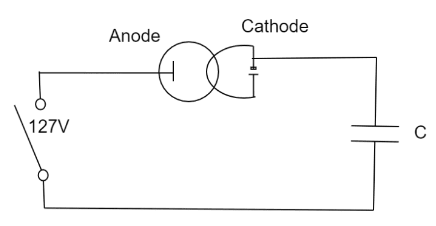
A perfect diode is connected to an a.c. Determine the limits within which the voltage between the anode and the cathode varies.
Answer
 Verified
478.5k+ views
Hint: Plot the time dependences of the external voltage $ {U_{ex}} $ (t), the current in the circuit $ {I_c} $ (t), the voltage across the capacitor $ {U_c} $ (t), and the voltage across the diode $ {U_a} $ (t). by this we will get the value of the required voltage.
Complete answer:
A diode is a nonlinear, unidirectional device. When you connect it to an AC supply, you're putting both positive and negative potential to it. However, after forward break over voltage, the diode only conducts in forward mode, that is, from anode to cathode (when positive). As a result, it will only supply output for the positive half of the cycle and none for the negative half. If the diode is linked in the opposite direction, the result is the opposite. Half wave rectification is the name given to this phenomena, and the device's name is changed to half wave rectifier.
Plotting the time dependences of the external voltage $ {U_{ex}} $ (t) , $ {I_c} $ (t) is the current in the circuit (which only flows in one direction while the diode is open), the voltage across the capacitor, $ {U_c} $ (t), and the voltage across the diode, $ {U_a} $ (t).
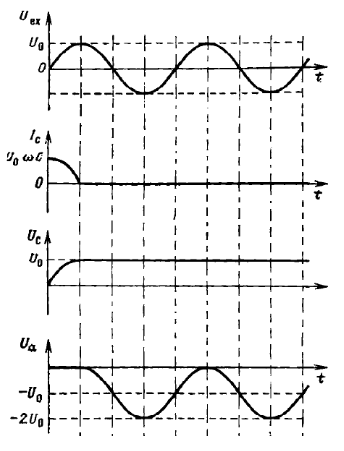
As a result, the voltage between the anode and the cathode can range from $ 0 $ to $ - 2{U_0} $ .
Note:
When a diode is forward biased and behaves as a perfect conductor with zero voltage across it, it is called an Ideal Diode. When the diode is reversed biased, it works as a perfect insulator, allowing no current to pass through.
Complete answer:
A diode is a nonlinear, unidirectional device. When you connect it to an AC supply, you're putting both positive and negative potential to it. However, after forward break over voltage, the diode only conducts in forward mode, that is, from anode to cathode (when positive). As a result, it will only supply output for the positive half of the cycle and none for the negative half. If the diode is linked in the opposite direction, the result is the opposite. Half wave rectification is the name given to this phenomena, and the device's name is changed to half wave rectifier.
Plotting the time dependences of the external voltage $ {U_{ex}} $ (t) , $ {I_c} $ (t) is the current in the circuit (which only flows in one direction while the diode is open), the voltage across the capacitor, $ {U_c} $ (t), and the voltage across the diode, $ {U_a} $ (t).
As a result, the voltage between the anode and the cathode can range from $ 0 $ to $ - 2{U_0} $ .
Note:
When a diode is forward biased and behaves as a perfect conductor with zero voltage across it, it is called an Ideal Diode. When the diode is reversed biased, it works as a perfect insulator, allowing no current to pass through.
Recently Updated Pages
Master Class 12 English: Engaging Questions & Answers for Success

Master Class 12 Social Science: Engaging Questions & Answers for Success
Master Class 12 Maths: Engaging Questions & Answers for Success
Master Class 12 Economics: Engaging Questions & Answers for Success
Master Class 12 Physics: Engaging Questions & Answers for Success
Master Class 12 Business Studies: Engaging Questions & Answers for Success
Trending doubts
Which are the Top 10 Largest Countries of the World?
What are the major means of transport Explain each class 12 social science CBSE
Draw a labelled sketch of the human eye class 12 physics CBSE
Draw the diagram showing the germination of pollen class 12 biology CBSE
Differentiate between insitu conservation and exsitu class 12 biology CBSE
Draw a neat and well labeled diagram of TS of ovary class 12 biology CBSE