




A particle of specific charge \[\dfrac{q}{m}=\pi ck{{g}^{-1}}\] is projected from the origin towards \[+ve\text{ }x-axis\] with a velocity of \[10m{{s}^{-1}}\] in a uniform magnetic field \[\overrightarrow{B}=-2\widehat{k}T\].The velocity of the particle after time \[\overrightarrow{t}=\dfrac{1}{12}s\] will be..
A. \[5\left[ \hat{i}+\sqrt{3}\hat{j} \right]\]
B. \[5\left[ \sqrt{3}\hat{i}+\hat{j} \right]\]
C. \[5\left[ \sqrt{3}\hat{i}-\hat{j} \right]\]
D. \[5\left[ \hat{i}+\hat{j} \right]\]
Answer
 Verified
569.1k+ views
Hint: Let a charged particle enter in a magnetic field (uniform) with a velocity perpendicular to the direction of field. We see that a force starts acting on the particle and revolves in a circular path.
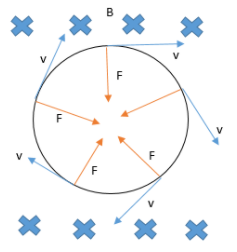
We termed 2 X magnetic fields inside the paper. In such conditions we observe that there is a particular radius of the circular path and a time period of Revolution is there.
In our diagram we conclude that a force is acting on the particle at every point which made it revolve in circular path as it is acting towards radius (centripetal force)
Complete answer:
We can write:
Centripetal force = Magnetic force.
\[\dfrac{m{{v}^{2}}}{r}=qvB \]
\[ v=\dfrac{qBr}{m}\text{ }\left( \text{This is the velocity of the particle} \right) \]
\[ r=\dfrac{mv}{qB} \]
Time period of revolution \[=\dfrac{2\pi r}{v}\]
\[T=\dfrac{2\pi }{v}\left( \dfrac{mv}{qB} \right) \]
\[T=\dfrac{2\pi m}{qB} \]
Let the direction of magnetic field in -z direction then if a particle with velocity ‘v’ making an angle \[\theta \] with field enters into it the components of velocity are divided into \[\sin \] and \[\cos ine\].
According to our discussion Time period of Revolution is
\[T=\dfrac{2\pi m}{qB}=\dfrac{2\pi m}{\left( \dfrac{q}{m} \right)B}\text{ }\left( \text{given }q=\dfrac{q}{m} \right) \]
\[ T=2\pi =1s \]
After a time period of \[\dfrac{1}{12}\sec ,\theta =\dfrac{360{}^\circ }{12}=30{}^\circ \]
The velocity components are
\[\overrightarrow{v}=10\left( \cos 30\widehat{i}+\sin 30\widehat{j} \right) \]
\[\overrightarrow{v}=10\left( \dfrac{\sqrt{3}}{2}\widehat{i}+\dfrac{1}{2}\widehat{j} \right) \]
\[\overrightarrow{v}=5\left( \sqrt{3}\widehat{i}+\widehat{j} \right) \]
The correct answer is option B.
Note:
The velocity component if perpendicular to the magnetic field then the particle is revolved in a circular path. As we have discussed that this path has its own velocity and revolution time - Let the particle enter parallel to the field. In this case the particle moves parallel with the same velocity in the direction of the field. We have a charged particle with motion having angle \['\theta '\] with the field then the particle moves in helical motion.
We termed 2 X magnetic fields inside the paper. In such conditions we observe that there is a particular radius of the circular path and a time period of Revolution is there.
In our diagram we conclude that a force is acting on the particle at every point which made it revolve in circular path as it is acting towards radius (centripetal force)
Complete answer:
We can write:
Centripetal force = Magnetic force.
\[\dfrac{m{{v}^{2}}}{r}=qvB \]
\[ v=\dfrac{qBr}{m}\text{ }\left( \text{This is the velocity of the particle} \right) \]
\[ r=\dfrac{mv}{qB} \]
Time period of revolution \[=\dfrac{2\pi r}{v}\]
\[T=\dfrac{2\pi }{v}\left( \dfrac{mv}{qB} \right) \]
\[T=\dfrac{2\pi m}{qB} \]
Let the direction of magnetic field in -z direction then if a particle with velocity ‘v’ making an angle \[\theta \] with field enters into it the components of velocity are divided into \[\sin \] and \[\cos ine\].
According to our discussion Time period of Revolution is
\[T=\dfrac{2\pi m}{qB}=\dfrac{2\pi m}{\left( \dfrac{q}{m} \right)B}\text{ }\left( \text{given }q=\dfrac{q}{m} \right) \]
\[ T=2\pi =1s \]
After a time period of \[\dfrac{1}{12}\sec ,\theta =\dfrac{360{}^\circ }{12}=30{}^\circ \]
The velocity components are
\[\overrightarrow{v}=10\left( \cos 30\widehat{i}+\sin 30\widehat{j} \right) \]
\[\overrightarrow{v}=10\left( \dfrac{\sqrt{3}}{2}\widehat{i}+\dfrac{1}{2}\widehat{j} \right) \]
\[\overrightarrow{v}=5\left( \sqrt{3}\widehat{i}+\widehat{j} \right) \]
The correct answer is option B.
Note:
The velocity component if perpendicular to the magnetic field then the particle is revolved in a circular path. As we have discussed that this path has its own velocity and revolution time - Let the particle enter parallel to the field. In this case the particle moves parallel with the same velocity in the direction of the field. We have a charged particle with motion having angle \['\theta '\] with the field then the particle moves in helical motion.
Recently Updated Pages
Master Class 12 Economics: Engaging Questions & Answers for Success

Master Class 12 Physics: Engaging Questions & Answers for Success
Master Class 12 English: Engaging Questions & Answers for Success
Master Class 12 Social Science: Engaging Questions & Answers for Success
Master Class 12 Maths: Engaging Questions & Answers for Success
Master Class 12 Business Studies: Engaging Questions & Answers for Success
Trending doubts
Which are the Top 10 Largest Countries of the World?
What are the major means of transport Explain each class 12 social science CBSE
Draw a labelled sketch of the human eye class 12 physics CBSE
Why cannot DNA pass through cell membranes class 12 biology CBSE
Differentiate between insitu conservation and exsitu class 12 biology CBSE
Draw a neat and well labeled diagram of TS of ovary class 12 biology CBSE