




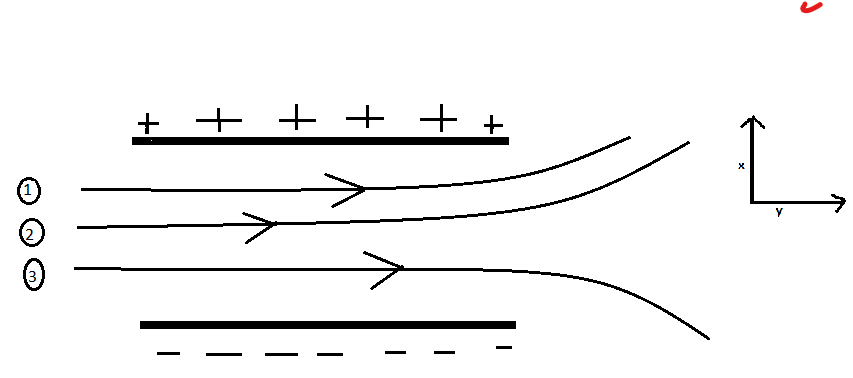
A particle of mass m and charge (-q) enters the region between the two charged plates initially moving along x-axis with speed ${{v}_{x}}$(like particle 1 in Fig.). The length of plate is L and a uniform electric field E is maintained between the plates. Show that the vertical deflection of the particle at the far edge of the plate is ${qE{{L}^{2}}}/{\left( 2mv_{x}^{2} \right)}\;$.
Compare this motion with motion of a projectile in a gravitational field.
Answer
 Verified
627.6k+ views
- Hint: A negative charged particle moving under the influence of an electric field will get deflected towards the positive plate. The vertical displacement of the charged particle can be calculated by using the equation of motion in y direction.
Complete step-by-step solution -
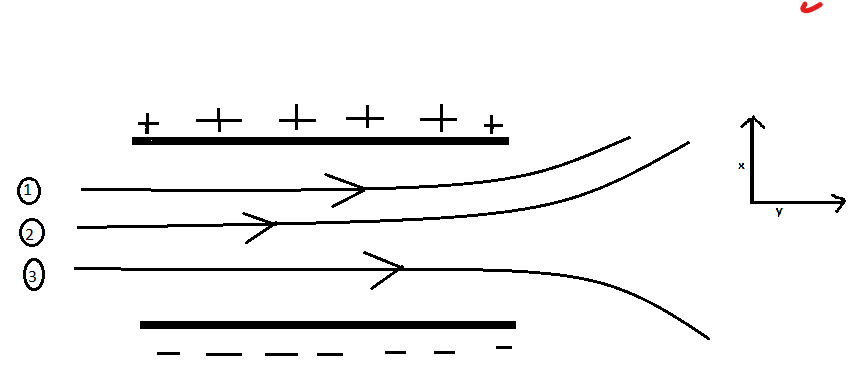
The particle is moving along the x axis in the presence of uniform electric field E as given in the question.
We have to find the vertical distance covered by the deflected particle along y axis say ‘h’
Time taken by the particle to cover the horizontal distance L with velocity \[{{v}_{x}}\] is
\[t=\dfrac{L}{{{v}_{x}}}\]
Force acting on the particle along y axis due to electric field is,
\[F=qE\]
Acceleration of the particle along y axis is given by,
\[a=\dfrac{F}{m}=\dfrac{qE}{m}\]
Now, to calculate the displacement along y axis we will use the equation of motion i.e.
\[s=ut+\dfrac{1}{2}a{{t}^{2}}\]
Since initial velocity of the particle along y axis is zero, \[u=0\]
\[s=0+\dfrac{1}{2}a{{t}^{2}}\]
Substituting the values of acceleration and time from above equations we get,
\[s=\dfrac{1}{2}\dfrac{qE}{m}{{\left( \dfrac{L}{{{v}_{x}}} \right)}^{2}}\]
Therefore, the vertical deflection of the particle at far edge of the plates is \[\dfrac{qE{{L}^{2}}}{2m{{v}_{x}}^{2}}\]
The motion of the free charged particle placed in the electric field is analogous to projectile motion as in both the cases there is deflection due to applied forces in a direction perpendicular to the direction of motion of the body/particle.
The vertical displacement for a charged particle in projectile motion is given by
\[y=\dfrac{1}{2}a{{t}^{2}}\]
Note: Students must remember that the vertical deflection of the charged particle is directly proportional to the ratio of charge and mass of the particle. If $\dfrac{e}{m}$for a particle is large, then the particle will be deflected more and vice versa.
Complete step-by-step solution -
The particle is moving along the x axis in the presence of uniform electric field E as given in the question.
We have to find the vertical distance covered by the deflected particle along y axis say ‘h’
Time taken by the particle to cover the horizontal distance L with velocity \[{{v}_{x}}\] is
\[t=\dfrac{L}{{{v}_{x}}}\]
Force acting on the particle along y axis due to electric field is,
\[F=qE\]
Acceleration of the particle along y axis is given by,
\[a=\dfrac{F}{m}=\dfrac{qE}{m}\]
Now, to calculate the displacement along y axis we will use the equation of motion i.e.
\[s=ut+\dfrac{1}{2}a{{t}^{2}}\]
Since initial velocity of the particle along y axis is zero, \[u=0\]
\[s=0+\dfrac{1}{2}a{{t}^{2}}\]
Substituting the values of acceleration and time from above equations we get,
\[s=\dfrac{1}{2}\dfrac{qE}{m}{{\left( \dfrac{L}{{{v}_{x}}} \right)}^{2}}\]
Therefore, the vertical deflection of the particle at far edge of the plates is \[\dfrac{qE{{L}^{2}}}{2m{{v}_{x}}^{2}}\]
The motion of the free charged particle placed in the electric field is analogous to projectile motion as in both the cases there is deflection due to applied forces in a direction perpendicular to the direction of motion of the body/particle.
The vertical displacement for a charged particle in projectile motion is given by
\[y=\dfrac{1}{2}a{{t}^{2}}\]
Note: Students must remember that the vertical deflection of the charged particle is directly proportional to the ratio of charge and mass of the particle. If $\dfrac{e}{m}$for a particle is large, then the particle will be deflected more and vice versa.
Recently Updated Pages
Three beakers labelled as A B and C each containing 25 mL of water were taken A small amount of NaOH anhydrous CuSO4 and NaCl were added to the beakers A B and C respectively It was observed that there was an increase in the temperature of the solutions contained in beakers A and B whereas in case of beaker C the temperature of the solution falls Which one of the following statements isarecorrect i In beakers A and B exothermic process has occurred ii In beakers A and B endothermic process has occurred iii In beaker C exothermic process has occurred iv In beaker C endothermic process has occurred

Master Class 12 Social Science: Engaging Questions & Answers for Success
Master Class 12 Physics: Engaging Questions & Answers for Success
Master Class 12 Maths: Engaging Questions & Answers for Success
Master Class 12 Economics: Engaging Questions & Answers for Success
Master Class 12 Chemistry: Engaging Questions & Answers for Success
Three beakers labelled as A B and C each containing 25 mL of water were taken A small amount of NaOH anhydrous CuSO4 and NaCl were added to the beakers A B and C respectively It was observed that there was an increase in the temperature of the solutions contained in beakers A and B whereas in case of beaker C the temperature of the solution falls Which one of the following statements isarecorrect i In beakers A and B exothermic process has occurred ii In beakers A and B endothermic process has occurred iii In beaker C exothermic process has occurred iv In beaker C endothermic process has occurred
Master Class 12 Social Science: Engaging Questions & Answers for Success
Master Class 12 Physics: Engaging Questions & Answers for Success
Trending doubts
Which are the Top 10 Largest Countries of the World?
Draw a labelled sketch of the human eye class 12 physics CBSE
Differentiate between homogeneous and heterogeneous class 12 chemistry CBSE
What are the major means of transport Explain each class 12 social science CBSE
Sulphuric acid is known as the king of acids State class 12 chemistry CBSE
Why should a magnesium ribbon be cleaned before burning class 12 chemistry CBSE