




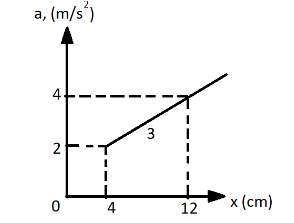
A particle moves along the positive x-axis with an acceleration ${a_x}$ in meter per second squared which increases linearly with x expressed in centimeter, as shown in the graph for an interval of its motion. If the velocity of the particle at $x = 4\;{\text{cm}}$ is $0.40\;{\text{m}}/{\text{s}}$, determine the velocity at $x = 12\;{\text{cm}}$.
A. $0.2\;{\text{m}}/{\text{s}}$
B. $0.4\;{\text{m}}/{\text{s}}$
C. $0.8\;{\text{m}}/{\text{s}}$
D. $1.6\;{\text{m}}/{\text{s}}$
Answer
 Verified
611.1k+ views
Hint: The above problem is based on the kinematics. The area under the acceleration time graph gives the velocity of the particle. The acceleration is the slope of the velocity time graph. The velocity of the particle is given at some position and velocity at other points can be found by calculating the area of the given graph.
Complete step by step answer:
Given: The initial position of the particle is ${x_1} = 4\;{\text{cm}} = 4\;{\text{cm}} \times \dfrac{{1\;{\text{m}}}}{{100\;{\text{cm}}}} = 0.04\;{\text{m}}$.
The initial velocity of the particle is $u = 0.40\;{\text{m}}/{\text{s}}$.
The final position of the particle is ${x_2} = 12\;{\text{cm}} = 12\;{\text{cm}} \times \dfrac{{1\;{\text{m}}}}{{100\;{\text{cm}}}} = 0.12\;{\text{m}}$.
The initial acceleration of the particle is ${a_1} = 2\;{\text{m}}/{{\text{s}}^2}$.
The final acceleration of the particle is ${a_2} = 4\;{\text{m}}/{{\text{s}}^2}$.
The expression for the area of the acceleration of the graph is given as
$A = \dfrac{1}{2}\left( {{a_1} + {a_2}} \right)\left( {{x_2} - {x_1}} \right)......\left( 1 \right)$
The area under the curve in the integral form is given as:
$A = \int\limits_u^v {vdv} $
$\Rightarrow A = \left( {\dfrac{{{v^2}}}{2}} \right)_u^v$
$\Rightarrow A = \dfrac{{{v^2}}}{2} - \dfrac{{{u^2}}}{2}......\left( 2 \right)$
Equate the expression (1) and expression (2) to find the final velocity of the particle.
$\dfrac{{{v^2}}}{2} - \dfrac{{{u^2}}}{2} = \dfrac{1}{2}\left( {{a_1} + {a_2}} \right)\left( {{x_2} - {x_1}} \right)$
$\Rightarrow{v^2} = {u^2} + \left( {{a_1} + {a_2}} \right)\left( {{x_2} - {x_1}} \right)$
$\Rightarrow v = \sqrt {{u^2} + \left( {{a_1} + {a_2}} \right)\left( {{x_2} - {x_1}} \right)} ......\left( 3 \right)$
Substitute $0.04\;{\text{m}}$for ${x_1}$, $0.12\;{\text{m}}$for ${x_2}$, $2\;{\text{m}}/{{\text{s}}^2}$ for ${a_1}$, $4\;{\text{m}}/{{\text{s}}^2}$ for ${a_2}$ and $0.40\;{\text{m}}/{\text{s}}$for u in the expression (3) to find the final velocity of the particle.
$\Rightarrow v = \sqrt {{{\left( {0.40\;{\text{m}}/{\text{s}}} \right)}^2} + \left( {2\;{\text{m}}/{{\text{s}}^2} + 4\;{\text{m}}/{{\text{s}}^2}} \right)\left( {0.12\;{\text{m}} - 0.04\;{\text{m}}} \right)} $
$\therefore v = 0.8\;{\text{m}}/{\text{s}}$
Thus, the velocity of the particle at $12\;{\text{cm}}$is $0.8\;{\text{m}}/{\text{s}}$ and the option (c) is the correct answer.
Note:The above problem can also be solved by using the third equation of the motion. The third equation of the motion is given as ${v^2} = {u^2} + 2ax$. Convert the value of position from centimeter to meter before substituting in the formula.
Complete step by step answer:
Given: The initial position of the particle is ${x_1} = 4\;{\text{cm}} = 4\;{\text{cm}} \times \dfrac{{1\;{\text{m}}}}{{100\;{\text{cm}}}} = 0.04\;{\text{m}}$.
The initial velocity of the particle is $u = 0.40\;{\text{m}}/{\text{s}}$.
The final position of the particle is ${x_2} = 12\;{\text{cm}} = 12\;{\text{cm}} \times \dfrac{{1\;{\text{m}}}}{{100\;{\text{cm}}}} = 0.12\;{\text{m}}$.
The initial acceleration of the particle is ${a_1} = 2\;{\text{m}}/{{\text{s}}^2}$.
The final acceleration of the particle is ${a_2} = 4\;{\text{m}}/{{\text{s}}^2}$.
The expression for the area of the acceleration of the graph is given as
$A = \dfrac{1}{2}\left( {{a_1} + {a_2}} \right)\left( {{x_2} - {x_1}} \right)......\left( 1 \right)$
The area under the curve in the integral form is given as:
$A = \int\limits_u^v {vdv} $
$\Rightarrow A = \left( {\dfrac{{{v^2}}}{2}} \right)_u^v$
$\Rightarrow A = \dfrac{{{v^2}}}{2} - \dfrac{{{u^2}}}{2}......\left( 2 \right)$
Equate the expression (1) and expression (2) to find the final velocity of the particle.
$\dfrac{{{v^2}}}{2} - \dfrac{{{u^2}}}{2} = \dfrac{1}{2}\left( {{a_1} + {a_2}} \right)\left( {{x_2} - {x_1}} \right)$
$\Rightarrow{v^2} = {u^2} + \left( {{a_1} + {a_2}} \right)\left( {{x_2} - {x_1}} \right)$
$\Rightarrow v = \sqrt {{u^2} + \left( {{a_1} + {a_2}} \right)\left( {{x_2} - {x_1}} \right)} ......\left( 3 \right)$
Substitute $0.04\;{\text{m}}$for ${x_1}$, $0.12\;{\text{m}}$for ${x_2}$, $2\;{\text{m}}/{{\text{s}}^2}$ for ${a_1}$, $4\;{\text{m}}/{{\text{s}}^2}$ for ${a_2}$ and $0.40\;{\text{m}}/{\text{s}}$for u in the expression (3) to find the final velocity of the particle.
$\Rightarrow v = \sqrt {{{\left( {0.40\;{\text{m}}/{\text{s}}} \right)}^2} + \left( {2\;{\text{m}}/{{\text{s}}^2} + 4\;{\text{m}}/{{\text{s}}^2}} \right)\left( {0.12\;{\text{m}} - 0.04\;{\text{m}}} \right)} $
$\therefore v = 0.8\;{\text{m}}/{\text{s}}$
Thus, the velocity of the particle at $12\;{\text{cm}}$is $0.8\;{\text{m}}/{\text{s}}$ and the option (c) is the correct answer.
Note:The above problem can also be solved by using the third equation of the motion. The third equation of the motion is given as ${v^2} = {u^2} + 2ax$. Convert the value of position from centimeter to meter before substituting in the formula.
Recently Updated Pages
Master Class 9 General Knowledge: Engaging Questions & Answers for Success

Master Class 9 Maths: Engaging Questions & Answers for Success
Master Class 9 Science: Engaging Questions & Answers for Success
Master Class 9 English: Engaging Questions & Answers for Success
Master Class 9 Social Science: Engaging Questions & Answers for Success
Class 9 Question and Answer - Your Ultimate Solutions Guide
Trending doubts
One Metric ton is equal to kg A 10000 B 1000 C 100 class 11 physics CBSE
Difference Between Prokaryotic Cells and Eukaryotic Cells
Two of the body parts which do not appear in MRI are class 11 biology CBSE
1 ton equals to A 100 kg B 1000 kg C 10 kg D 10000 class 11 physics CBSE
10 examples of friction in our daily life
Name the Largest and the Smallest Cell in the Human Body ?