




A particle is executing SHM with time period $T$. Starting from mean position, time taken by it to complete $\dfrac{5}{8}$ oscillations, is
A. $\dfrac{T}{{12}}$
B. $\dfrac{T}{6}$
C. $\dfrac{{5T}}{{12}}$
D. $\dfrac{{7T}}{{12}}$
Answer
 Verified
612.9k+ views
Hint: To solve the given question we will use the concept of phasor diagram. A phasor diagram is used to represent two or more stationary sinusoidal quantities at any instant of time. The projection of phasor onto an axis at a specific time gives the value of the quantity at that time.
Formula used:
$Y = A\sin \omega t$
Complete step-by-step answer:
According to phasor diagram concept, we know that
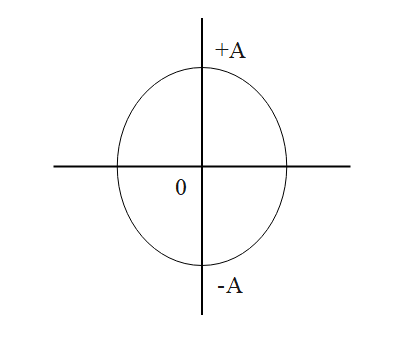
So, Total distance covered by a particle in one oscillation $ = 4A$
we will divide this whole path in $8$ intervals,
Then, each interval would be of measurement $\dfrac{A}{2}$
So, $\dfrac{5}{8}$ oscillations mean, it has already completed $\dfrac{1}{2}$ oscillations
i.e. total distance $ = 2A$ and is halfway to the other side which is $\dfrac{A}{2}$.
Equation of SHM is given by, $Y = A\sin \omega t$; where $A = $ amplitude and $\omega = \dfrac{{2\pi }}{T}$
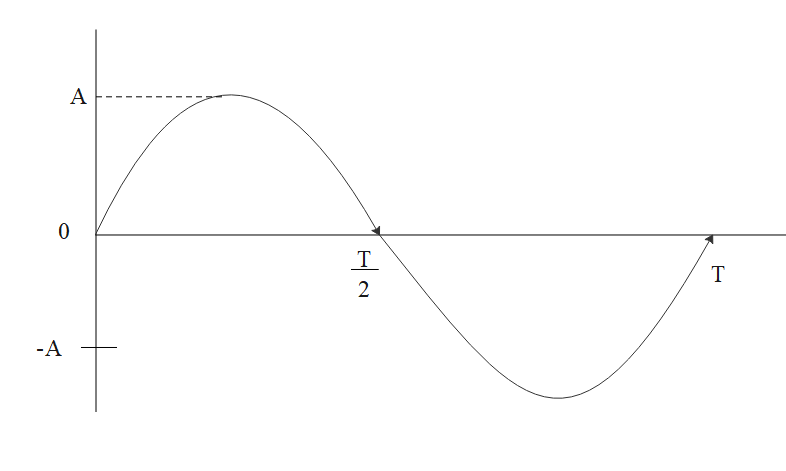
$ \Rightarrow \dfrac{A}{2} = A\sin \dfrac{{2\pi }}{T} \times t$
$t = \dfrac{T}{{12}}$
Now, substituting $t = \dfrac{T}{{12}}$
Total time taken = time to complete previous $\dfrac{1}{2}$ oscillations + time taken to complete $\dfrac{A}{2}$
$ = \dfrac{t}{2} + \dfrac{t}{{12}} = \dfrac{{7T}}{{12}}$
So, the correct answer is “Option D”.
Additional Information: Phasor diagrams are used in simple harmonic motion and RLC circuits which have elements that are out of phase with one another and thus difficult to work with in configuration space.
When the motion of a particle performing uniform circular motion is projected onto its diameter, the projection undergoes simple harmonic motion. The circular motion is the representation of SHM in the phase diagram or phasor, and the angular velocity of this circular motion is the frequency of the SHM.
Note: The equation of SHM explicitly represents a sinusoidal function, i.e. it represents a function which varies periodically with time. Amplitude is defined as the maximum displacement. The shortest time taken to complete one oscillation is defined as the time period.
Formula used:
$Y = A\sin \omega t$
Complete step-by-step answer:
According to phasor diagram concept, we know that
So, Total distance covered by a particle in one oscillation $ = 4A$
we will divide this whole path in $8$ intervals,
Then, each interval would be of measurement $\dfrac{A}{2}$
So, $\dfrac{5}{8}$ oscillations mean, it has already completed $\dfrac{1}{2}$ oscillations
i.e. total distance $ = 2A$ and is halfway to the other side which is $\dfrac{A}{2}$.
Equation of SHM is given by, $Y = A\sin \omega t$; where $A = $ amplitude and $\omega = \dfrac{{2\pi }}{T}$
$ \Rightarrow \dfrac{A}{2} = A\sin \dfrac{{2\pi }}{T} \times t$
$t = \dfrac{T}{{12}}$
Now, substituting $t = \dfrac{T}{{12}}$
Total time taken = time to complete previous $\dfrac{1}{2}$ oscillations + time taken to complete $\dfrac{A}{2}$
$ = \dfrac{t}{2} + \dfrac{t}{{12}} = \dfrac{{7T}}{{12}}$
So, the correct answer is “Option D”.
Additional Information: Phasor diagrams are used in simple harmonic motion and RLC circuits which have elements that are out of phase with one another and thus difficult to work with in configuration space.
When the motion of a particle performing uniform circular motion is projected onto its diameter, the projection undergoes simple harmonic motion. The circular motion is the representation of SHM in the phase diagram or phasor, and the angular velocity of this circular motion is the frequency of the SHM.
Note: The equation of SHM explicitly represents a sinusoidal function, i.e. it represents a function which varies periodically with time. Amplitude is defined as the maximum displacement. The shortest time taken to complete one oscillation is defined as the time period.
Recently Updated Pages
Master Class 12 Economics: Engaging Questions & Answers for Success

Master Class 12 English: Engaging Questions & Answers for Success
Master Class 12 Social Science: Engaging Questions & Answers for Success
Master Class 12 Maths: Engaging Questions & Answers for Success
Master Class 12 Physics: Engaging Questions & Answers for Success
Master Class 12 Business Studies: Engaging Questions & Answers for Success
Trending doubts
Which are the Top 10 Largest Countries of the World?
Draw a labelled sketch of the human eye class 12 physics CBSE
Differentiate between homogeneous and heterogeneous class 12 chemistry CBSE
Why is the cell called the structural and functional class 12 biology CBSE
Draw ray diagrams each showing i myopic eye and ii class 12 physics CBSE
Which is the correct genotypic ratio of mendel dihybrid class 12 biology CBSE