




A particle falls on the earth from: (1) infinity, (2) the height of 10 times the radius of the earth. What will be the ratio of velocity gain on reaching the surface of the earth?
A) $\sqrt {11} :\sqrt {10} $
B) $\sqrt {10} :\sqrt {11} $
C) 10:11
D) 11:10
Answer
 Verified
600.6k+ views
Hint: There is no external force acting in the system of the earth particle system. Therefore, Energy of the system would be conserved, hence, apply this idea for initial and final configurations of the earth and body system for the two cases.
Formula Used:
Potential Energy due to gravitational pull of earth: $P.E = \dfrac{{ - Gm{M_e}}}{r}$
Where $G$ is the gravitational constant, $m$ is the mass of earth and $M$ is the mass of Earth.
Kinetic energy of a particle moving with velocity $v$: \[K.E = \dfrac{1}{2}m{v^2}\]
Where $m$ is the mass of the particle and $v$ is velocity.
Total Energy of the system is conserved: $K.E + P.E = k$
Where $k$ is constant.
Complete step by step answer:
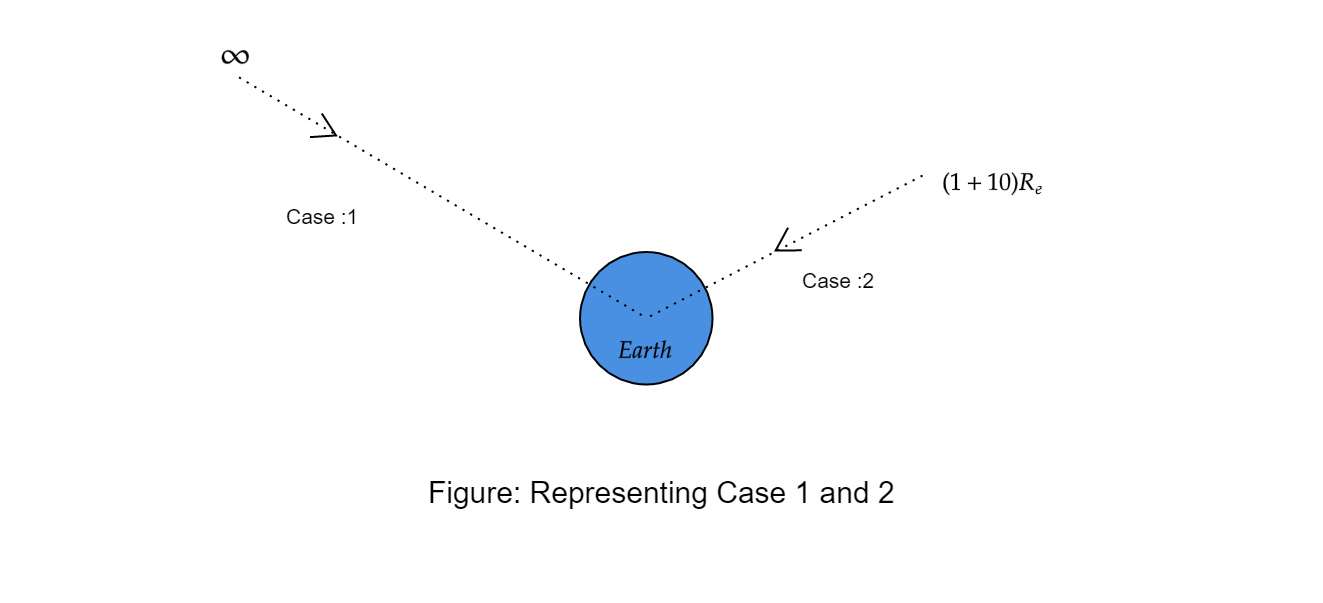
Given initial radii in two cases: $r = \infty $ in case particles coming from infinity and $r = 10{R_{earth}}$ in other case.
Let final velocity be ${v_1}$ and ${v_2}$ for two cases respectively
The following diagram is representing the two cases.
Step 1:
Case 1: The total energy of the combined system earth and particle:
${(T.E)_{initial}} = P.E + K.E$
Initially particle stationery, so $K.E. = 0$
${(T.E)_{initial}} = \dfrac{{ - G{M_e}m}}{\infty } + 0 = 0$ …… (1)
Similarly, in Case 2:
${(T.E)_{initial}} = P.E + K.E$
Initially particle stationery, so $K.E. = 0$
${(T.E)_{initial}} = \dfrac{{ - G{M_e}m}}{{11{R_e}}} + 0$ …… (2)
Step 2: The total energy of the combined system when reaching the earth’s surface:
Case 1:
${(T.E)_{final}} = P.{E_{surface}} + K.{E_{final}}$
${(T.E)_{final}} = \dfrac{{ - G{M_e}m}}{{{R_e}}} + \dfrac{1}{2}m{v_1}^2$ …… (3)
Similarly, in Case 2:
${(T.E)_{final}} = \dfrac{{ - G{M_e}m}}{{{R_e}}} + \dfrac{1}{2}m{v_2}^2$ …… (4)
Step 3: Using conservation of energy condition in each case:
${(T.E)_{initial}} = {(T.E)_{final}}$ …… (5)
Case 1:
Equating equation (1) and (3) we get-
$0 = \dfrac{{ - G{M_e}m}}{{{R_e}}} + \dfrac{1}{2}m{v_1}^2$
$ \Rightarrow - \dfrac{1}{2}m{v_1}^2 = \dfrac{{ - G{M_e}m}}{{{R_e}}}$
$ \Rightarrow {v_1} = \sqrt {\dfrac{{2G{M_e}}}{{{R_e}}}} $ …… (6)
Similarly, in case 2:
Equating equation (2) and (4) we get-
$\dfrac{{ - G{M_e}m}}{{11{R_e}}} + 0 = \dfrac{{ - G{M_e}m}}{{{R_e}}} + \dfrac{1}{2}m{v_2}^2$
$ \Rightarrow \dfrac{{ - G{M_e}}}{{11{R_e}}} + \dfrac{{G{M_e}}}{{{R_e}}} = \dfrac{1}{2}{v_2}^2$
$ \Rightarrow \dfrac{1}{2}{v_2}^2 = \dfrac{{ - G{M_e} + 11G{M_e}}}{{11{R_e}}} = \dfrac{{10G{M_e}}}{{11{R_e}}}$
$ \Rightarrow {v_2} = \sqrt {\dfrac{2}{1}\dfrac{{10G{M_e}}}{{11{R_e}}}} $ …… (7)
Step 4: Taking ratio of two final velocity from equation (6) and (7) we get:
$\dfrac{{{v_1}}}{{{v_2}}} = \dfrac{{\sqrt {\dfrac{{2G{M_e}}}{{{R_e}}}} }}{{\sqrt {\dfrac{2}{1}\dfrac{{10G{M_e}}}{{11{R_e}}}} }} = \dfrac{{\sqrt {11} }}{{\sqrt {10} }}$
Therefore, the correct option is (A) $\sqrt {11} :\sqrt {10} $.
Note:
The total energy of a closed system is always conserved. If there is no energy transformation going on. It means that energy is not dissipating through friction or generating heat or sound or light etc. That is why it is said as a closed system, the total energy of the Universe is constant.
Formula Used:
Potential Energy due to gravitational pull of earth: $P.E = \dfrac{{ - Gm{M_e}}}{r}$
Where $G$ is the gravitational constant, $m$ is the mass of earth and $M$ is the mass of Earth.
Kinetic energy of a particle moving with velocity $v$: \[K.E = \dfrac{1}{2}m{v^2}\]
Where $m$ is the mass of the particle and $v$ is velocity.
Total Energy of the system is conserved: $K.E + P.E = k$
Where $k$ is constant.
Complete step by step answer:
Given initial radii in two cases: $r = \infty $ in case particles coming from infinity and $r = 10{R_{earth}}$ in other case.
Let final velocity be ${v_1}$ and ${v_2}$ for two cases respectively
The following diagram is representing the two cases.
Step 1:
Case 1: The total energy of the combined system earth and particle:
${(T.E)_{initial}} = P.E + K.E$
Initially particle stationery, so $K.E. = 0$
${(T.E)_{initial}} = \dfrac{{ - G{M_e}m}}{\infty } + 0 = 0$ …… (1)
Similarly, in Case 2:
${(T.E)_{initial}} = P.E + K.E$
Initially particle stationery, so $K.E. = 0$
${(T.E)_{initial}} = \dfrac{{ - G{M_e}m}}{{11{R_e}}} + 0$ …… (2)
Step 2: The total energy of the combined system when reaching the earth’s surface:
Case 1:
${(T.E)_{final}} = P.{E_{surface}} + K.{E_{final}}$
${(T.E)_{final}} = \dfrac{{ - G{M_e}m}}{{{R_e}}} + \dfrac{1}{2}m{v_1}^2$ …… (3)
Similarly, in Case 2:
${(T.E)_{final}} = \dfrac{{ - G{M_e}m}}{{{R_e}}} + \dfrac{1}{2}m{v_2}^2$ …… (4)
Step 3: Using conservation of energy condition in each case:
${(T.E)_{initial}} = {(T.E)_{final}}$ …… (5)
Case 1:
Equating equation (1) and (3) we get-
$0 = \dfrac{{ - G{M_e}m}}{{{R_e}}} + \dfrac{1}{2}m{v_1}^2$
$ \Rightarrow - \dfrac{1}{2}m{v_1}^2 = \dfrac{{ - G{M_e}m}}{{{R_e}}}$
$ \Rightarrow {v_1} = \sqrt {\dfrac{{2G{M_e}}}{{{R_e}}}} $ …… (6)
Similarly, in case 2:
Equating equation (2) and (4) we get-
$\dfrac{{ - G{M_e}m}}{{11{R_e}}} + 0 = \dfrac{{ - G{M_e}m}}{{{R_e}}} + \dfrac{1}{2}m{v_2}^2$
$ \Rightarrow \dfrac{{ - G{M_e}}}{{11{R_e}}} + \dfrac{{G{M_e}}}{{{R_e}}} = \dfrac{1}{2}{v_2}^2$
$ \Rightarrow \dfrac{1}{2}{v_2}^2 = \dfrac{{ - G{M_e} + 11G{M_e}}}{{11{R_e}}} = \dfrac{{10G{M_e}}}{{11{R_e}}}$
$ \Rightarrow {v_2} = \sqrt {\dfrac{2}{1}\dfrac{{10G{M_e}}}{{11{R_e}}}} $ …… (7)
Step 4: Taking ratio of two final velocity from equation (6) and (7) we get:
$\dfrac{{{v_1}}}{{{v_2}}} = \dfrac{{\sqrt {\dfrac{{2G{M_e}}}{{{R_e}}}} }}{{\sqrt {\dfrac{2}{1}\dfrac{{10G{M_e}}}{{11{R_e}}}} }} = \dfrac{{\sqrt {11} }}{{\sqrt {10} }}$
Therefore, the correct option is (A) $\sqrt {11} :\sqrt {10} $.
Note:
The total energy of a closed system is always conserved. If there is no energy transformation going on. It means that energy is not dissipating through friction or generating heat or sound or light etc. That is why it is said as a closed system, the total energy of the Universe is constant.
Recently Updated Pages
Master Class 11 Social Science: Engaging Questions & Answers for Success

Master Class 11 Physics: Engaging Questions & Answers for Success
Master Class 11 Maths: Engaging Questions & Answers for Success
Master Class 11 Economics: Engaging Questions & Answers for Success
Master Class 11 Computer Science: Engaging Questions & Answers for Success
Master Class 11 Chemistry: Engaging Questions & Answers for Success
Trending doubts
One Metric ton is equal to kg A 10000 B 1000 C 100 class 11 physics CBSE
There are 720 permutations of the digits 1 2 3 4 5 class 11 maths CBSE
1 Quintal is equal to a 110 kg b 10 kg c 100kg d 1000 class 11 physics CBSE
State and prove Bernoullis theorem class 11 physics CBSE
Difference Between Prokaryotic Cells and Eukaryotic Cells
Which among the following are examples of coming together class 11 social science CBSE