




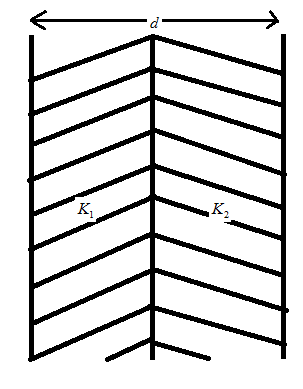
A parallel plate condenser is filled with two dielectrics as shown in figure. Area of each plate is $ A{m^2} $ and the separation is $ d $ meter. The dielectric constants are $ {K_1} $ and $ {K_2} $ respectively. Its capacitance (in farad) will be:
(A) $ \dfrac{{2{\varepsilon _0}A}}{d}\left( {\dfrac{{{K_1} + {K_2}}}{{{K_1}{K_2}}}} \right) $
(B) $ \dfrac{{2{\varepsilon _0}A}}{d}\left( {\dfrac{{{K_1}{K_2}}}{{{K_1} + {K_2}}}} \right) $
(C) $ \dfrac{{{\varepsilon _0}A}}{d}\left( {\dfrac{{{K_1} + {K_2}}}{{2{K_1}{K_2}}}} \right) $
(D) $ \dfrac{{{\varepsilon _0}A{K_1}{K_2}}}{{2\left( {{d_2}{K_1} + {d_1}{K_2}} \right)}} $
Answer
 Verified
563.1k+ views
Hint :Here, use the given figure and also the information given in the question such that the space between the parallel plates is divided into two equal parts hence the distance between two plates is divides as $ \dfrac{d}{2} $ and $ \dfrac{d}{2} $ . Use formula for effective capacitance of capacitors in series combination.
Complete Step By Step Answer:
Here, in the above figure and the information given says that the parallel plate capacitor is half filled with dielectric $ {K_1} $ and half with $ {K_2} $ and the total area is $ A{m^2} $ and the distance is divided between two dielectrics is $ d $ . Let $ {C_1} $ be the capacitance of capacitor with $ {K_1} $ and $ {C_2} $ be the capacitance of capacitor with dielectric $ {K_2} $
Thus, we have formula for calculating the capacitance as
$ C = \dfrac{{KA{\varepsilon _0}}}{d} $ ….(general formula for capacitance)
Thus we have,
$ {C_1} = \dfrac{{{K_1}A{\varepsilon _0}}}{{\dfrac{d}{2}}} $
$ \Rightarrow {C_1} = \dfrac{{2{K_1}A{\varepsilon _0}}}{d} $ …. $ (1) $
Similarly,
$ {C_2} = \dfrac{{2{K_2}A{\varepsilon _0}}}{d} $ …. $ (2) $
They are in series. Thus, we have to use the formula for effective capacitance in series combination.
So,
$ {C_{eff}} = \dfrac{1}{{{C_1}}} + \dfrac{1}{{{C_2}}} $
$ \Rightarrow {C_{eff}} = \dfrac{{{C_1}{C_2}}}{{{C_1} + {C_2}}} $
From equations $ (1) $ and $ (2) $ , we can write above equation as:
$ \Rightarrow {C_{eff}} = \dfrac{{\left( {\dfrac{{2{K_1}A{\varepsilon _0}}}{d}} \right)\left( {\dfrac{{2{K_2}A{\varepsilon _0}}}{d}} \right)}}{{\left( {\dfrac{{2{K_1}A{\varepsilon _0}}}{d} + \dfrac{{2{K_2}A{\varepsilon _0}}}{d}} \right)}} $
$ \Rightarrow {C_{eff}} = \dfrac{{4\left( {{K_1}{K_2}\dfrac{{{A^2}{\varepsilon _0}^2}}{{{d^2}}}} \right)}}{{\left( {2{K_1} + 2{K_2}} \right)\dfrac{{A{\varepsilon _0}}}{d}}} $
$ \Rightarrow {C_{eff}} = \dfrac{4}{2}\left( {\dfrac{{{K_1}{K_2}}}{{{K_1} + {K_2}}}} \right)\dfrac{{A{\varepsilon _0}}}{d} $
$ \Rightarrow {C_{eff}} = 2\dfrac{{A{\varepsilon _0}}}{d}\left( {\dfrac{{{K_1}{K_2}}}{{{K_1} + {K_2}}}} \right) $
Thus, the required answer is given by $ \dfrac{{2A{\varepsilon _0}}}{d}\left( {\dfrac{{{K_1}{K_2}}}{{{K_1} + {K_2}}}} \right) $
The correct answer is option B.
Note :
Here, we can observe that the capacitor is filled with two different dielectrics which divides the capacitor from between in two equal parts. Here we see that the gap between two parallel plates is divided between two in two equal parts. And also these two capacitors are connected in series that is why we use the series combination formula for calculating capacitance in the capacitor.
Complete Step By Step Answer:
Here, in the above figure and the information given says that the parallel plate capacitor is half filled with dielectric $ {K_1} $ and half with $ {K_2} $ and the total area is $ A{m^2} $ and the distance is divided between two dielectrics is $ d $ . Let $ {C_1} $ be the capacitance of capacitor with $ {K_1} $ and $ {C_2} $ be the capacitance of capacitor with dielectric $ {K_2} $
Thus, we have formula for calculating the capacitance as
$ C = \dfrac{{KA{\varepsilon _0}}}{d} $ ….(general formula for capacitance)
Thus we have,
$ {C_1} = \dfrac{{{K_1}A{\varepsilon _0}}}{{\dfrac{d}{2}}} $
$ \Rightarrow {C_1} = \dfrac{{2{K_1}A{\varepsilon _0}}}{d} $ …. $ (1) $
Similarly,
$ {C_2} = \dfrac{{2{K_2}A{\varepsilon _0}}}{d} $ …. $ (2) $
They are in series. Thus, we have to use the formula for effective capacitance in series combination.
So,
$ {C_{eff}} = \dfrac{1}{{{C_1}}} + \dfrac{1}{{{C_2}}} $
$ \Rightarrow {C_{eff}} = \dfrac{{{C_1}{C_2}}}{{{C_1} + {C_2}}} $
From equations $ (1) $ and $ (2) $ , we can write above equation as:
$ \Rightarrow {C_{eff}} = \dfrac{{\left( {\dfrac{{2{K_1}A{\varepsilon _0}}}{d}} \right)\left( {\dfrac{{2{K_2}A{\varepsilon _0}}}{d}} \right)}}{{\left( {\dfrac{{2{K_1}A{\varepsilon _0}}}{d} + \dfrac{{2{K_2}A{\varepsilon _0}}}{d}} \right)}} $
$ \Rightarrow {C_{eff}} = \dfrac{{4\left( {{K_1}{K_2}\dfrac{{{A^2}{\varepsilon _0}^2}}{{{d^2}}}} \right)}}{{\left( {2{K_1} + 2{K_2}} \right)\dfrac{{A{\varepsilon _0}}}{d}}} $
$ \Rightarrow {C_{eff}} = \dfrac{4}{2}\left( {\dfrac{{{K_1}{K_2}}}{{{K_1} + {K_2}}}} \right)\dfrac{{A{\varepsilon _0}}}{d} $
$ \Rightarrow {C_{eff}} = 2\dfrac{{A{\varepsilon _0}}}{d}\left( {\dfrac{{{K_1}{K_2}}}{{{K_1} + {K_2}}}} \right) $
Thus, the required answer is given by $ \dfrac{{2A{\varepsilon _0}}}{d}\left( {\dfrac{{{K_1}{K_2}}}{{{K_1} + {K_2}}}} \right) $
The correct answer is option B.
Note :
Here, we can observe that the capacitor is filled with two different dielectrics which divides the capacitor from between in two equal parts. Here we see that the gap between two parallel plates is divided between two in two equal parts. And also these two capacitors are connected in series that is why we use the series combination formula for calculating capacitance in the capacitor.
Recently Updated Pages
Master Class 12 Economics: Engaging Questions & Answers for Success

Master Class 12 English: Engaging Questions & Answers for Success
Master Class 12 Social Science: Engaging Questions & Answers for Success
Master Class 12 Maths: Engaging Questions & Answers for Success
Master Class 12 Physics: Engaging Questions & Answers for Success
Master Class 12 Business Studies: Engaging Questions & Answers for Success
Trending doubts
Which are the Top 10 Largest Countries of the World?
Draw a labelled sketch of the human eye class 12 physics CBSE
Differentiate between homogeneous and heterogeneous class 12 chemistry CBSE
Sulphuric acid is known as the king of acids State class 12 chemistry CBSE
Why is the cell called the structural and functional class 12 biology CBSE
Draw ray diagrams each showing i myopic eye and ii class 12 physics CBSE