




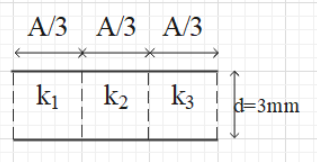
A parallel plate capacitor is of area 6$c{{m}^{2}}$ and a separation 3mm. The gap is filled with three dielectric materials of equal thickness (see figure) with dielectric constant ${{k}_{1}}=10$, ${{k}_{2}}=12$ and ${{k}_{3}}=14$. The dielectric constant of a material which when fully inserted in above capacitor gives same capacitor would be
A. 12
B. 4
C. 36
D. 14
Answer
 Verified
627.9k+ views
Hint: When a dielectric medium (material) is inserted in between the parallel plates of a capacitance, the capacitor acts as a new capacitor with more capacitance value. i.e. $C'=\dfrac{k{{\varepsilon }_{{}^\circ }}A}{d}=kC$. If there are more than one dielectric materials, each dielectric material acts as a separate capacitor. Then we can convert the dielectrics into capacitors, which makes the work easier. Also, use the formulas for finding the equivalent capacitance when the capacitors are in series and parallel connection.
Formulas used:
$C'=\dfrac{k{{\varepsilon }_{{}^\circ }}A}{d}=kC$
$C={{C}_{1}}+{{C}_{2}}+{{C}_{3}}$
Complete answer:
The capacitance of capacitor is given as $C=\dfrac{{{\varepsilon }_{\circ }}A}{d}$ , where C is the capacitance of the capacitor, A is area of parallel metal plates, d is the perpendicular distance between the two parallel plates and ${{\varepsilon }_{\circ }}$ is the permittivity of the free space. This value of capacitance is when there is air in the space between the plates. If there is another medium, which we call as dielectric then the capacitance of the capacitor changes. Dielectric medium is a poor conducting material that creates an internal electric field when an external electric field acts on it.
To understand the new electric field created between the plates after adding the dielectric material, we have something known as dielectric constant (k). $k=\dfrac{E}{E'}$, where E is the electric field without the dielectric material and E’ is the reduced electric field after inserting the dielectric material. The value of k is always greater than one.
When a dielectric material is inserted in between the parallel plates of the capacitor, the capacitance of the capacitor increases by a factor of K called dielectric constant. Therefore, the new capacitance becomes $C'=\dfrac{k{{\varepsilon }_{\circ }}A}{d}=kC$.
So the dielectric acts as an updated capacitor in the circuit.
Air is also a dielectric medium with dielectric constant equal to 1.
In the given figure, there are three dielectrics and dielectric constants are ${{k}_{1}}$, ${{k}_{2}}$ and ${{k}_{3}}$ as shown.
If you see the given figure, we can divide it into three different capacitors. Let the capacitance with dielectric constants ${{k}_{1}}$, ${{k}_{2}}$ and ${{k}_{3}}$ be ${{C}_{1}}$, ${{C}_{2}}$ and ${{C}_{3}}$ respectively. Let us now write the expression for each capacitance.
The width of the capacitor (${{C}_{1}}$) is d and the area is $\dfrac{A}{3}$, so the capacitance ${{C}_{1}}={{k}_{1}}\dfrac{{{\varepsilon }_{\circ }}\left( \dfrac{A}{3} \right)}{d}={{k}_{1}}\dfrac{{{\varepsilon }_{\circ }}A}{3d}$ ……….(1).
Similarly, the capacitance${{C}_{2}}={{k}_{2}}\dfrac{{{\varepsilon }_{\circ }}\left( \dfrac{A}{3} \right)}{d}={{k}_{2}}\dfrac{{{\varepsilon }_{\circ }}A}{3d}$ ……..(2).
And ${{C}_{3}}={{k}_{3}}\dfrac{{{\varepsilon }_{\circ }}\left( \dfrac{A}{3} \right)}{d}={{k}_{3}}\dfrac{{{\varepsilon }_{\circ }}A}{3d}$ ….. (3)
As we can see that the dielectric with electric constants ${{k}_{1}}$ and ${{k}_{2}}$ are in series and ${{k}_{3}}$ is in parallel with the series connection of ${{k}_{1}}$ and ${{k}_{3}}$. Redraw the figure and replace the dielectrics with their respective capacitance as shown. It will be easier to understand.
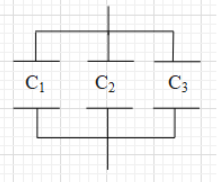
All the three capacitors are in parallel. Therefore, effective capacitance ($C$) of these three will be the sum of the individual capacitances i.e.
$C={{C}_{1}}+{{C}_{2}}+{{C}_{3}}$ .
Substitute the values of ${{C}_{1}}$, ${{C}_{2}}$ and ${{C}_{3}}$ from equations (1), (2) and (3).
$\Rightarrow C={{k}_{1}}\dfrac{{{\varepsilon }_{\circ }}A}{3d}+{{k}_{2}}\dfrac{{{\varepsilon }_{\circ }}A}{3d}+{{k}_{3}}\dfrac{{{\varepsilon }_{\circ }}A}{3d}$
$\Rightarrow C=\left( \dfrac{{{k}_{1}}+{{k}_{3}}+{{k}_{3}}}{3} \right)\dfrac{{{\varepsilon }_{\circ }}A}{d}$.
If we replace these dielectric with the single dielectric of dielectric constant k, the value of C must remain the same, i.e. $C=\left( \dfrac{{{k}_{1}}+{{k}_{3}}+{{k}_{3}}}{3} \right)\dfrac{{{\varepsilon }_{\circ }}A}{d}$.
This means that $\left( \dfrac{{{k}_{1}}+{{k}_{3}}+{{k}_{3}}}{3} \right)=k$
It is given that ${{k}_{1}}=10$, ${{k}_{2}}=12$ and ${{k}_{3}}=14$. Substitute the value in the above equation.
$\Rightarrow k=\left( \dfrac{10+12+14}{3} \right)=12$.
Hence, the correct option is A.
Note:
Different materials have different values of dielectric constant. The perfectly conducting materials have the value dielectric constants as infinity ($k=\infty $). A perfectly insulating material has the value of dielectric constant as zero ($k=0$).
In these types of questions, always remember to convert the dielectrics into capacitors. Then check which are in series and which are in parallel connection and solve accordingly.
Formulas used:
$C'=\dfrac{k{{\varepsilon }_{{}^\circ }}A}{d}=kC$
$C={{C}_{1}}+{{C}_{2}}+{{C}_{3}}$
Complete answer:
The capacitance of capacitor is given as $C=\dfrac{{{\varepsilon }_{\circ }}A}{d}$ , where C is the capacitance of the capacitor, A is area of parallel metal plates, d is the perpendicular distance between the two parallel plates and ${{\varepsilon }_{\circ }}$ is the permittivity of the free space. This value of capacitance is when there is air in the space between the plates. If there is another medium, which we call as dielectric then the capacitance of the capacitor changes. Dielectric medium is a poor conducting material that creates an internal electric field when an external electric field acts on it.
To understand the new electric field created between the plates after adding the dielectric material, we have something known as dielectric constant (k). $k=\dfrac{E}{E'}$, where E is the electric field without the dielectric material and E’ is the reduced electric field after inserting the dielectric material. The value of k is always greater than one.
When a dielectric material is inserted in between the parallel plates of the capacitor, the capacitance of the capacitor increases by a factor of K called dielectric constant. Therefore, the new capacitance becomes $C'=\dfrac{k{{\varepsilon }_{\circ }}A}{d}=kC$.
So the dielectric acts as an updated capacitor in the circuit.
Air is also a dielectric medium with dielectric constant equal to 1.
In the given figure, there are three dielectrics and dielectric constants are ${{k}_{1}}$, ${{k}_{2}}$ and ${{k}_{3}}$ as shown.
If you see the given figure, we can divide it into three different capacitors. Let the capacitance with dielectric constants ${{k}_{1}}$, ${{k}_{2}}$ and ${{k}_{3}}$ be ${{C}_{1}}$, ${{C}_{2}}$ and ${{C}_{3}}$ respectively. Let us now write the expression for each capacitance.
The width of the capacitor (${{C}_{1}}$) is d and the area is $\dfrac{A}{3}$, so the capacitance ${{C}_{1}}={{k}_{1}}\dfrac{{{\varepsilon }_{\circ }}\left( \dfrac{A}{3} \right)}{d}={{k}_{1}}\dfrac{{{\varepsilon }_{\circ }}A}{3d}$ ……….(1).
Similarly, the capacitance${{C}_{2}}={{k}_{2}}\dfrac{{{\varepsilon }_{\circ }}\left( \dfrac{A}{3} \right)}{d}={{k}_{2}}\dfrac{{{\varepsilon }_{\circ }}A}{3d}$ ……..(2).
And ${{C}_{3}}={{k}_{3}}\dfrac{{{\varepsilon }_{\circ }}\left( \dfrac{A}{3} \right)}{d}={{k}_{3}}\dfrac{{{\varepsilon }_{\circ }}A}{3d}$ ….. (3)
As we can see that the dielectric with electric constants ${{k}_{1}}$ and ${{k}_{2}}$ are in series and ${{k}_{3}}$ is in parallel with the series connection of ${{k}_{1}}$ and ${{k}_{3}}$. Redraw the figure and replace the dielectrics with their respective capacitance as shown. It will be easier to understand.
All the three capacitors are in parallel. Therefore, effective capacitance ($C$) of these three will be the sum of the individual capacitances i.e.
$C={{C}_{1}}+{{C}_{2}}+{{C}_{3}}$ .
Substitute the values of ${{C}_{1}}$, ${{C}_{2}}$ and ${{C}_{3}}$ from equations (1), (2) and (3).
$\Rightarrow C={{k}_{1}}\dfrac{{{\varepsilon }_{\circ }}A}{3d}+{{k}_{2}}\dfrac{{{\varepsilon }_{\circ }}A}{3d}+{{k}_{3}}\dfrac{{{\varepsilon }_{\circ }}A}{3d}$
$\Rightarrow C=\left( \dfrac{{{k}_{1}}+{{k}_{3}}+{{k}_{3}}}{3} \right)\dfrac{{{\varepsilon }_{\circ }}A}{d}$.
If we replace these dielectric with the single dielectric of dielectric constant k, the value of C must remain the same, i.e. $C=\left( \dfrac{{{k}_{1}}+{{k}_{3}}+{{k}_{3}}}{3} \right)\dfrac{{{\varepsilon }_{\circ }}A}{d}$.
This means that $\left( \dfrac{{{k}_{1}}+{{k}_{3}}+{{k}_{3}}}{3} \right)=k$
It is given that ${{k}_{1}}=10$, ${{k}_{2}}=12$ and ${{k}_{3}}=14$. Substitute the value in the above equation.
$\Rightarrow k=\left( \dfrac{10+12+14}{3} \right)=12$.
Hence, the correct option is A.
Note:
Different materials have different values of dielectric constant. The perfectly conducting materials have the value dielectric constants as infinity ($k=\infty $). A perfectly insulating material has the value of dielectric constant as zero ($k=0$).
In these types of questions, always remember to convert the dielectrics into capacitors. Then check which are in series and which are in parallel connection and solve accordingly.
Recently Updated Pages
Master Class 12 Business Studies: Engaging Questions & Answers for Success

Master Class 12 Chemistry: Engaging Questions & Answers for Success
Master Class 12 Biology: Engaging Questions & Answers for Success
Class 12 Question and Answer - Your Ultimate Solutions Guide
Master Class 11 English: Engaging Questions & Answers for Success
Master Class 11 Social Science: Engaging Questions & Answers for Success
Trending doubts
Which are the Top 10 Largest Countries of the World?
Draw a labelled sketch of the human eye class 12 physics CBSE
Differentiate between homogeneous and heterogeneous class 12 chemistry CBSE
Differentiate between Pyramid of energy and pyramid class 12 biology CBSE
Why is the cell called the structural and functional class 12 biology CBSE
Draw the diagram of the pyramid of energy Explain In class 12 biology CBSE