




A parallel beam of light is incident from air at an angle \[\alpha \] on the side PQ of a right angled triangular prism of a refractive index \[\eta = \sqrt 2 \]. Light undergoes total internal reflection in the prism at the face PR when \[\alpha \] has a minimum value of \[{45^o}\]. The angle \[\theta \] of the prism is:
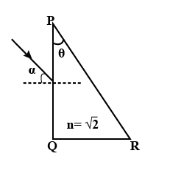
A. \[{15^o}\]
B. \[{22.5^o}\]
C. \[{30^o}\]
D. \[{45^o}\]
Answer
 Verified
660.9k+ views
Hint – In questions we should remember the laws of refraction and specially the Snell’s law i.e.
${n_1}\sin \alpha = {n_2}\sin \beta $, where \[\alpha \] is angle of incidence and $\beta $ is angle of refraction.
Formula used-
1) ${n_1}\sin \alpha = {n_2}\sin \beta $
2) Angle sum of a triangle is ${180^o}$
Complete step-by-step answer:
The ray will bend toward the normal since it goes from the rarer to denser medium and then strikes with the face PR and then TIR happens.
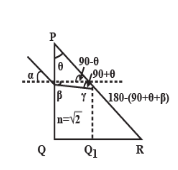
Given, \[\eta = \sqrt 2 \]
${\alpha _{\min }} = {45^o}$
We know that, ${n_1}\sin \alpha = {n_2}\sin \beta $
$1 \times \sin \alpha = n \times \sin \beta $
When the value of ${\alpha _{\min }} = {45^o}$and \[\eta = \sqrt 2 \].
Then the value of $\sin \beta = \dfrac{1}{2}$
Therefore the value of\[\beta = {30^o}\]
Here the new term \[\delta \] is called the angle of deviation. It is defined as the difference of the angle between refraction and the incidence angle and this angle is made when there is a minimum two mediums of different refractive index as here it is air and glass.
\[\delta = 90 - (180 - (90 + \theta + \beta ))\]
∴ Applying Snell's law at surface PR we get the equation as:
\[
\therefore \sqrt 2 \sin \delta = 1 \\
\therefore \sin (\theta + \beta ) = \dfrac{1}{{\sqrt 2 }} \\
\theta + \beta = {45^o} \\
\theta + {30^o} = {45^o} \\
Therefore,\theta = {15^o} \\
\]
Hence, the correct option is A.
Note: In this question we should use Snell's law of refraction and basic geometry of triangles to find the angle as the sum of angles of a triangle is ${180^o}$. Doing this will solve your problem. Generally these types of problems arise from this chapter. So, learning the important formulas will be a better option for students.
${n_1}\sin \alpha = {n_2}\sin \beta $, where \[\alpha \] is angle of incidence and $\beta $ is angle of refraction.
Formula used-
1) ${n_1}\sin \alpha = {n_2}\sin \beta $
2) Angle sum of a triangle is ${180^o}$
Complete step-by-step answer:
The ray will bend toward the normal since it goes from the rarer to denser medium and then strikes with the face PR and then TIR happens.
Given, \[\eta = \sqrt 2 \]
${\alpha _{\min }} = {45^o}$
We know that, ${n_1}\sin \alpha = {n_2}\sin \beta $
$1 \times \sin \alpha = n \times \sin \beta $
When the value of ${\alpha _{\min }} = {45^o}$and \[\eta = \sqrt 2 \].
Then the value of $\sin \beta = \dfrac{1}{2}$
Therefore the value of\[\beta = {30^o}\]
Here the new term \[\delta \] is called the angle of deviation. It is defined as the difference of the angle between refraction and the incidence angle and this angle is made when there is a minimum two mediums of different refractive index as here it is air and glass.
\[\delta = 90 - (180 - (90 + \theta + \beta ))\]
∴ Applying Snell's law at surface PR we get the equation as:
\[
\therefore \sqrt 2 \sin \delta = 1 \\
\therefore \sin (\theta + \beta ) = \dfrac{1}{{\sqrt 2 }} \\
\theta + \beta = {45^o} \\
\theta + {30^o} = {45^o} \\
Therefore,\theta = {15^o} \\
\]
Hence, the correct option is A.
Note: In this question we should use Snell's law of refraction and basic geometry of triangles to find the angle as the sum of angles of a triangle is ${180^o}$. Doing this will solve your problem. Generally these types of problems arise from this chapter. So, learning the important formulas will be a better option for students.
Recently Updated Pages
Explain the structure of megasporangium class 12 biology CBSE

Why is chloroform kept in dark coloured bottles class 12 chemistry CBSE
Derive the balancing condition of a Wheatstone bri class 12 physics CBSE
Draw VI characteristics of a pn junction diode Explain class 12 physics CBSE
Is it possible to carry pride in ones language too class 12 english CBSE
In a population at Hardy Weinberg equilibrium the allele class 12 biology CBSE
Trending doubts
Draw a labelled sketch of the human eye class 12 physics CBSE
Which are the Top 10 Largest Countries of the World?
Draw ray diagrams each showing i myopic eye and ii class 12 physics CBSE
Which is the correct genotypic ratio of mendel dihybrid class 12 biology CBSE
Differentiate between homogeneous and heterogeneous class 12 chemistry CBSE
Which animal never drinks water in its entire life class 12 biology CBSE