




A parallel beam of light falls on a convex lens. The path of the rays is shown in the figure. It follows that
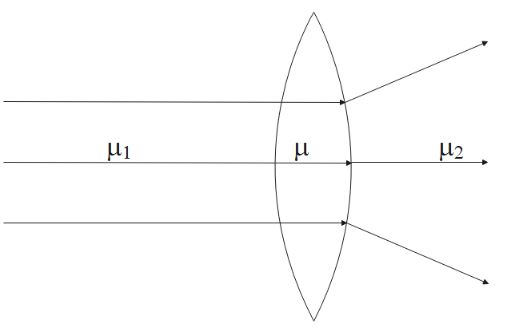
A. ${\mu _1} > \mu > {\mu _2}$
B. ${\mu _2} < \mu < {\mu _1}$
C. ${\mu _1} = \mu < {\mu _2}$
D. ${\mu _1} = \mu > {\mu _2}$
Answer
 Verified
570.3k+ views
Hint:This question utilizes the concept of refraction. When a ray of light travels from one medium to another of different refractive indexes, the speed of light changes. This causes the ray of light to bend. But, if the ray travels from one medium to another without any change in refractive index, light does not bend.
Complete step by step answer:
When light passes from a denser to a rarer ( less dense ) substance, (for example passing from water into air), the light is refracted (or bent) away from the normal. Similarly, when it passes from a rarer to a denser substance, it bends towards the normal.
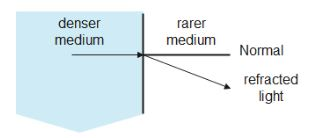
The normal is a line perpendicular (forming a 90 degree angle) to the boundary (contact surface) between the two substances. The bending occurs because light travels more slowly in a denser medium and faster in a rarer medium.
Let The medium with refractive index ${\mu _1}$ be $medium{\kern 1pt} {\kern 1pt} 1$, $\mu $ be $medium{\kern 1pt} {\kern 1pt} 2$ and ${\mu _2}$ be $medium{\kern 1pt} {\kern 1pt} 3$
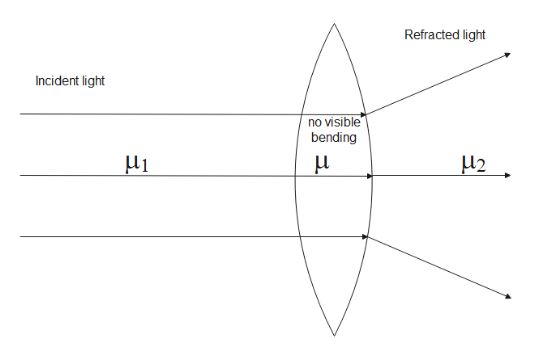
From this figure, we can see that when the incident light passes from $medium{\kern 1pt} {\kern 1pt} 1$ to $medium{\kern 1pt} {\kern 1pt} 2$ , there is no deviation, which means that
${\mu _1} = \mu $ ------------(i)
Now, when the ray passes from $medium{\kern 1pt} {\kern 1pt} 2$ to $medium{\kern 1pt} {\kern 1pt} 3$ , it gets refracted. By observing closely, we can see that the ray diverges from the lens.
If the ray was converging, we could have said that $\mu > {\mu _2}$
Since they are diverging,
$\mu < {\mu _2}$ -----------(ii)
Merging eq (i) and (ii), we get
${\mu _1} = \mu < {\mu _2}$
Therefore, the correct option is C.
Note:When a ray travels through the optical centre of any lens, it passes through the lens symmetrically and undeviated. This is because it passes through the normal of the intersecting medium. Thus, in the figure, the ray passing through the between of the lens does not get deviated.
Complete step by step answer:
When light passes from a denser to a rarer ( less dense ) substance, (for example passing from water into air), the light is refracted (or bent) away from the normal. Similarly, when it passes from a rarer to a denser substance, it bends towards the normal.
The normal is a line perpendicular (forming a 90 degree angle) to the boundary (contact surface) between the two substances. The bending occurs because light travels more slowly in a denser medium and faster in a rarer medium.
Let The medium with refractive index ${\mu _1}$ be $medium{\kern 1pt} {\kern 1pt} 1$, $\mu $ be $medium{\kern 1pt} {\kern 1pt} 2$ and ${\mu _2}$ be $medium{\kern 1pt} {\kern 1pt} 3$
From this figure, we can see that when the incident light passes from $medium{\kern 1pt} {\kern 1pt} 1$ to $medium{\kern 1pt} {\kern 1pt} 2$ , there is no deviation, which means that
${\mu _1} = \mu $ ------------(i)
Now, when the ray passes from $medium{\kern 1pt} {\kern 1pt} 2$ to $medium{\kern 1pt} {\kern 1pt} 3$ , it gets refracted. By observing closely, we can see that the ray diverges from the lens.
If the ray was converging, we could have said that $\mu > {\mu _2}$
Since they are diverging,
$\mu < {\mu _2}$ -----------(ii)
Merging eq (i) and (ii), we get
${\mu _1} = \mu < {\mu _2}$
Therefore, the correct option is C.
Note:When a ray travels through the optical centre of any lens, it passes through the lens symmetrically and undeviated. This is because it passes through the normal of the intersecting medium. Thus, in the figure, the ray passing through the between of the lens does not get deviated.
Recently Updated Pages
Explain the structure of megasporangium class 12 biology CBSE

Why is chloroform kept in dark coloured bottles class 12 chemistry CBSE
Derive the balancing condition of a Wheatstone bri class 12 physics CBSE
Draw VI characteristics of a pn junction diode Explain class 12 physics CBSE
Is it possible to carry pride in ones language too class 12 english CBSE
In a population at Hardy Weinberg equilibrium the allele class 12 biology CBSE
Trending doubts
Draw a labelled sketch of the human eye class 12 physics CBSE
Which are the Top 10 Largest Countries of the World?
Draw ray diagrams each showing i myopic eye and ii class 12 physics CBSE
One megawatt is equal to how many units of electri class 12 physics CBSE
Which is the correct genotypic ratio of mendel dihybrid class 12 biology CBSE
Give 10 examples of unisexual and bisexual flowers