




A nylon guitar string has a linear density of $7.20g/m$ and is under a tension of $150N$. The fixed supports are distance D$ = 90cm$ apart. The string is oscillating in the standing wave pattern shown in the figure.
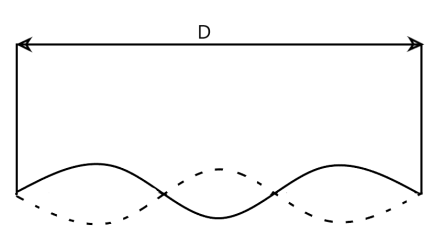
(I) The speed of the travelling waves whose superposition gives this standing wave
(A) $\dfrac{{125}}{{\sqrt 3 }}m/s$
(B) $\dfrac{{500}}{{\sqrt 3 }}m/s$
(C) $\dfrac{{250}}{{\sqrt 3 }}m/s$
(D) $100\sqrt 3 m/s$
(II) The wavelength of the travelling waves whose superposition gives this standing wave
(A) $20cm$
(B) $40.0cm$
(C) $60.0cm$
(D) $80.0cm$
(III) The frequency of the travelling waves whose superposition gives this standing wave
(A) $\dfrac{{1000}}{{3\sqrt 3 }}Hz$
(B) $\dfrac{{1250}}{{3\sqrt 3 }}Hz$
(C)$\dfrac{{1500}}{{3\sqrt 3 }}Hz$
(D) $\dfrac{{1750}}{{3\sqrt 3 }}Hz$
Answer
 Verified
576.6k+ views
Hint: The speed of the wave has a relation with the linear density$(\mu )$ and tension$(T)$ as speed $v = \sqrt {\dfrac{T}{\mu }} $ . And wavelength is basically the distance between two successive crests or troughs of a wave. The frequency of a wave is the ratio of the speed and the wavelength of the wave.
Complete answer:
The pulling force along the length or the tension is given $150N$ and mass per unit length or linear density is given $7.20g/m$ .
(I) So $T = 150N$ and $\mu = 7.20g/m$ $ = 7.20 \times {10^{ - 3}}kg/m$
Now $v = \sqrt {\dfrac{T}{\mu }} $ $ = \sqrt {\dfrac{{150}}{{7.20 \times {{10}^{ - 3}}}}} $ $m/s$
$ = \sqrt {\dfrac{{150}}{{720 \times {{10}^{ - 5}}}}} $$m/s$
$ = \sqrt {\dfrac{{150 \times {{10}^5}}}{{720}}} $ $m/s$
$ = \sqrt {\dfrac{{62500}}{3}} m/s$
$ = \dfrac{{250}}{{\sqrt 3 }}m/s$
So, the speed of the travelling waves whose superposition gives this standing wave is $\dfrac{{250}}{{\sqrt 3 }}m/s$.
The correct answer is option (C)
(II) Wavelength is the distance between two successive crests or troughs. So we can draw the wavelength for this wave like
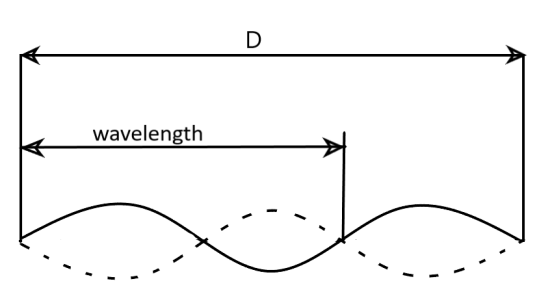
Two half cycles complete a wavelength$(\lambda )$. So one half cycle means $\dfrac{\lambda }{2}$ . Here $3$ half cycles are present in between distance $D$$ = 90cm$
Hence, $3 \times \dfrac{\lambda }{2} = 90$
$ \Rightarrow \lambda = 30 \times 2$
$ \Rightarrow \lambda = 60$
So, the wavelength of the travelling waves whose superposition gives this standing wave is $60.0cm$.
The correct answer is option (C)
(III) The ratio of the speed of speed and wavelength of the wave is its frequency. Frequency describes the number of waves that pass a particular place in a particular time.
So, frequency $ = \dfrac{v}{\lambda }$ [ where $v$ is the speed and $\lambda $ is the wavelength of that wave]
Now $v = \dfrac{{250}}{{\sqrt 3 }}m/s$ and $\lambda = 60cm = .6m$
Frequency $ = $ $\dfrac{{250}}{{\sqrt 3 }} \div 0.6$$Hz$
$ = \dfrac{{2500}}{{6\sqrt 3 }}$$Hz$
$ = \dfrac{{1250}}{{3\sqrt 3 }}$$Hz$
So, the frequency of the travelling waves whose superposition gives this standing wave is $\dfrac{{1250}}{{3\sqrt 3 }}Hz$
The correct answer is option (B).
Note:
A guitar string has a number of frequencies at which it vibrates naturally. These natural frequencies are called the harmonics of the guitar strings. And the natural frequency and wavelength depend upon the tension, linear density and the tension of the string. Solving this problem with making a meaningful diagram makes this problem a lot easier to solve.
Complete answer:
The pulling force along the length or the tension is given $150N$ and mass per unit length or linear density is given $7.20g/m$ .
(I) So $T = 150N$ and $\mu = 7.20g/m$ $ = 7.20 \times {10^{ - 3}}kg/m$
Now $v = \sqrt {\dfrac{T}{\mu }} $ $ = \sqrt {\dfrac{{150}}{{7.20 \times {{10}^{ - 3}}}}} $ $m/s$
$ = \sqrt {\dfrac{{150}}{{720 \times {{10}^{ - 5}}}}} $$m/s$
$ = \sqrt {\dfrac{{150 \times {{10}^5}}}{{720}}} $ $m/s$
$ = \sqrt {\dfrac{{62500}}{3}} m/s$
$ = \dfrac{{250}}{{\sqrt 3 }}m/s$
So, the speed of the travelling waves whose superposition gives this standing wave is $\dfrac{{250}}{{\sqrt 3 }}m/s$.
The correct answer is option (C)
(II) Wavelength is the distance between two successive crests or troughs. So we can draw the wavelength for this wave like
Two half cycles complete a wavelength$(\lambda )$. So one half cycle means $\dfrac{\lambda }{2}$ . Here $3$ half cycles are present in between distance $D$$ = 90cm$
Hence, $3 \times \dfrac{\lambda }{2} = 90$
$ \Rightarrow \lambda = 30 \times 2$
$ \Rightarrow \lambda = 60$
So, the wavelength of the travelling waves whose superposition gives this standing wave is $60.0cm$.
The correct answer is option (C)
(III) The ratio of the speed of speed and wavelength of the wave is its frequency. Frequency describes the number of waves that pass a particular place in a particular time.
So, frequency $ = \dfrac{v}{\lambda }$ [ where $v$ is the speed and $\lambda $ is the wavelength of that wave]
Now $v = \dfrac{{250}}{{\sqrt 3 }}m/s$ and $\lambda = 60cm = .6m$
Frequency $ = $ $\dfrac{{250}}{{\sqrt 3 }} \div 0.6$$Hz$
$ = \dfrac{{2500}}{{6\sqrt 3 }}$$Hz$
$ = \dfrac{{1250}}{{3\sqrt 3 }}$$Hz$
So, the frequency of the travelling waves whose superposition gives this standing wave is $\dfrac{{1250}}{{3\sqrt 3 }}Hz$
The correct answer is option (B).
Note:
A guitar string has a number of frequencies at which it vibrates naturally. These natural frequencies are called the harmonics of the guitar strings. And the natural frequency and wavelength depend upon the tension, linear density and the tension of the string. Solving this problem with making a meaningful diagram makes this problem a lot easier to solve.
Recently Updated Pages
Master Class 12 Economics: Engaging Questions & Answers for Success

Master Class 12 English: Engaging Questions & Answers for Success
Master Class 12 Social Science: Engaging Questions & Answers for Success
Master Class 12 Maths: Engaging Questions & Answers for Success
Master Class 12 Physics: Engaging Questions & Answers for Success
Master Class 9 General Knowledge: Engaging Questions & Answers for Success
Trending doubts
Which are the Top 10 Largest Countries of the World?
Draw a labelled sketch of the human eye class 12 physics CBSE
Differentiate between homogeneous and heterogeneous class 12 chemistry CBSE
Why is the cell called the structural and functional class 12 biology CBSE
Draw ray diagrams each showing i myopic eye and ii class 12 physics CBSE
Which is the correct genotypic ratio of mendel dihybrid class 12 biology CBSE