




A number of oscillations completed per second is called:
(A) Amplitude
(B) Speed
(C) Time period
(D) Frequency
Answer
 Verified
601.8k+ views
Hint:The amplitude, frequency, wavelength are the properties of the wave. The waves are the energy that propagates and the part of the wave repeats itself. The waves may be light waves, sound waves, electromagnetic waves etc. The light and electromagnetic waves travel in vacuum whereas the sound and water waves travel through the medium.
Useful formula:
The frequency of the wave is given as
$f = \dfrac{c}{\lambda }$
Where $f$ is the frequency of the wave, $c$ is the speed of the wave and $\lambda $ is the wavelength of the wave.
Complete step by step solution:
Amplitude is defined as the maximum distance moved by the considered wave. In a graph, it is calculated as the distance between the centre line of the axis and the top most point of the wave in its crest or the bottom most point of the wave in its trough. The speed is
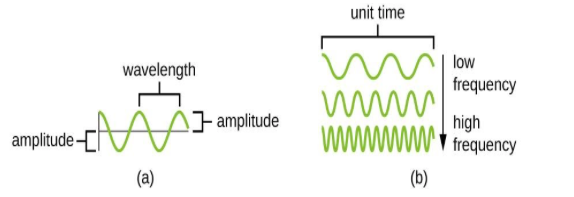
defined as the rate of change of the distance with respect to the time.
The distance is obtained as distance of one wave and the time is obtained as the time taken for the travelling of one wave. The time period is taken as the time taken by the complete one cycle of the wave . Frequency is the number of times the oscillation repeats itself per second. It is the inverse of the time period. Hence the number of oscillations completed per second is frequency.
Thus the option (D) is correct.
Note:While the movement of the waves vary, the propagating medium may also vary. At that time the wavelength and the velocity of the waves changes but the frequency does not depend on the medium and it solely depends only on the nature of the waves.
Useful formula:
The frequency of the wave is given as
$f = \dfrac{c}{\lambda }$
Where $f$ is the frequency of the wave, $c$ is the speed of the wave and $\lambda $ is the wavelength of the wave.
Complete step by step solution:
Amplitude is defined as the maximum distance moved by the considered wave. In a graph, it is calculated as the distance between the centre line of the axis and the top most point of the wave in its crest or the bottom most point of the wave in its trough. The speed is
defined as the rate of change of the distance with respect to the time.
The distance is obtained as distance of one wave and the time is obtained as the time taken for the travelling of one wave. The time period is taken as the time taken by the complete one cycle of the wave . Frequency is the number of times the oscillation repeats itself per second. It is the inverse of the time period. Hence the number of oscillations completed per second is frequency.
Thus the option (D) is correct.
Note:While the movement of the waves vary, the propagating medium may also vary. At that time the wavelength and the velocity of the waves changes but the frequency does not depend on the medium and it solely depends only on the nature of the waves.
Recently Updated Pages
Master Class 9 General Knowledge: Engaging Questions & Answers for Success

Master Class 9 Maths: Engaging Questions & Answers for Success
Master Class 9 Science: Engaging Questions & Answers for Success
Master Class 9 English: Engaging Questions & Answers for Success
Master Class 9 Social Science: Engaging Questions & Answers for Success
Class 9 Question and Answer - Your Ultimate Solutions Guide
Trending doubts
Which are the Top 10 Largest Countries of the World?
Draw a labelled sketch of the human eye class 12 physics CBSE
Differentiate between homogeneous and heterogeneous class 12 chemistry CBSE
Sulphuric acid is known as the king of acids State class 12 chemistry CBSE
Why is the cell called the structural and functional class 12 biology CBSE
A dentist uses a small mirror that gives a magnification class 12 physics CBSE