




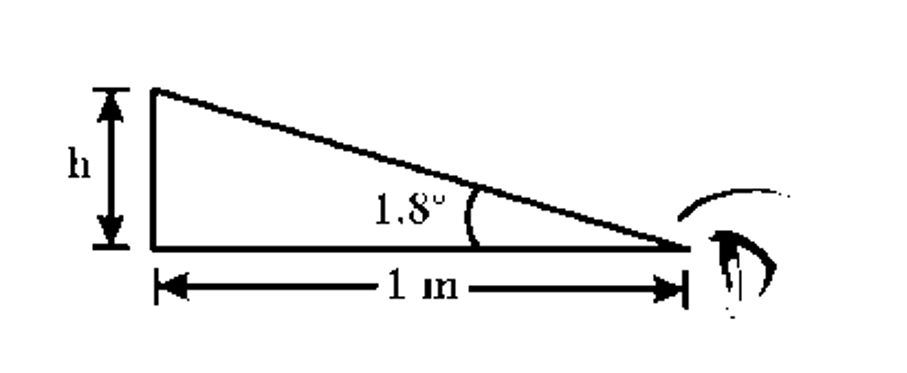
A normal eye can see an object making an angle of \[{1.8^o}\] at the eyes. What is the approximately height of object which can be seen by an eye placed as a distance of 1m from the object:
Answer
 Verified
613.5k+ views
Hint: In such questions when given angles are very small then there are certain assumptions from which you can relate the situation in the given problem. Don’t get misconceptions about this question and do not try to solve such questions with the usual trigonometric formula, you may get wrong answers in such situations like using \[\tan \theta \] in this case.
Complete step by step answer:
There are several approximations that you can make over some trigonometric functions.
These are:
\[\sin \theta \approx \theta \]
\[\tan \theta \approx \theta \]
\[\cos \theta \approx 1 - \dfrac{{{\theta ^2}}}{2} \approx 1\]
Now according to question the best suitable formula is
\[\tan \theta \approx \theta \]
$\Rightarrow$ \[\tan \theta = \dfrac{P}{B}\]
$\Rightarrow$ \[\theta = {18^o}\]
$\Rightarrow$ \[\tan \theta = \theta = {(1.8)^o} = \dfrac{P}{B}\]
$\Rightarrow$ \[\dfrac{h}{1} = 1.8\]
Thus, h = 1.8m.
Note: There are a number of ways to demonstrate the validity of the small-angle approximations. The most direct method is to truncate the McLaurin series for each of the trigonometric functions. Depending on the order of the approximation. Like we have approximated \[\cos \theta \approx 1 - \dfrac{{{\theta ^2}}}{2} \approx 1\].
Complete step by step answer:
There are several approximations that you can make over some trigonometric functions.
These are:
\[\sin \theta \approx \theta \]
\[\tan \theta \approx \theta \]
\[\cos \theta \approx 1 - \dfrac{{{\theta ^2}}}{2} \approx 1\]
Now according to question the best suitable formula is
\[\tan \theta \approx \theta \]
$\Rightarrow$ \[\tan \theta = \dfrac{P}{B}\]
$\Rightarrow$ \[\theta = {18^o}\]
$\Rightarrow$ \[\tan \theta = \theta = {(1.8)^o} = \dfrac{P}{B}\]
$\Rightarrow$ \[\dfrac{h}{1} = 1.8\]
Thus, h = 1.8m.
Note: There are a number of ways to demonstrate the validity of the small-angle approximations. The most direct method is to truncate the McLaurin series for each of the trigonometric functions. Depending on the order of the approximation. Like we have approximated \[\cos \theta \approx 1 - \dfrac{{{\theta ^2}}}{2} \approx 1\].
Recently Updated Pages
Master Class 12 Economics: Engaging Questions & Answers for Success

Master Class 12 English: Engaging Questions & Answers for Success
Master Class 12 Social Science: Engaging Questions & Answers for Success
Master Class 12 Maths: Engaging Questions & Answers for Success
Master Class 12 Physics: Engaging Questions & Answers for Success
Master Class 12 Business Studies: Engaging Questions & Answers for Success
Trending doubts
Which are the Top 10 Largest Countries of the World?
Draw a labelled sketch of the human eye class 12 physics CBSE
Differentiate between homogeneous and heterogeneous class 12 chemistry CBSE
Why is the cell called the structural and functional class 12 biology CBSE
Draw ray diagrams each showing i myopic eye and ii class 12 physics CBSE
Which is the correct genotypic ratio of mendel dihybrid class 12 biology CBSE