




A non-conducting ring of radius ‘ $ R $ ’ has a uniformly distributed positive charge $ Q $ . A small part of the ring of length $ d $ , is removed $ (d < < R) $ . The electric field at the centre of the ring will now be:
(A) directed towards the gap, inversely proportional to $ {R^3} $
(B) directed towards the gap, inversely proportional to $ {R^2} $
(C) directed away from the gap, inversely proportional to $ {R^3} $
(D) directed away from the gap, inversely proportional to $ {R^2} $
Answer
 Verified
506.7k+ views
Hint: To solve this question, the electric field at the center of the total ring and the electric field due to the small part of the ring should be found. The direction of the electric field lines is directed from the positive charge to the negative charge. So it would help to analyze the direction of the resultant electric field.
Complete answer:
Coulomb’s Law states that the force between two point charges is directly proportional to the product of the magnitude of the charges and inversely proportional to the square of the distance between them.
$ \,\,\,\,\,\,F \propto \dfrac{{{q_1}\,{q_2}}}{{{r^2}}} $
$ \Rightarrow F = \dfrac{1}{{4\pi {\varepsilon _o}}}\dfrac{{{q_1}\,{q_2}}}{{{r^2}}} $
Where $ F = $ force in Newton
$ {q_1}\,\& \,{q_2} = $ charge in Coulombs
$ r = $ distance between two charges in meter
$ {\varepsilon _o} = $ the permittivity of free space
When a charge is placed in a space and a second charge is brought near it, the second charge will experience an electrostatic force. This space is referred to as the electric field. The electric field at a point due to a point charge is equal to the force experienced by the test unit positive charge placed at that point.
$ \,\,\,\,\,\,\,E = \dfrac{F}{q} $
$ \Rightarrow E = \dfrac{1}{{4\pi {\varepsilon _o}}}\dfrac{q}{{{r^2}}} $
Where $ F = $ force in Newton
$ q = $ charge in Coulombs
$ r = $ distance between two charges in meter
$ {\varepsilon _o} = $ the permittivity of free space
Now, the electric field at the center of the total ring is zero due to symmetry and uniformly distributed charged particles. It is given that the charge on the entire ring is $ Q $ . According to the question, if we remove a small part of length $ d $ from the ring, as shown in the diagram, the electric field developed at the center due to the small part and the remaining part of the ring should be equal and opposite in direction so that the electric field at the center is zero. As the charge is positive in nature, the electric field lines are directed outwards.
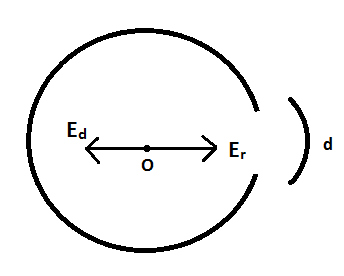
Let the surface charge density of the ring is denoted by $ \rho $ . Surface charge density is defined as charge per unit surface area. So, the surface charge density of the ring is given by:
$ \rho = \dfrac{Q}{{2\pi R}} $
Where $ Q = $ charge on the ring
$ R = $ the radius of the ring
A small part of the length $ d $ is removed. So charge on this small part is given by:
$ \,\,\,\,\,\,dq = \rho .\,d $
$ \Rightarrow dq = Q\dfrac{d}{{2\pi R}} $
For the electric field at the center to be zero, $ {E_r} = {E_d} $ .
Where $ {E_r} = $ Electric field due to the remaining part
$ {E_d} = $ Electric field due to the small part
So, the electric field due to the small part is:
$ \,\,\,\,\,\,{E_d} = \dfrac{1}{{4\pi {\varepsilon _o}}}\dfrac{{dq}}{{{R^2}}} $
$ \Rightarrow {E_d} = \dfrac{1}{{4\pi {\varepsilon _o}}}\dfrac{{\left( {\dfrac{{Q\,d}}{{2\pi R}}} \right)}}{{{R^2}}} $
$ \Rightarrow {E_d} = \dfrac{1}{{4\pi {\varepsilon _o}}}\dfrac{{Q\,d}}{{2\pi {R^3}}} $
So, from the equation, we can conclude that the electric field is inversely proportional to $ {R^3} $ and the electric field is directed towards the gap to balance the fields.
Therefore, option (A) is the correct answer.
Note:
Electric field lines are imaginary lines. It is used to represent the path followed by a unit positive test charge. The idea of field lines was introduced by Michael Faraday. Field lines originate from a positive charge and terminate at a negative charge, thus giving the direction of the field.
These electric field lines never intersect each other because, at the point of intersection, the net intensity will have two different directions which is not possible. Also, inside a conductor, the electric field is zero and hence there are no field lines inside a conductor.
Complete answer:
Coulomb’s Law states that the force between two point charges is directly proportional to the product of the magnitude of the charges and inversely proportional to the square of the distance between them.
$ \,\,\,\,\,\,F \propto \dfrac{{{q_1}\,{q_2}}}{{{r^2}}} $
$ \Rightarrow F = \dfrac{1}{{4\pi {\varepsilon _o}}}\dfrac{{{q_1}\,{q_2}}}{{{r^2}}} $
Where $ F = $ force in Newton
$ {q_1}\,\& \,{q_2} = $ charge in Coulombs
$ r = $ distance between two charges in meter
$ {\varepsilon _o} = $ the permittivity of free space
When a charge is placed in a space and a second charge is brought near it, the second charge will experience an electrostatic force. This space is referred to as the electric field. The electric field at a point due to a point charge is equal to the force experienced by the test unit positive charge placed at that point.
$ \,\,\,\,\,\,\,E = \dfrac{F}{q} $
$ \Rightarrow E = \dfrac{1}{{4\pi {\varepsilon _o}}}\dfrac{q}{{{r^2}}} $
Where $ F = $ force in Newton
$ q = $ charge in Coulombs
$ r = $ distance between two charges in meter
$ {\varepsilon _o} = $ the permittivity of free space
Now, the electric field at the center of the total ring is zero due to symmetry and uniformly distributed charged particles. It is given that the charge on the entire ring is $ Q $ . According to the question, if we remove a small part of length $ d $ from the ring, as shown in the diagram, the electric field developed at the center due to the small part and the remaining part of the ring should be equal and opposite in direction so that the electric field at the center is zero. As the charge is positive in nature, the electric field lines are directed outwards.
Let the surface charge density of the ring is denoted by $ \rho $ . Surface charge density is defined as charge per unit surface area. So, the surface charge density of the ring is given by:
$ \rho = \dfrac{Q}{{2\pi R}} $
Where $ Q = $ charge on the ring
$ R = $ the radius of the ring
A small part of the length $ d $ is removed. So charge on this small part is given by:
$ \,\,\,\,\,\,dq = \rho .\,d $
$ \Rightarrow dq = Q\dfrac{d}{{2\pi R}} $
For the electric field at the center to be zero, $ {E_r} = {E_d} $ .
Where $ {E_r} = $ Electric field due to the remaining part
$ {E_d} = $ Electric field due to the small part
So, the electric field due to the small part is:
$ \,\,\,\,\,\,{E_d} = \dfrac{1}{{4\pi {\varepsilon _o}}}\dfrac{{dq}}{{{R^2}}} $
$ \Rightarrow {E_d} = \dfrac{1}{{4\pi {\varepsilon _o}}}\dfrac{{\left( {\dfrac{{Q\,d}}{{2\pi R}}} \right)}}{{{R^2}}} $
$ \Rightarrow {E_d} = \dfrac{1}{{4\pi {\varepsilon _o}}}\dfrac{{Q\,d}}{{2\pi {R^3}}} $
So, from the equation, we can conclude that the electric field is inversely proportional to $ {R^3} $ and the electric field is directed towards the gap to balance the fields.
Therefore, option (A) is the correct answer.
Note:
Electric field lines are imaginary lines. It is used to represent the path followed by a unit positive test charge. The idea of field lines was introduced by Michael Faraday. Field lines originate from a positive charge and terminate at a negative charge, thus giving the direction of the field.
These electric field lines never intersect each other because, at the point of intersection, the net intensity will have two different directions which is not possible. Also, inside a conductor, the electric field is zero and hence there are no field lines inside a conductor.
Recently Updated Pages
Three beakers labelled as A B and C each containing 25 mL of water were taken A small amount of NaOH anhydrous CuSO4 and NaCl were added to the beakers A B and C respectively It was observed that there was an increase in the temperature of the solutions contained in beakers A and B whereas in case of beaker C the temperature of the solution falls Which one of the following statements isarecorrect i In beakers A and B exothermic process has occurred ii In beakers A and B endothermic process has occurred iii In beaker C exothermic process has occurred iv In beaker C endothermic process has occurred

Master Class 12 Social Science: Engaging Questions & Answers for Success
Master Class 12 Physics: Engaging Questions & Answers for Success
Master Class 12 Maths: Engaging Questions & Answers for Success
Master Class 12 Economics: Engaging Questions & Answers for Success
Master Class 12 Chemistry: Engaging Questions & Answers for Success
Three beakers labelled as A B and C each containing 25 mL of water were taken A small amount of NaOH anhydrous CuSO4 and NaCl were added to the beakers A B and C respectively It was observed that there was an increase in the temperature of the solutions contained in beakers A and B whereas in case of beaker C the temperature of the solution falls Which one of the following statements isarecorrect i In beakers A and B exothermic process has occurred ii In beakers A and B endothermic process has occurred iii In beaker C exothermic process has occurred iv In beaker C endothermic process has occurred
Master Class 12 Social Science: Engaging Questions & Answers for Success
Master Class 12 Physics: Engaging Questions & Answers for Success
Trending doubts
Which are the Top 10 Largest Countries of the World?
Draw a labelled sketch of the human eye class 12 physics CBSE
What are the major means of transport Explain each class 12 social science CBSE
Differentiate between homogeneous and heterogeneous class 12 chemistry CBSE
Sulphuric acid is known as the king of acids State class 12 chemistry CBSE
Why should a magnesium ribbon be cleaned before burning class 12 chemistry CBSE