




A non conducting disc of radius \[R\], charge \[q\] is rotating about an axis passing through its centre and perpendicular to its plane with an angular velocity \[\omega \], charge \[q\] is uniformly distributed over its surface. The magnetic moment of the disc is:
A. \[\dfrac{1}{4}q\omega {R^2}\]
B. \[\dfrac{1}{2}q\omega R\]
C. \[q\omega R\]
D. \[\dfrac{1}{2}q\omega {R^2}\]
Answer
 Verified
575.1k+ views
Hint:To find the magnetic moment of the disc, first recall the formula for magnetic moment of a current loop. Take a small annular region of the disc and find the magnetic moment of this region and then integrate the value taking the limit of radius from zero to \[R\], to find the value of magnetic moment of the whole disc.
Complete step by step answer:
Given, radius of a non conducting disc, \[R\]. Charge on the disc, \[q\]. Angular velocity of the disc, \[\omega \]. The magnetic moment of a current loop is given by the formula,
\[\mu = IA\]
where \[I\] is the current through the loop and \[A\] is the area of the loop.
Surface charge density is defined as charge per unit area. Here, area of the disc is \[\pi {R^2}\] and charge is \[q\] so, surface charge density will be,
\[\sigma = \dfrac{q}{{\pi {R^2}}}\] (i)
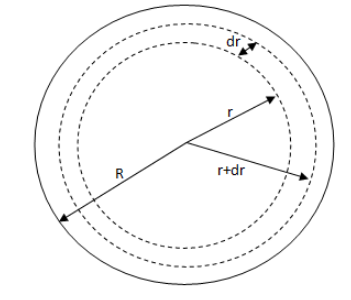
Now, we take a small cross section such that its length is \[dr\] with its inner radius is \[r\] and outer radius is \[r + dr\] and \[dr < < r\].
Here, surface charge density for this region will be,
\[\sigma = \dfrac{{dq}}{{d\left( {\pi {r^2}} \right)}}\]
\[ \Rightarrow \sigma = \dfrac{{dq}}{{2\pi rdr}}\]
\[ \Rightarrow dq = 2\pi rdr\sigma \]
Putting the value of \[\sigma \] in the above equation we get,
\[dq = 2\pi rdr\left( {\dfrac{q}{{\pi {R^2}}}} \right)\]
\[ \Rightarrow dq = \dfrac{{2q}}{{{R^2}}}rdr\]
The charge \[dq\] completes one revolution in the time interval, \[T = \dfrac{{2\pi }}{\omega }\]
We know current is charge per unit time. So here current through this small region will be,
\[dI = \dfrac{{dq}}{T}\]
Putting the values of \[dq\] and \[T\] we get,
\[dI = \dfrac{{\left( {\dfrac{{2q}}{{{R^2}}}rdr} \right)}}{{\left( {\dfrac{{2\pi }}{\omega }} \right)}}\]
\[ \Rightarrow dI = \dfrac{{\left( {\dfrac{q}{{{R^2}}}rdr} \right)}}{{\left( {\dfrac{\pi }{\omega }} \right)}}\] (ii)
Area enclosed by this current is \[A = \pi {r^2}\]
So, magnetic moment due to this loop will be, (using equation (i))
\[d\mu = dI \times A\]
Putting the value of \[dI\] and \[A\] we get,
\[d\mu = \dfrac{{\left( {\dfrac{q}{{{R^2}}}rdr} \right)}}{{\left( {\dfrac{\pi }{\omega }} \right)}} \times \pi {r^2}\]
\[ \Rightarrow d\mu = \dfrac{{\omega q}}{{{R^2}}}rdr \times {r^2}\]
\[ \Rightarrow d\mu = \dfrac{{\omega q}}{{{R^2}}}{r^3}dr\]
Now, we get the magnetic moment of the disc by integrating on both sides of the above equation from \[0\] to \[R\] on right side and \[0\] to \[\mu \] on left side,
\[\int\limits_0^\mu {d\mu } = \int\limits_0^R {\dfrac{{\omega q}}{{{R^2}}}{r^3}dr} \]
\[ \Rightarrow \mu = \dfrac{{\omega q}}{{{R^2}}}\left[ {\dfrac{{{r^4}}}{4}} \right]_0^R\]
\[ \Rightarrow \mu = \dfrac{{\omega q}}{{{R^2}}}\left[ {\dfrac{{{R^4}}}{4}} \right]\]
\[ \therefore \mu = \dfrac{1}{4}q\omega {R^2}\]
Therefore, the magnetic moment of the disc is \[\dfrac{1}{4}q\omega {R^2}\].
Hence, the correct answer is option A.
Note: The magnetic moment can be defined as the magnetic strength and orientation of an object that produces a magnetic field. It is a vector quantity and direction of magnetic moment can be found using right hand rule, which is perpendicular to the current loop.
Complete step by step answer:
Given, radius of a non conducting disc, \[R\]. Charge on the disc, \[q\]. Angular velocity of the disc, \[\omega \]. The magnetic moment of a current loop is given by the formula,
\[\mu = IA\]
where \[I\] is the current through the loop and \[A\] is the area of the loop.
Surface charge density is defined as charge per unit area. Here, area of the disc is \[\pi {R^2}\] and charge is \[q\] so, surface charge density will be,
\[\sigma = \dfrac{q}{{\pi {R^2}}}\] (i)
Now, we take a small cross section such that its length is \[dr\] with its inner radius is \[r\] and outer radius is \[r + dr\] and \[dr < < r\].
Here, surface charge density for this region will be,
\[\sigma = \dfrac{{dq}}{{d\left( {\pi {r^2}} \right)}}\]
\[ \Rightarrow \sigma = \dfrac{{dq}}{{2\pi rdr}}\]
\[ \Rightarrow dq = 2\pi rdr\sigma \]
Putting the value of \[\sigma \] in the above equation we get,
\[dq = 2\pi rdr\left( {\dfrac{q}{{\pi {R^2}}}} \right)\]
\[ \Rightarrow dq = \dfrac{{2q}}{{{R^2}}}rdr\]
The charge \[dq\] completes one revolution in the time interval, \[T = \dfrac{{2\pi }}{\omega }\]
We know current is charge per unit time. So here current through this small region will be,
\[dI = \dfrac{{dq}}{T}\]
Putting the values of \[dq\] and \[T\] we get,
\[dI = \dfrac{{\left( {\dfrac{{2q}}{{{R^2}}}rdr} \right)}}{{\left( {\dfrac{{2\pi }}{\omega }} \right)}}\]
\[ \Rightarrow dI = \dfrac{{\left( {\dfrac{q}{{{R^2}}}rdr} \right)}}{{\left( {\dfrac{\pi }{\omega }} \right)}}\] (ii)
Area enclosed by this current is \[A = \pi {r^2}\]
So, magnetic moment due to this loop will be, (using equation (i))
\[d\mu = dI \times A\]
Putting the value of \[dI\] and \[A\] we get,
\[d\mu = \dfrac{{\left( {\dfrac{q}{{{R^2}}}rdr} \right)}}{{\left( {\dfrac{\pi }{\omega }} \right)}} \times \pi {r^2}\]
\[ \Rightarrow d\mu = \dfrac{{\omega q}}{{{R^2}}}rdr \times {r^2}\]
\[ \Rightarrow d\mu = \dfrac{{\omega q}}{{{R^2}}}{r^3}dr\]
Now, we get the magnetic moment of the disc by integrating on both sides of the above equation from \[0\] to \[R\] on right side and \[0\] to \[\mu \] on left side,
\[\int\limits_0^\mu {d\mu } = \int\limits_0^R {\dfrac{{\omega q}}{{{R^2}}}{r^3}dr} \]
\[ \Rightarrow \mu = \dfrac{{\omega q}}{{{R^2}}}\left[ {\dfrac{{{r^4}}}{4}} \right]_0^R\]
\[ \Rightarrow \mu = \dfrac{{\omega q}}{{{R^2}}}\left[ {\dfrac{{{R^4}}}{4}} \right]\]
\[ \therefore \mu = \dfrac{1}{4}q\omega {R^2}\]
Therefore, the magnetic moment of the disc is \[\dfrac{1}{4}q\omega {R^2}\].
Hence, the correct answer is option A.
Note: The magnetic moment can be defined as the magnetic strength and orientation of an object that produces a magnetic field. It is a vector quantity and direction of magnetic moment can be found using right hand rule, which is perpendicular to the current loop.
Recently Updated Pages
Master Class 12 Social Science: Engaging Questions & Answers for Success

Master Class 12 Physics: Engaging Questions & Answers for Success
Master Class 12 Maths: Engaging Questions & Answers for Success
Master Class 12 Economics: Engaging Questions & Answers for Success
Master Class 12 Chemistry: Engaging Questions & Answers for Success
Master Class 12 Business Studies: Engaging Questions & Answers for Success
Trending doubts
Which are the Top 10 Largest Countries of the World?
Draw a labelled sketch of the human eye class 12 physics CBSE
Explain the structure of megasporangium class 12 biology CBSE
What are the major means of transport Explain each class 12 social science CBSE
How many chromosomes are found in human ovum a 46 b class 12 biology CBSE
The diagram of the section of a maize grain is given class 12 biology CBSE