




A Nicol prism is based on the action of:
(A). Refraction
(B). Double refraction
(C). Dichroism
(D). Both B and C
Answer
 Verified
602.4k+ views
Hint: Recall that a Nicol prism is made up of a birefringent material, calcite. This means that an incident ray of light gets split up into two rays of light inside the prism. And this prism is also a polarizer and an analyser. To this end, determine how the two rays are produced in the crystal and remember to account for the refraction of both the rays.
Complete step-by-step answer:
A Nicol prism is made up of two prisms of calcite ($CaCO_3$) cemented with Canada balsam.
We know that polarization is a process by which the vibrations of a transverse wave are confined to one geometric orientation (direction).
A Nicol prism is a polarizer that is used to produce and analyse plane polarized light. Plane polarized light is the light whose electric field oscillated in just one plane.
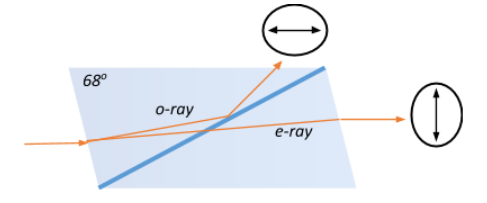
It is designed in such a way that it eliminates the ordinary o-ray by total internal reflection while transmits the extraordinary e-ray through the prism.
Now, let us look at how it works.
Unpolarized light enters through the left side of the crystal and gets split into two orthogonally polarized light rays that are differently directed owing to the birefringence of calcite. Birefringence is the property of a material that determines the dependence of a refractive index on the polarization of light. Due to this property, the Nicol prism produces an ordinary o-ray and an extraordinary e-ray.
The o-ray, upon experiencing a refractive index of $\mu_o = 1.658$ in the calcite undergoes total internal reflection at the calcite-balsam glue interface (because its angle of incidence will exceed the critical angle for the interface), and eventually passes out through the top side of the prism.
The o-ray, upon experiencing a lower refractive index $\mu_e = 1.486$ in the calcite does not undergo total internal reflection as it strikes the interface at sub-critical angles. It then leaves through the lower half of the prism as a ray of plane polarised light.
This is how a Nicol prism behaves as a polarizer. Since the Nicol prism produces two emergent refracted rays, the Nicol Prism performs polarization by the process of double refraction.
Therefore, the correct choice would be B. Double refraction.
Note: In addition to the above properties, the o-rays and e-rays have the following characteristics:
The image formed by the o-ray is stationary whereas the image formed by the e-ray will rotate about the stationary image of the o-ray when the crystal is rotated.
The vibrations of o-ray are generally perpendicular to the optic axis of the crystal, whereas those of e-ray are parallel to the optic axis of the crystal.
The speed of the o-ray is the same in all directions and so, for a point source of light inside the crystal, the wavefront is spherical. The speed of e-ray changes with its direction in the crystal and forms an ellipsoidal wavefront.
O-ray obeys the laws of refraction whereas e-ray does not.
Also, do not forget that along the optic axis of the crystal, the o-ray and the e-ray have the same speed.
Complete step-by-step answer:
A Nicol prism is made up of two prisms of calcite ($CaCO_3$) cemented with Canada balsam.
We know that polarization is a process by which the vibrations of a transverse wave are confined to one geometric orientation (direction).
A Nicol prism is a polarizer that is used to produce and analyse plane polarized light. Plane polarized light is the light whose electric field oscillated in just one plane.
It is designed in such a way that it eliminates the ordinary o-ray by total internal reflection while transmits the extraordinary e-ray through the prism.
Now, let us look at how it works.
Unpolarized light enters through the left side of the crystal and gets split into two orthogonally polarized light rays that are differently directed owing to the birefringence of calcite. Birefringence is the property of a material that determines the dependence of a refractive index on the polarization of light. Due to this property, the Nicol prism produces an ordinary o-ray and an extraordinary e-ray.
The o-ray, upon experiencing a refractive index of $\mu_o = 1.658$ in the calcite undergoes total internal reflection at the calcite-balsam glue interface (because its angle of incidence will exceed the critical angle for the interface), and eventually passes out through the top side of the prism.
The o-ray, upon experiencing a lower refractive index $\mu_e = 1.486$ in the calcite does not undergo total internal reflection as it strikes the interface at sub-critical angles. It then leaves through the lower half of the prism as a ray of plane polarised light.
This is how a Nicol prism behaves as a polarizer. Since the Nicol prism produces two emergent refracted rays, the Nicol Prism performs polarization by the process of double refraction.
Therefore, the correct choice would be B. Double refraction.
Note: In addition to the above properties, the o-rays and e-rays have the following characteristics:
The image formed by the o-ray is stationary whereas the image formed by the e-ray will rotate about the stationary image of the o-ray when the crystal is rotated.
The vibrations of o-ray are generally perpendicular to the optic axis of the crystal, whereas those of e-ray are parallel to the optic axis of the crystal.
The speed of the o-ray is the same in all directions and so, for a point source of light inside the crystal, the wavefront is spherical. The speed of e-ray changes with its direction in the crystal and forms an ellipsoidal wavefront.
O-ray obeys the laws of refraction whereas e-ray does not.
Also, do not forget that along the optic axis of the crystal, the o-ray and the e-ray have the same speed.
Recently Updated Pages
Three beakers labelled as A B and C each containing 25 mL of water were taken A small amount of NaOH anhydrous CuSO4 and NaCl were added to the beakers A B and C respectively It was observed that there was an increase in the temperature of the solutions contained in beakers A and B whereas in case of beaker C the temperature of the solution falls Which one of the following statements isarecorrect i In beakers A and B exothermic process has occurred ii In beakers A and B endothermic process has occurred iii In beaker C exothermic process has occurred iv In beaker C endothermic process has occurred

Master Class 12 Social Science: Engaging Questions & Answers for Success
Master Class 12 Physics: Engaging Questions & Answers for Success
Master Class 12 Maths: Engaging Questions & Answers for Success
Master Class 12 Economics: Engaging Questions & Answers for Success
Master Class 12 Chemistry: Engaging Questions & Answers for Success
Three beakers labelled as A B and C each containing 25 mL of water were taken A small amount of NaOH anhydrous CuSO4 and NaCl were added to the beakers A B and C respectively It was observed that there was an increase in the temperature of the solutions contained in beakers A and B whereas in case of beaker C the temperature of the solution falls Which one of the following statements isarecorrect i In beakers A and B exothermic process has occurred ii In beakers A and B endothermic process has occurred iii In beaker C exothermic process has occurred iv In beaker C endothermic process has occurred
Master Class 12 Social Science: Engaging Questions & Answers for Success
Master Class 12 Physics: Engaging Questions & Answers for Success
Trending doubts
Which are the Top 10 Largest Countries of the World?
Draw a labelled sketch of the human eye class 12 physics CBSE
Explain the structure of megasporangium class 12 biology CBSE
What are the major means of transport Explain each class 12 social science CBSE
Differentiate between homogeneous and heterogeneous class 12 chemistry CBSE
Sulphuric acid is known as the king of acids State class 12 chemistry CBSE