




(a) Name the human male reproductive organ that produces sperms and also secretes a hormone. Write the functions of the secreted hormone.
(b) Name the parts of the human female reproductive system where
i. Fertilization takes place
ii. Implantation of the fertilized egg occurs
Explain how the embryo gets nourishment inside the mother’s body.
Answer
 Verified
597.3k+ views
Hint: The human male and female reproductive system together make the human reproductive system. The sperms are male gametes formed by the male reproductive system. Ovum or eggs are female gametes produced by the female reproductive system. Humans have defined sexual differentiation.
Complete answer: The primary human male sexual organ called testes is the site of the production of sperms. The testes are oval-shaped paired organs that lie enclosed in the scrotum. Inside the testes is the complex network of tubules called seminiferous tubules. These tubules consist of mother gamete cells that form sperms through spermatogenesis. The testes also secrete a male hormone called testosterone which is required for sperm formation and regulation of secondary sexual characters in males.
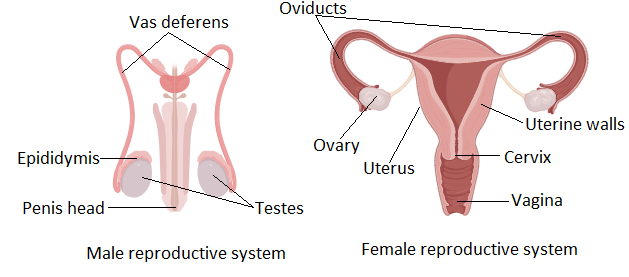
The primary sexual organs of the female reproductive system are called ovaries. These are two paired irregularly spherical structures present on both sides of the lower abdominal region. The ovaries release eggs which are female gametes. The gametes are received by a tubular structure called the fallopian tube. The fallopian tube is an elongated structure that extends towards both ovaries and connects centrally to the uterus. The fallopian tube is also called the oviduct. So, the oviduct is the site of fertilization as the egg stays in it for 24 hours till fertilization.
If the egg gets fertilized by a sperm, it is travelled down the oviduct to reach the uterus. Implantation of the egg occurs in the uterine walls after 4 to 5 days. Once implanted in the uterus, the embryo establishes a connection with the mother through a disc-shaped tissue called the placenta. The growing embryo takes nourishment through the placenta. The placenta involves a rich blood supply from the mother’s body to the embryo. Waste materials are also exchanged through the placenta.
Note: Every month one of the ovaries releases an egg. If the eggs get fertilized, it will follow the path to embryo formation. If it will not get fertilized, it will degrade. This causes the uterine wall to shed off which was made to receive a zygote in case of fertilization. This causes menstruation in females.
Complete answer: The primary human male sexual organ called testes is the site of the production of sperms. The testes are oval-shaped paired organs that lie enclosed in the scrotum. Inside the testes is the complex network of tubules called seminiferous tubules. These tubules consist of mother gamete cells that form sperms through spermatogenesis. The testes also secrete a male hormone called testosterone which is required for sperm formation and regulation of secondary sexual characters in males.
The primary sexual organs of the female reproductive system are called ovaries. These are two paired irregularly spherical structures present on both sides of the lower abdominal region. The ovaries release eggs which are female gametes. The gametes are received by a tubular structure called the fallopian tube. The fallopian tube is an elongated structure that extends towards both ovaries and connects centrally to the uterus. The fallopian tube is also called the oviduct. So, the oviduct is the site of fertilization as the egg stays in it for 24 hours till fertilization.
If the egg gets fertilized by a sperm, it is travelled down the oviduct to reach the uterus. Implantation of the egg occurs in the uterine walls after 4 to 5 days. Once implanted in the uterus, the embryo establishes a connection with the mother through a disc-shaped tissue called the placenta. The growing embryo takes nourishment through the placenta. The placenta involves a rich blood supply from the mother’s body to the embryo. Waste materials are also exchanged through the placenta.
Note: Every month one of the ovaries releases an egg. If the eggs get fertilized, it will follow the path to embryo formation. If it will not get fertilized, it will degrade. This causes the uterine wall to shed off which was made to receive a zygote in case of fertilization. This causes menstruation in females.
Recently Updated Pages
Master Class 12 Business Studies: Engaging Questions & Answers for Success

Master Class 12 Chemistry: Engaging Questions & Answers for Success
Master Class 12 Biology: Engaging Questions & Answers for Success
Class 12 Question and Answer - Your Ultimate Solutions Guide
Master Class 11 English: Engaging Questions & Answers for Success
Master Class 11 Social Science: Engaging Questions & Answers for Success
Trending doubts
Which are the Top 10 Largest Countries of the World?
Draw a labelled sketch of the human eye class 12 physics CBSE
Differentiate between homogeneous and heterogeneous class 12 chemistry CBSE
Why is the cell called the structural and functional class 12 biology CBSE
Draw ray diagrams each showing i myopic eye and ii class 12 physics CBSE
Which is the correct genotypic ratio of mendel dihybrid class 12 biology CBSE