




a) Name an instrument used for measuring electric potential difference. And with help of the diagram show how this instrument is connected in an electric circuit?
b) Why does this instrument practically not consume any electric energy from the electric circuit?
Answer
 Verified
639.6k+ views
Hint: Instrument used for measuring electric potential difference must be connected such that it has the same voltage across it as that of the resistor. And also it shouldn’t allow any electric current to pass through it.
Complete step-by-step answer:
a) The instrument used for measuring electric potential difference between two points in an electric circuit is known as voltmeter. It is always connected in parallel to the resistance in an electric circuit.
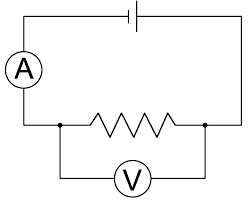
b) The resistance of the voltmeter is very high and as it is connected in parallel to the resistance in an electric circuit the potential difference across the resistor and voltmeter is the same. Thus, due to high resistance in voltmeter in comparatively very less resistance in the resistor of the electric circuit most of the current passes through the resistor. The current passing through voltmeter is negligible and usually considered zero.
\[\text{I =}\dfrac{\text{V}}{\text{R}}\] where I is current through the wire V is voltage across the wire and R is resistance of the wire in an electric circuit. Consider RV is the resistance of voltmeter, as we can see from the equation that \[\text{Current}\propto ~~\dfrac{1}{\text{Resistance}}\] , as RV is very high current though it becomes very less or negligible.
Now, we know
electrical energy = voltage x current,
Electrical energy \[\text{=V }\!\!\times\!\!\text{ I}\]
Thus, we conclude that voltmeter practically does not consume any electric energy from the electric circuit.
Note:- Voltmeter does not give very accurate reading but is suitable for approximate calculations. This is due to the high internal resistance of the instrument which causes error in measurement.
Complete step-by-step answer:
a) The instrument used for measuring electric potential difference between two points in an electric circuit is known as voltmeter. It is always connected in parallel to the resistance in an electric circuit.
b) The resistance of the voltmeter is very high and as it is connected in parallel to the resistance in an electric circuit the potential difference across the resistor and voltmeter is the same. Thus, due to high resistance in voltmeter in comparatively very less resistance in the resistor of the electric circuit most of the current passes through the resistor. The current passing through voltmeter is negligible and usually considered zero.
\[\text{I =}\dfrac{\text{V}}{\text{R}}\] where I is current through the wire V is voltage across the wire and R is resistance of the wire in an electric circuit. Consider RV is the resistance of voltmeter, as we can see from the equation that \[\text{Current}\propto ~~\dfrac{1}{\text{Resistance}}\] , as RV is very high current though it becomes very less or negligible.
Now, we know
electrical energy = voltage x current,
Electrical energy \[\text{=V }\!\!\times\!\!\text{ I}\]
Thus, we conclude that voltmeter practically does not consume any electric energy from the electric circuit.
Note:- Voltmeter does not give very accurate reading but is suitable for approximate calculations. This is due to the high internal resistance of the instrument which causes error in measurement.
Recently Updated Pages
Master Class 12 Economics: Engaging Questions & Answers for Success

Master Class 12 English: Engaging Questions & Answers for Success
Master Class 12 Social Science: Engaging Questions & Answers for Success
Master Class 12 Maths: Engaging Questions & Answers for Success
Master Class 12 Physics: Engaging Questions & Answers for Success
Master Class 12 Business Studies: Engaging Questions & Answers for Success
Trending doubts
Which are the Top 10 Largest Countries of the World?
Draw a labelled sketch of the human eye class 12 physics CBSE
Differentiate between homogeneous and heterogeneous class 12 chemistry CBSE
Why is the cell called the structural and functional class 12 biology CBSE
Draw ray diagrams each showing i myopic eye and ii class 12 physics CBSE
Which is the correct genotypic ratio of mendel dihybrid class 12 biology CBSE